
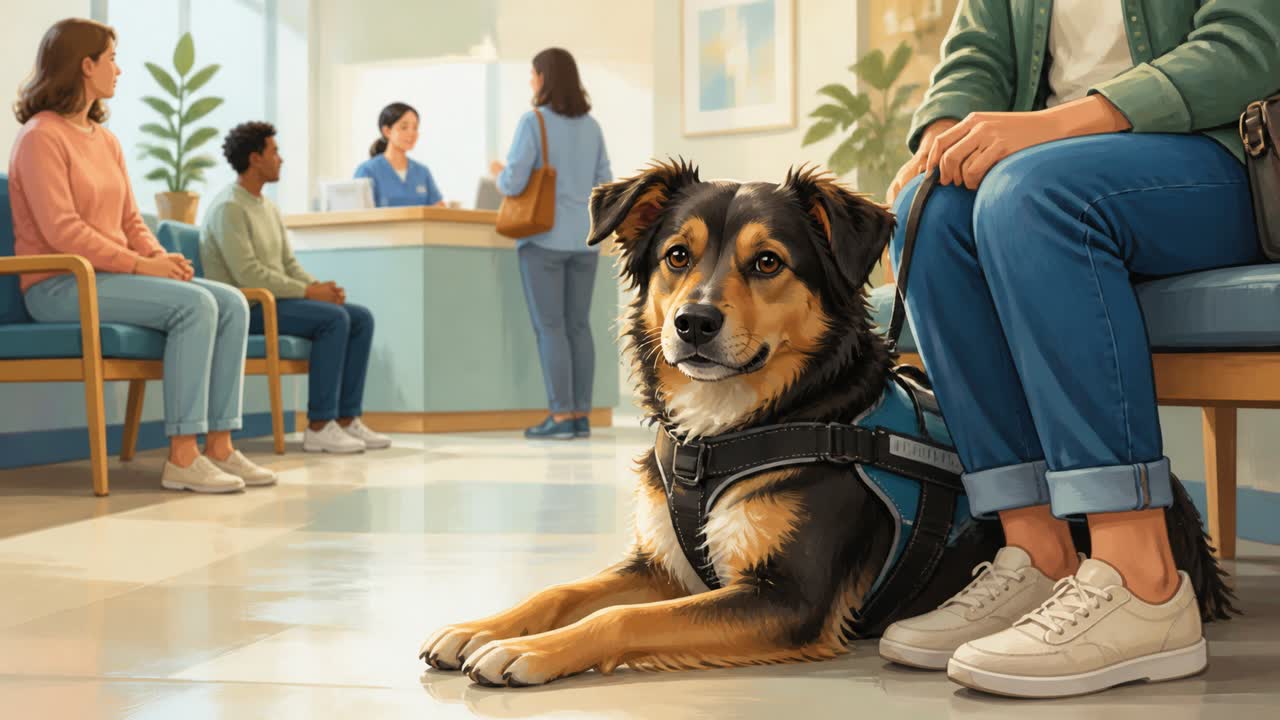
A service dog in vaccine clinic waiting rooms is generally handled like a service dog in other public healthcare settings: the dog may accompany the handler in areas open to patients, as long as the dog is under control, housebroken, and not creating a legitimate safety or infection-control problem.
This article focuses on waiting rooms, check-in lines, observation areas, and clinic conversations. It is not about bringing pets to a clinic, emotional support animals, therapy-dog visits, or vaccine rules for the dog itself.
The safest approach is practical preparation: keep the dog close, plan for crowded seating, know the two ADA questions, and carry helpful records for yourself without treating an ID card, vest, certificate, or registry as a legal requirement.
Quick Overview
- Most public vaccine clinics must consider ADA service animal access in patient areas open to the public.
- Staff may usually ask whether the dog is required because of a disability and what task or work the dog is trained to perform.
- Staff should not demand a service dog certificate, registration card, diagnosis, or demonstration of the task.
- A clinic may ask that a dog be removed if it is out of control, not housebroken, or creates a real safety issue.
1) How Public Access Applies in Vaccine Clinic Waiting Rooms
Under ADA service animal guidance, a service dog is a dog coached to do work or perform tasks for a person with a disability.
The waiting room matters because it is usually a public-facing patient area. If the clinic, pharmacy, county health site, or temporary vaccine event is open to patients, the baseline expectation is that a trained service dog may remain with the handler unless a specific exception applies.
2) Service Dog at Vaccine Clinic Waiting Rooms: What Staff may Ask
If the need for the service dog is not obvious, clinic staff may generally ask two limited questions: whether a disability makes the dog required, and what task or work the dog has been trained to perform.
A practical answer might be: “Yes, this is my service dog. He is trained to alert me before a medical episode and help me move to a safe position.” Another might be: “Yes. She is trained to guide me and help me navigate crowded indoor spaces.”
People run into trouble when staff ask for paperwork as if it controls access. Recognition gear or organized training records may help some handlers reduce awkward conversations, but those items are not the core legal test for public access. Task training, disability-related need, and behavior in the space matter more.
3) When a Clinic can Set Limits or Ask the Dog to Leave
A vaccine clinic can enforce reasonable health and safety rules. A service dog should stay on the floor or close to the handler, not block walkways, not approach other patients, and not interfere with vaccination stations, sharps containers, coolers, medical carts, or emergency exits.
Staff may ask that the dog be dismissed if it is not housebroken, or if the dog is uncontrollable and its handler does not take effective action. A clinic may also need to address a narrow, fact-specific safety concern, such as a sterile clinical area that is not open to ordinary patient waiting.
If there is a conflict, ask for the practical reason and the alternative offered. The goal is not to win an argument in the lobby; it is to keep the appointment moving while protecting access. A supervisor can often separate confusion about pets from the clinic’s actual public access rules.
4) Preparing Your Dog for the Waiting-Room Environment
Vaccine clinics can be harder than they look. The visit may involve automatic doors, pharmacy aisles, crying children, anxious adults, rolling chairs, close seating, public address announcements, and a required observation period after the shot. A service dog that works well in a quiet store may still need practice for a dense healthcare waiting area.
Before the appointment, rehearse the basics: settling under a chair, holding position in line, ignoring dropped food, passing other dogs, and staying calm when people reach toward the handler. If your dog uses a mat, a compact one can help define a resting place during the observation period.
If you are still evaluating whether your dog’s training and behavior meet public access standards, a structured service check can help you organize the task list, behavior expectations, and gaps to address before a high-stress appointment.
5) Documentation that can Reduce Friction without Overstating the Law
For a vaccine clinic, you usually should not need to present service dog paperwork at check-in. Still, responsible records can help if a conversation gets confusing or if the clinic is part of a workplace, school, housing, or travel-related process.
Helpful private records may include a task-training log, vaccination records for the dog, notes from a training program, a written task list, or medical documentation when a separate accommodation process requires it. These records are for organization and problem-solving. They should not be presented as proof that replaces the ADA definition or guarantees access everywhere.
If the vaccine appointment is tied to upcoming travel, remember that airport and airline requirements are a separate lane from clinic waiting-room access. Review current flight rules for the trip itself rather than assuming the clinic visit determines travel access.
6) What to Do If You are Challenged at the Clinic
Stay brief, factual, and polite. You can say, “This is my service dog. He is trained to perform disability-related tasks, and he is under control. Could you please check with a supervisor before delaying my appointment?” That keeps the focus on access and operations.
If staff insist on a certificate or registration, avoid a long debate. If the problem is seating, ask whether you can wait in a corner, stand in line with more space, or complete observation in a nearby area where staff can still monitor you.
Afterward, write down the date, location, staff names if known, what was said, and whether you received the vaccine. Good notes are often more useful than trying to resolve everything at the front desk while the clinic is busy.
FAQs
Can I bring a service dog to vaccine clinic waiting rooms?
In most public-facing vaccine clinic waiting rooms, yes, if the dog is a task-trained service dog, under control, and housebroken. A clinic can address specific safety or control issues, but a general no-pets policy usually isn’t enough to exclude a service dog.
Can clinic staff ask for my service dog certificate?
They may ask the two ADA service animal questions when the need is not obvious. Still, they generally should not require a certificate, registry card, ID, or proof of training as a condition of public access.
What if another patient is allergic to dogs?
Staff should usually try to accommodate both people, such as by separating seating or adjusting the waiting arrangement. Allergies alone do not automatically mean the service dog must leave.
Can my service dog sit on a clinic chair?
Usually no. The dog should remain on the floor, under control, and out of walkways unless a disability-related task requires a different position and the clinic can safely allow it.
Should I call the vaccine clinic before I arrive?
Calling ahead can help if the clinic is temporary, crowded, inside a school or workplace, or run by a contractor. Ask about entrances, check-in flow, observation space, and who handles access questions.
Sources
- ADA.gov: Service Animals
- ADA.gov: Service Animals FAQ
- CDC: Dogs
- CDC: Pet Travel Safety
- HUD: Information for Persons with Disabilities
Takeaway
A vaccine clinic waiting room is a practical public-access setting: the dog’s training, behavior, and the clinic’s real safety needs matter more than paperwork or labels.
- Prepare for crowds, tight seating, check-in questions, and the observation period.
- Use a calm two-question ADA script if staff are unsure what to ask.
- Keep useful records for organization, but do not rely on certificates or registries as the basis for access.