
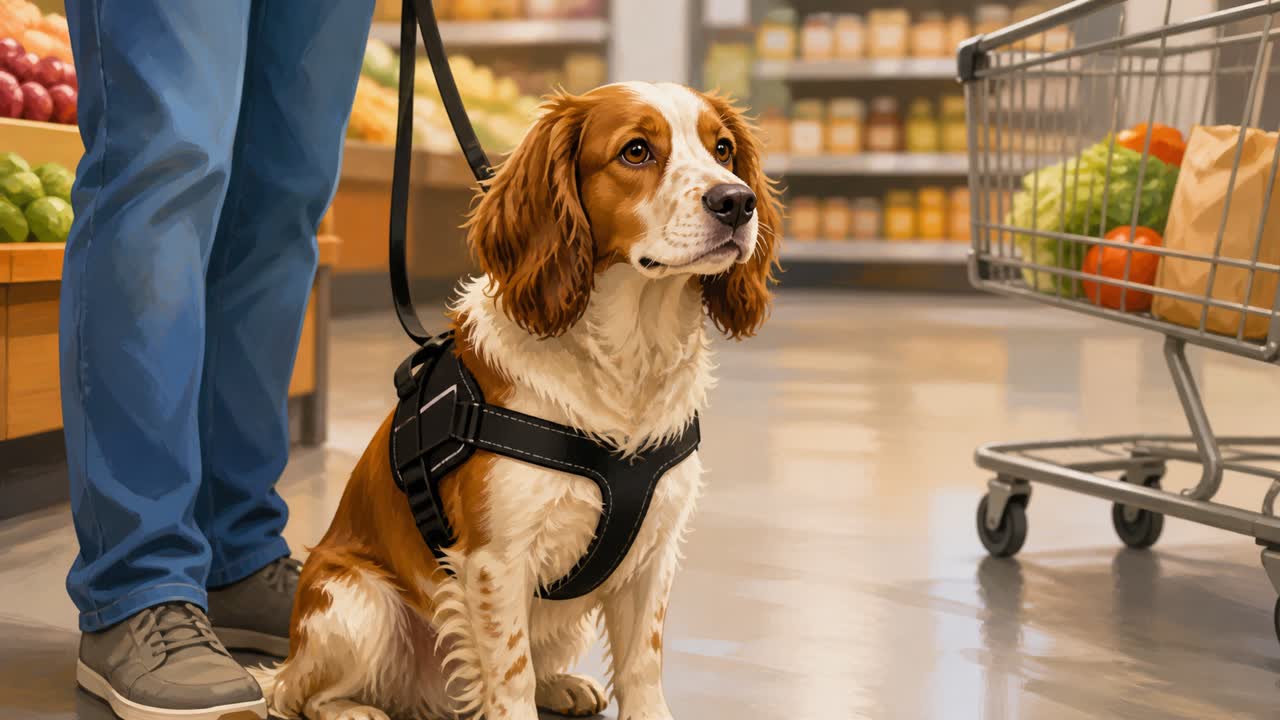
Service dog distraction proofing in grocery stores is about preparing a task-trained dog to stay focused around food smells, carts, narrow aisles, dropped items, children, and sudden movement. The goal is not to make a dog “perfect.” It is to build reliable public-access behavior in one of the most distracting everyday environments.
This topic is narrower than general service dog training. It focuses on grocery-store conditions: impulse control near food, handler attention, safe navigation, and knowing when to end a training session before the dog becomes overwhelmed.
In the United States, public access under the ADA depends on the dog being individually trained to do work or tasks for a person with a disability. Stores generally cannot require a certificate, ID card, or registry listing, but they may ask the ADA’s two allowed questions when the need is not obvious, and they may remove a dog that is out of control or not housebroken.
Quick Overview
- Start outside the store and progress slowly before practicing full shopping trips.
- Train around carts, automatic doors, food smells, floor debris, and crowded aisles separately.
- Use short sessions so the dog can succeed without rehearsing mistakes.
- Focus on calm task readiness, not just obedience cues.
1) Know What Grocery Stores are Actually Testing
Grocery stores combine many distractions at once. A dog may handle a sidewalk, lobby, or quiet office well, then struggle when faced with meat counters, produce bins, children reaching out, carts rattling behind them, or food dropped on the floor.
Good distraction proofing breaks that environment into smaller skills. If you are still confirming whether a dog’s work fits the ADA service animal framework, a structured service screening can help organize the task and access questions before public outings become stressful.
The standard is practical control. A dog does not have to be invisible, but it should not sniff merchandise, block aisles, lunge toward food, seek attention from shoppers, or create a safety problem.
2) Build the Foundation before Entering the Aisles
Start with the skills the store will demand: loose-leash movement, reliable handler focus, leave-it around food, settling in place, turning in tight spaces, and staying composed near moving carts. Practice these in lower-pressure settings before asking the dog to handle a busy store.
A useful progression is parking lot, entrance area, one quiet aisle, checkout area, then a short real purchase. Each step should be calm enough that the dog can still respond to known cues and perform needed tasks.
Training logs are worth keeping. Note the date, location, duration, distractions, what went well, and what needs more practice. These records are not a legal access ticket, but they help you make responsible decisions and explain your training process if you are working with a trainer, clinician, employer, landlord, or program evaluator.
3) Practice Food Distractions without Creating Bad Habits
Food is the most obvious grocery-store challenge. A service dog should not investigate displays, lick packaging, sniff at meat cases, or pick up dropped items. Start with controlled food distractions at home or in a training space before practicing near real store shelves.
Reward the dog for choosing the handler over the food. If the dog fixates, reduce the difficulty rather than repeating a failed setup. Distance, shorter sessions, and easier aisles matter. A dog repeatedly allowed to pull toward food learns the wrong pattern.
Also respect store hygiene and shopper comfort. Even a friendly dog can create concern if its nose is close to open produce or prepared food areas. Calm positioning protects access for the handler and reduces friction for everyone nearby.
4) Train around Carts, Crowds, and Tight Turns
Shopping carts change the dog’s picture of movement. They rattle, stop suddenly, roll close to paws, and narrow the handler’s path. Practice walking beside a cart, stopping without drifting, turning at aisle ends, and moving into a tuck position while the handler reaches for an item.
Crowds add another layer. The dog may need to ignore people talking, children staring, other shoppers stepping around them, or someone making kissy sounds. This is where a calm behavior check can help separate normal training gaps from public-access concerns that need more work before you continue store practice.
If the dog startles, give space and recover. A single startle is not failure. But repeated barking, lunging, freezing, or pulling through aisles means the session is too hard for that day.
5) Understand Access Conversations before They Happen
Store staff may be unsure what they can ask. Under ADA guidance, when the disability-related need is not obvious, staff may generally ask if what makes the dog required is a disability and what assignments the dog has been trained to perform. They should not demand medical details, a demonstration, special ID, or certification as a condition of entry.
A short script helps: “Yes, this is a service dog required because of a disability. He is trained to alert and guide me to a safe position.” Keep it factual and calm. The public access guide is a useful place to review the general access framework before a conflict occurs.
At the same time, access rights come with behavior responsibilities. If the dog is out of control and the handler does not take successful action, or if the dog is not housebroken, a business may have grounds to ask that the dog be removed.
6) Use Service Dog Distraction Proofing in Grocery Stores as a Readiness Check
Treat service dog distraction proofing in grocery stores as a readiness check, not a one-time pass-or-fail test. Some dogs need weeks or months of gradual practice before they can work calmly in a busy supermarket.
Before longer trips, ask whether the dog can enter calmly, ignore food, stay near the handler, avoid blocking aisles, tolerate checkout lines, and still perform trained tasks; if the answer is no, scale back. A short successful trip is better than a long trip that teaches stress or impulsive behavior.
For broader educational context on service animal rules, practical documentation, and everyday access scenarios, the Knowledge Center can help keep training, records, and compliance expectations organized without relying on misleading certificate-first claims.
FAQs
Is service dog distraction proofing in grocery stores required by law?
The ADA does not require a specific grocery-store test or certificate. However, a service dog must be under control in public and trained to perform disability-related work or tasks. Grocery-store practice is a practical way to prepare for a demanding public setting.
Can a grocery store ask for my service dog’s certificate?
In most ADA-covered public access situations, staff cannot require a certificate, ID card, vest, or registry listing as proof. If the need is not obvious, they may ask the two ADA-permitted questions about disability-related need and trained work or tasks.
What if my dog sniffs food or picks something up?
End or simplify the session. Practice leave-it, handler focus, and food neutrality in easier environments before returning to store aisles. A service dog should not interfere with merchandise or create hygiene concerns.
How long should grocery-store training sessions be?
Early sessions may be only a few minutes. The right length is the amount of time the dog can remain calm, responsive, and task-ready. Build duration gradually instead of pushing until the dog fails.
Should my service dog wear a vest in the grocery store?
A vest may reduce confusion, but it does not create ADA access rights. Training, task work, and control matter more. Some handlers use identification for communication and peace of mind, but it should not be treated as a legal substitute for behavior and task training.
Sources
- ADA.gov: Service Animals
- ADA.gov: Service Animals FAQ
- CDC: Dogs
- CDC: Pet Travel Safety
- HUD: Information for Persons with Disabilities
Takeaway
Grocery stores are one of the best real-world tests of a service dog’s public-access readiness because they combine food, noise, movement, and close contact with the public. Build the skills gradually, keep useful records, and prioritize calm control over paperwork.
- Train food neutrality, cart awareness, and aisle manners separately before combining them.
- Keep sessions short enough for the dog to stay successful and ready for tasks.
- Use documentation as an organizing tool, not as a replacement for training or ADA compliance.