
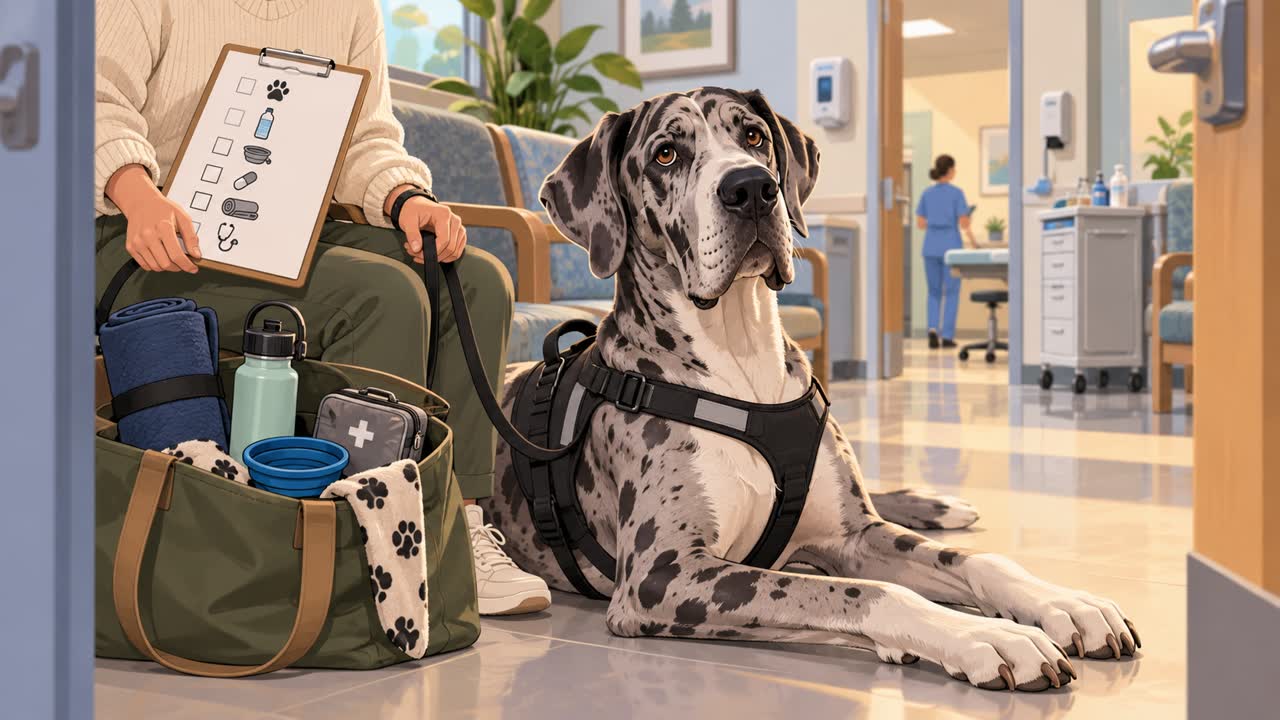
A service dog medical appointment preparation checklist should cover access, the dog’s working position, care needs, procedure restrictions, and a backup plan. Calling the medical office before an unfamiliar or complex appointment can prevent confusion without turning the call into a request for permission to bring a qualifying service dog.
Under the Americans with Disabilities Act (ADA), a service dog may generally accompany its handler in patient areas where the public is allowed. Access may be restricted in particular locations when the dog would compromise a sterile environment or create a legitimate safety concern.
This checklist is designed for routine appointments, diagnostic visits, and outpatient procedures. Inpatient stays require additional planning because hospital personnel are not ordinarily responsible for feeding, supervising, or walking the dog.
Quick Overview
- Confirm the appointment location, expected duration, and planned procedures.
- Ask about sterile rooms, imaging equipment, sedation, and other specific hazards.
- Plan where the dog will settle without blocking staff, equipment, or exits.
- Bring water, waste bags, necessary medication, and backup-handler details.
1) Use this Service Dog Medical Appointment Preparation Checklist
Start by reviewing the appointment confirmation and identifying which department you will visit. A short primary-care consultation requires less planning than an MRI, infusion, dental procedure, or appointment involving sedation.
Before leaving, confirm:
- The address, building, floor, and check-in location.
- The anticipated appointment length.
- Whether testing, imaging, injections, or a procedure is expected.
- Where the dog can relieve itself before and after the visit.
- Whether a support person or backup handler should attend.
- How you will travel home if medication affects your ability to function safely.
Pack only what supports the visit: leash or harness, water, waste bags, a small mat if useful, required medication, emergency contacts, and any task notes you rely on. General daily living tips can help with routines, but the medical team should answer procedure-specific questions.
2) Call Ahead for Procedures or Unfamiliar Facilities
Advance notice is not generally required for routine ADA public access, but it is practical when the appointment involves sedation, radiation, sterile conditions, specialized machinery, or restricted clinical spaces. Ask to speak with the office manager, accessibility coordinator, or clinical team rather than relying solely on a scheduling representative.
Explain that a trained service dog will accompany you and ask which rooms or procedures are planned. The purpose is to identify specific hazards and alternatives. For example, a dog may be able to remain in an examination room but not beside certain equipment while it is operating.
If a temporary restriction is necessary, ask whether the dog can wait with a trusted handler nearby and rejoin you afterward. Avoid leaving the dog unattended in a vehicle or unsecured public area.
3) Prepare for Allowed Questions and Records
When the dog’s role is not apparent, staff may generally ask whether the dog is required because of a disability and what work or task it has been trained to perform. They generally may not demand your diagnosis, require a task demonstration, or make access depend on a special vest, purchased certificate, registration, or ID card.
A brief response is usually enough: “Yes, this dog is required because of a disability and is trained to [describe the task].” Optional identification may provide organization or peace of mind, but it does not replace task training or controlled behavior.
Keep the patient’s medical records separate from routine animal information. Current veterinary or vaccination records can help with travel, emergencies, or general local requirements, although they are not ordinarily the legal test for entering a medical office. Records can be organized in our app, but an app entry does not establish access rights.
4) Plan the Dog’s Position and Behavior
Decide where the dog can settle while preserving access to its trained task. A corner beside the examination table, a wall-side position, or a spot beneath a chair may work. The dog should not block doors, emergency equipment, staff routes, or access to the patient.
The dog should remain housebroken and under control. A leash, harness, or tether is generally expected unless it hampers the dog’s work or the handler’s disability prevents its use. In that case, maintain control through voice commands, signals, or another effective method.
Practice relevant skills before the visit, including elevators, crowded waiting rooms, mobility equipment, alarms, close staff movement, and quiet settling. Do not allow the dog to climb on medical furniture unless a trained task requires a different controlled position and the clinical team can accommodate it safely.
5) Arrange Care During Examinations and Procedures
The handler is ordinarily responsible for supervising, feeding, watering, and cleaning up after the dog. Clinic staff generally are not required to hold the leash, take the dog outside, or supervise it during treatment.
A backup handler may be necessary if the appointment involves sedation, anesthesia, painful treatment, removal of the handler’s equipment, or a position that prevents effective control. Choose someone who understands the dog’s commands, boundaries, and care routine.
Discuss how the dog’s trained alerts or responses fit into the clinical plan. If the dog alerts during the appointment, staff should know whether the handler needs medication, a pause, repositioning, or another response. The dog’s alert can provide useful information, but it does not replace professional medical assessment.
The supplied ESA check concerns a different assistance-animal context and does not determine medical-office access for a service dog. Public access generally turns on disability-related task training and control, not emotional support alone.
6) Handle Restrictions or Disputes Calmly
Medical facilities may restrict a service dog from a specific area when its presence would compromise sterile conditions or create a legitimate safety risk. Examples can include operating rooms and certain specially controlled treatment areas. A restriction should be based on the actual room and procedure, not a facility-wide assumption that dogs are unsafe.
If access is questioned, ask what specific condition supports the restriction and whether a safe alternative would keep the dog nearby. Excluding a dog from one room does not automatically justify excluding it from the waiting room, consultation area, or other patient spaces.
A facility may generally require removal if the dog is uncontrolled and the handler does not act effectively, or if the dog is not housebroken. The facility should still offer medical services without the dog present.
Document a serious disagreement with the date, location, staff involved, reason given, and alternatives proposed. Ask for the patient advocate, accessibility contact, or grievance process. Separate public-access questions from residential matters; housing rules use a different legal framework.
FAQs
What belongs on a service dog medical appointment preparation checklist?
Include appointment details, planned procedures, the dog’s settling position, relief breaks, necessary supplies, trained-task information, emergency contacts, and a backup caregiver when treatment could limit your ability to handle the dog.
Should I notify the medical office in advance?
Notice is not generally required for an ordinary visit, but calling ahead is useful for imaging, surgery, sedation, sterile environments, long procedures, or unfamiliar facilities.
Can a doctor’s office require a service dog certificate?
A purchased certificate, registration, vest, or ID is generally not required for ADA public access. When the dog’s role is not apparent, staff may ask the two limited questions about disability-related need and trained work.
Can my service dog enter an examination room?
Usually, yes, when patients are allowed in the room and the dog can remain safely under control. Specific equipment, sterile conditions, or procedures may require a different arrangement.
Must clinic staff watch my dog during treatment?
No. Medical personnel are not ordinarily responsible for supervising or caring for a service dog. Arrange a trusted backup handler if you may be unable to maintain control.
Sources
- ADA.gov: Service Animals
- ADA.gov: Service Animals FAQ
- CDC: Dogs
- CDC: Pet Travel Safety
- HUD: Information for Persons with Disabilities
Takeaway
Medical visits go more smoothly when the handler confirms procedure details, plans the dog’s position and care, and prepares an alternative arrangement for restricted clinical areas.
- Call ahead when treatment involves sedation, sterile conditions, or specialized equipment.
- Bring essential supplies and identify a backup handler when needed.
- Keep access discussions focused on trained tasks, control, and specific safety conditions.