
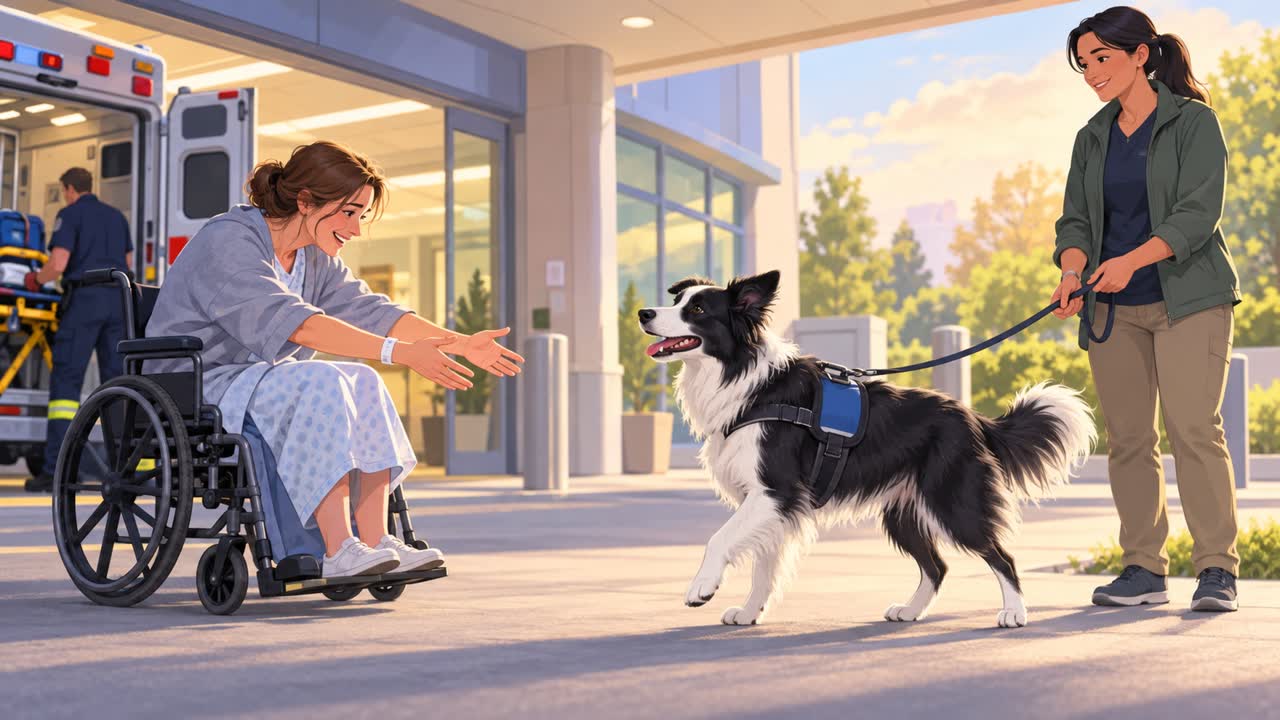
A service dog reunification plan after emergency transport explains who will take temporary custody of the dog, how responders can identify that person, and where the handler and dog should reconnect. Preparing this plan before an emergency reduces the risk of leaving the dog without safe supervision when an ambulance transports the handler.
Emergency medical needs come first. Responders may be able to transport a service dog with its handler, but vehicle space, medical equipment, safety conditions, local protocols, and the receiving facility’s procedures can affect what happens.
This guide focuses on separation and reunification after an unplanned medical transport. It complements, but does not replace, broader evacuation planning or a hospital admission care plan.
Quick Overview
- Name a primary and secondary emergency caregiver for the dog.
- Keep caregiver details where responders can find them quickly.
- Prepare written instructions for handling, feeding, medication, and veterinary care.
- Choose secure temporary-care and reunification locations.
- Confirm where the ambulance is taking the handler before moving the dog.
- Do not assume emergency personnel or hospital employees can provide routine animal care.
1) Build a Service Dog Reunification Plan after Emergency Transport
Create a short written plan another person can follow when the handler can’t communicate. It should identify the dog, its usual equipment, two caregivers, the preferred veterinary clinic, and the person authorized to make urgent animal-care decisions.
Include:
- The dog’s name, description, microchip number, and recent photo.
- The handler’s name and emergency contacts.
- Primary and backup caregiver names and phone numbers.
- Commands, task-interruption cautions, and handling instructions.
- Food, medication, allergy, and veterinary information.
- Approved temporary-care and reunification locations.
Keep one copy in an emergency bag and another with each caregiver. Review the plan after moving, changing healthcare systems, or replacing a contact. A broader rules guide can help distinguish public-access principles from emergency-service procedures.
2) Decide Who Takes Custody If the Dog cannot Ride
The best caregiver is someone who can arrive quickly, handle the dog safely, and follow the dog’s established routine. The person should understand that the dog may be stressed, may try to remain with the handler, and may respond differently during sirens, crowds, or hurried movement.
Give the caregiver written permission to collect the dog from a residence, emergency scene, hospital, shelter, animal-control facility, or veterinary clinic when permitted. Provide keys, building instructions, and any information needed to enter the home lawfully.
Do not make the plan depend on one person. A caregiver may be traveling, asleep, or unreachable. List at least one backup and establish an order for contacting them. A voluntary service screening may help organize task and readiness information, but it is not a substitute for an emergency caregiver or authorization form.
3) Make Essential Information Easy to Find
During an emergency, a detailed file is useful only if someone can locate it. Carry a concise emergency card in a wallet, medical-information pouch, or phone emergency profile. Place a visible notice inside the home where responders are likely to see it, while avoiding unnecessary public disclosure of private information.
The card can state that the dog is a trained service animal, name the emergency caregivers, and identify where the full care instructions are stored. It should also indicate whether the dog has medication or urgent veterinary needs.
A purchased certificate, registry card, or special ID is not generally required to establish ADA public access. Optional identification may help organize information or alert responders, but it cannot replace current contacts, safe handling instructions, or a confirmed custody plan.
4) Coordinate the Handoff at the Emergency Scene
If the handler can communicate, tell responders the dog is a service animal and briefly explain its trained task. Ask whether the dog can travel safely without interfering with medical care. The answer may depend on the handler’s condition, ambulance configuration, equipment, crew safety, and local policy.
If the dog cannot accompany the handler, confirm the destination hospital before separation whenever possible. Record who or what agency takes custody, where the dog is going, and how the caregiver can retrieve it. Photograph or note any equipment traveling with the dog.
Secure the dog with familiar equipment when safe. Avoid transferring it to an unverified bystander. If police, fire personnel, animal control, or a veterinary facility becomes involved, get the agency name, contact number, incident number, and release instructions.
Ordinary ADA principles are summarized in the public access guide, but emergency transport decisions can also involve immediate medical and vehicle-safety judgments.
5) Plan Reunification at the Hospital or Another Location
A receiving hospital may generally allow a service dog in patient areas where the dog does not compromise sterile conditions or create a legitimate safety concern. However, the handler must ordinarily be able to control and care for the dog, or have another person available to do so.
The caregiver should call the hospital before arriving with the dog. Ask whether the patient has been admitted, whether the dog can enter the current unit, and where the handoff should occur. Do not bring the dog directly into an operating, isolation, or specially controlled area without clinical approval.
If immediate hospital reunification is not workable, choose a stable alternative: the handler’s home, the caregiver’s home, a trusted veterinary facility, or another preapproved location. Reunification should occur when the handler can safely resume control or when a support person can remain responsible for the dog.
6) Prepare for Transfers, Extended Separation, and Review
The first hospital may transfer the handler to another facility without much notice. The caregiver should confirm the destination directly with authorized hospital staff and avoid relying on social media or secondhand messages. The plan should specify who may receive medical-location information and who decides whether the dog follows later.
For an extended separation, maintain the dog’s feeding, medication, exercise, rest, and training routines as closely as possible. Watch for injury, gastrointestinal upset, refusal to eat, unusual fear, or behavior changes, and contact a veterinarian when appropriate.
If the handler is transferred by commercial air after stabilization, review the applicable flight rules separately. Airline requirements differ from ground ambulance procedures and hospital-access rules.
After the emergency, document what worked and what failed. Update disconnected phone numbers, unclear authorizations, missing supplies, or unsuitable handoff locations. Replace consumed medication and food, and confirm that caregivers remain willing and able to help.
FAQs
Will an ambulance always take a service dog?
No. Transportation may depend on the patient’s medical needs, available space, equipment, safety, local protocols, and receiving-facility arrangements. A backup custody plan is essential.
What should a service dog reunification plan after emergency transport include?
Include caregiver contacts, handling instructions, medical and veterinary information, custody authorization, temporary-care locations, the likely hospital destination, and a clear process for confirming when reunification is safe.
Can hospital staff care for the dog?
Hospital employees are not ordinarily required to feed, walk, supervise, or otherwise care for a service dog. The handler should arrange a caregiver when independent care is not possible.
Can the dog reunite with the handler in the emergency department?
Possibly, if the dog can be accommodated safely and someone can maintain control. Access may be restricted in particular treatment areas because of sterile conditions, equipment, or immediate safety needs.
Should the dog wear identification?
Optional identification can help responders locate emergency contacts, but a special service-dog certificate, registry, or ID is not generally required for ADA public access. Current contact and care information is more useful during reunification.
What if the caregiver cannot reach the hospital?
The plan should name a backup caregiver and an approved temporary-care location. The caregiver can coordinate with the hospital, responding agency, animal control, or veterinary facility as appropriate.
What records should travel with the dog?
Carry emergency contacts, medication instructions, required local vaccination information, veterinary details, feeding directions, and written authorization for temporary care. Keep sensitive information limited to what caregivers actually need.
Sources
- ADA.gov: Service Animals
- ADA.gov: Service Animals FAQ
- CDC: Dogs
- CDC: Pet Travel Safety
- HUD: Information for Persons with Disabilities
Takeaway
An effective reunification plan gives responders and caregivers clear instructions without interfering with urgent medical treatment.
- Name two reachable caregivers and authorize temporary custody in writing.
- Record the handler’s destination and every transfer of the dog.
- Reunite only when the handler or a support person can safely resume responsibility.