
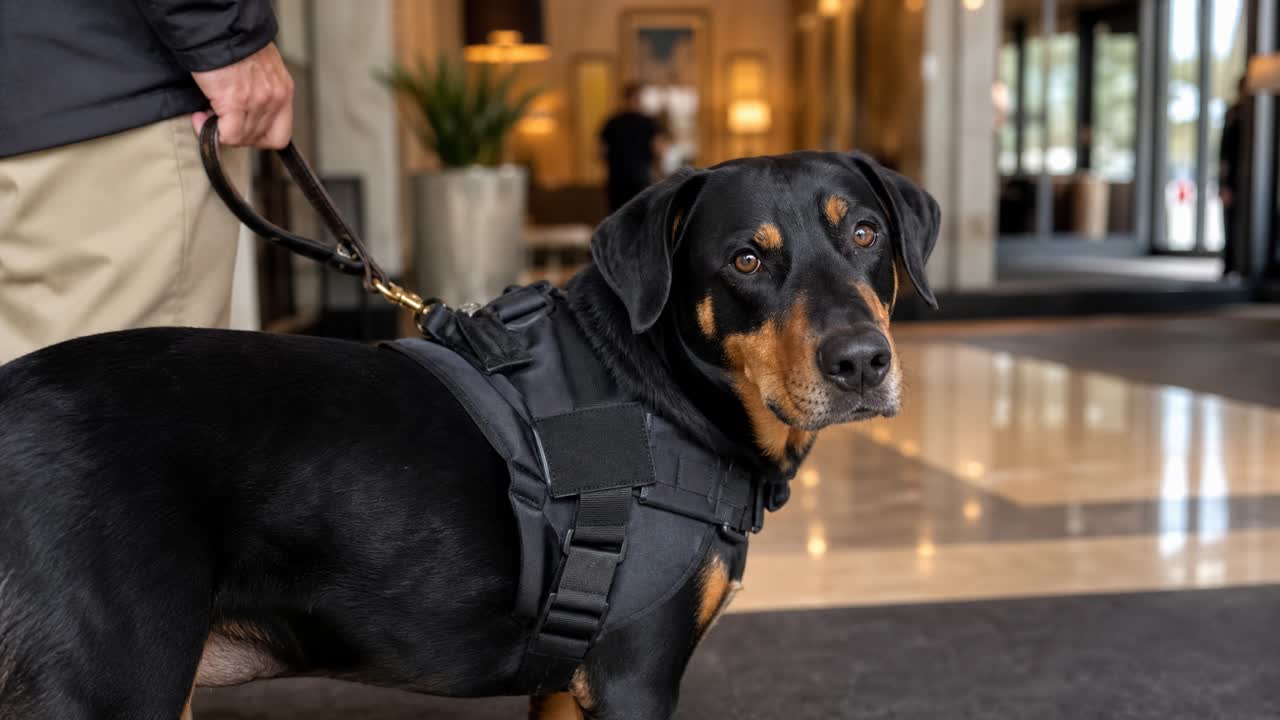
Service dog escalator training safety starts with a simple point: many dogs should not ride escalators at all. Moving steps, narrow grooves, and comb plates at the top and bottom can catch nails, fur, paw pads, or equipment. For some teams, the safest choice is to use an elevator, a ramp, or stairs instead of trying to build escalator tolerance.
This topic is narrower than a general public-access article. It is not about proving your dog belongs in a store. It is about preventing avoidable injury, reducing stress, and making safe route decisions before a busy entrance, airport, mall, or transit station becomes a problem.
If you are thinking about service dog escalator training safety, treat it as a risk-management issue first and a training issue second. A calm dog with strong behavior screening still may not be a good escalator candidate, especially if the dog is small, long-coated, recovering from injury, or hesitant around moving surfaces.
Quick Overview
- Escalators can injure dogs even when they’re otherwise well trained.
- The safest default is to choose an elevator, ramp, or stairs whenever one is available.
- Puppies, small dogs, senior dogs, and dogs with orthopedic issues face higher risk.
- Harnesses, leashes, and loose fur can also get caught near entry or exit points.
1) Why Escalators are Risky for Service Dogs
Escalators combine motion, noise, vibration, and tight mechanical edges. A dog has to judge when to step on, balance on moving stairs, stay clear of other people, and step off at the exact right moment. That is a lot to ask in a crowded environment.
The biggest concern is physical injury. Nails can snag, paw pads can slip, and straps or fur can catch near the comb plate where steps flatten out. Even one bad incident can create lasting fear around entrances, transit hubs, or busy retail spaces. From a working-dog perspective, that risk often outweighs the benefit of using the escalator in the first place.
That is why practical handlers review the setting before moving forward. A quick scan of the route, plus a backup plan from your rules guide, is usually more valuable than trying to push through because other people are in a hurry.
2) When not to Use an Escalator
For many teams, the right answer is simply “never” or “only in rare situations.” Small dogs are at obvious risk, but larger dogs are not automatically safe. Long nails, fluffy feet, mobility problems, past paw injuries, and slick or oversized gear all raise the odds of trouble.
Avoid escalators if your dog is young, aging, fatigued, recovering from surgery, or showing reluctance around moving surfaces. Also avoid them when the station or store is crowded, when people are carrying bags that may bump your dog, or when the escalator is unusually steep or noisy.
This is also a good place to separate legal access from unnecessary performance demands. A business generally cannot require your dog to demonstrate escalator use. If your dog can work safely by using a different route, that is usually the smarter decision and still fully consistent with a task-trained dog meeting basic service screening expectations.
3) Safe Training Goals that Make More Sense
Instead of teaching “ride every escalator,” focus on skills that support safe navigation in public. Useful goals include stopping on cue near moving machinery, waiting calmly while you find an elevator, ignoring crowd pressure, and pivoting away from a risky entrance.
You can also build confidence around the sounds and motion of escalators without stepping onto them. Stand at a comfortable distance, reward calm attention, practice a settle, and leave before stress builds. The aim is not to make every dog ride; it is to prevent panic, pulling, or unsafe decisions when escalators are nearby.
For teams that need a predictable public routine, route planning matters. Learn which entrances have elevators, which transit stations have working lifts, and how to ask staff for the most accessible path. That practical preparation usually reduces friction more than trying to solve everything with equipment or paperwork.
4) If You Attempt Exposure Work, Keep It Highly Controlled
If a qualified trainer or veterinary professional believes limited escalator exposure is appropriate, keep the setup conservative. Start in a quiet location, use well-fitted gear, keep nails trimmed, and do not train when the dog is tired. The first sign of hesitation, crowding, or unsafe foot placement is enough reason to stop.
Do not drag, lure, or pressure a reluctant dog onto moving steps. Forced repetitions can create a public-access problem where none existed before. A dog that avoids escalators but calmly uses elevators may still be the safer and more reliable working partner.
Keep simple records of what happened: location, surface type, crowd level, dog response, and whether you switched to a safer route. Those notes support future decisions and can be more meaningful than cosmetic items that are not legally required. Calm handling and consistent performance matter most.
5) How to Handle Public Situations without Conflict
Sometimes the social pressure is the hardest part. A bystander may assume the escalator is the normal route and question why you are waiting for the elevator. You do not need to justify a risky choice. A short, neutral script works well: “We’re taking the elevator for safety.”
If staff ask questions, keep the conversation centered on safe access and good behavior. Under the ADA, businesses are limited in what they can ask about a service animal. Focus on whether the dog is under control and appropriately working in the space, not on whether the team used a particular machine or entrance.
That is also why preparation beats argument. Knowing your route, keeping your dog close and composed, and understanding basic access expectations can prevent many stressful moments before they grow.
6) When to Get Extra Help
Ask for professional input if your dog has slipped, snagged a nail, shown fear around moving steps, or developed hesitation around entrances after an incident. A veterinarian can check for pain or paw injury, and an experienced trainer can help decide whether the goal should be desensitization near escalators or full avoidance.
If your work or housing routine involves buildings where escalators are common, document the safer alternatives you use. That might include a preferred entrance, elevator location, or backup route during outages. Practical records like that can make daily life smoother without drifting into misleading “proof” language.
For related guidance, see our rules guide, service screening, public access rules, and behavior screening.
FAQs
Is service dog escalator training safety really necessary if my dog is confident in public?
Yes. Public confidence does not remove mechanical risk. A steady dog can still get a paw, nail, or strap caught at the entry or exit point.
Do service dogs have to ride escalators to qualify for public access?
No. Public access in the U.S. is tied to disability-related task training and appropriate behavior, not to escalator use. Choosing a safer route does not make a legitimate team less legitimate.
Are some dogs better off never using escalators?
Yes. Small dogs, senior dogs, long-coated dogs, and dogs with orthopedic concerns are often better served by elevators, ramps, or stairs.
Can a business insist that I take the escalator instead of the elevator?
That would usually be a poor safety practice. In most settings, the safer accessible route is the better choice for both handler and dog.
Should I use a vest, ID, or certificate for escalator situations?
Those items don’t make escalator use safe, and they aren’t generally legally required for public access. If optional identification helps you stay organized, it should be secondary to route planning, training notes, and calm handling.
Sources
- ADA.gov: Service Animals
- ADA.gov: Service Animals FAQ
- CDC: Dogs
- CDC: Pet Travel Safety
- HUD: Information for Persons with Disabilities
Takeaway
For most handlers, the safest approach to escalators is caution first. A service dog does not need to prove reliability by riding every moving staircase, and many teams are better protected by choosing elevators, ramps, or stairs instead.
- Treat escalators as a real injury risk, not a routine training milestone.
- Build public-access reliability around route planning, calm behavior, and safe alternatives.
- Use practical records and professional guidance when an incident, fear response, or recurring access problem comes up.