
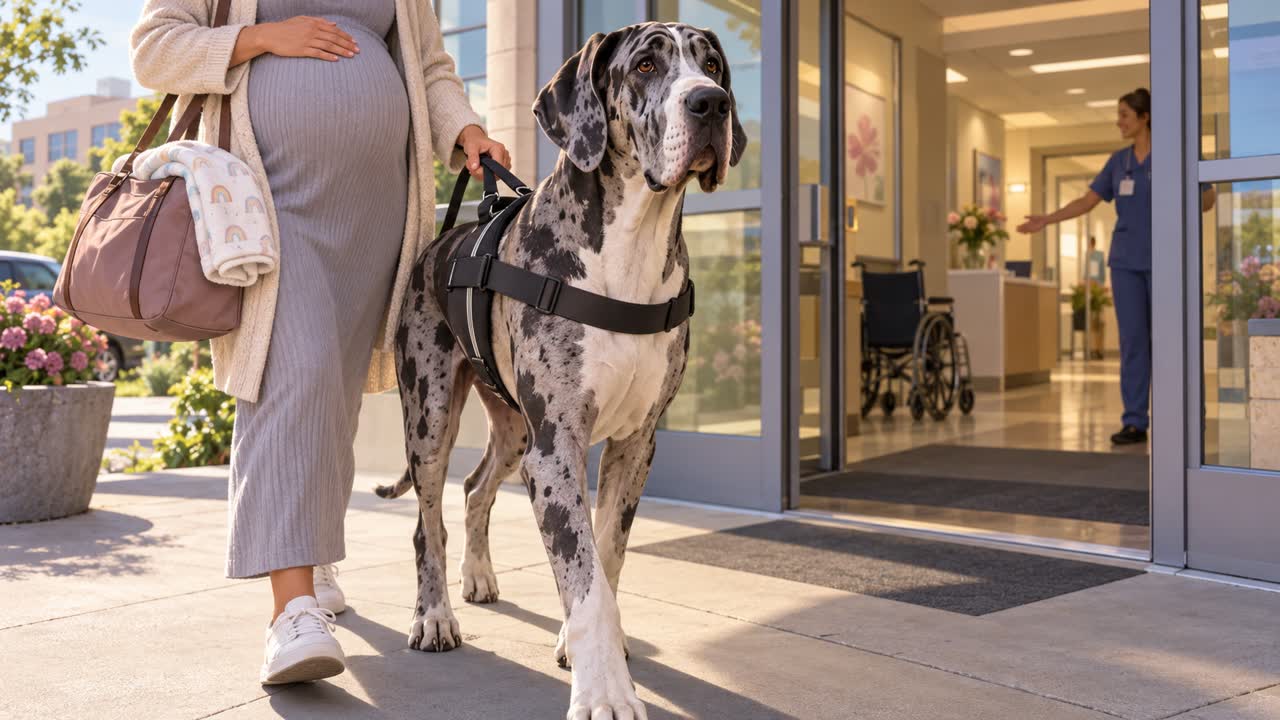
A service dog during labor and delivery admission may require planning with the hospital because childbirth care can involve triage, room changes, monitoring equipment, urgent procedures, and a possible stay longer than expected.
The safest plan considers both the patient’s disability-related needs and the clinical environment. When possible, contact the hospital’s labor and delivery unit, patient advocate, or accessibility coordinator before the due date, then confirm the plan again when arriving for admission.
This guide addresses practical planning for U.S. hospital care. It does not replace medical advice from an obstetric clinician, pediatric clinician, or hospital care team.
Quick Overview
- Contact labor and delivery and the hospital accessibility contact before admission.
- Discuss the dog’s role, care needs, relief plan, and likely support person.
- Plan for triage, room changes, monitoring equipment, surgery, and unexpected separation.
- Keep the dog controlled, clean, and clear of clinical equipment and sterile areas.
1) Plan for a Service Dog During Labor and Delivery Admission
Begin the conversation before labor starts whenever possible. Ask the hospital where to submit an accommodation request and whether the labor and delivery department has a patient advocate, nurse manager, or accessibility coordinator who can help coordinate the plan.
Explain the practical need: the dog performs trained disability-related work, may need to remain close to the patient, and requires a safe settling location, relief breaks, water, and a backup caregiver. Keep the conversation focused on access and care logistics, not unnecessary medical history.
Ask about the triage entrance, security screening, elevators, room locations, outdoor relief access, overnight rules, and how staff will communicate the plan during shift changes. General background is available through the Knowledge Center, but the hospital must address its own unit conditions.
2) Confirm How Hospital Access Rules Apply
Disability-access requirements generally cover hospitals, but labor and delivery can include areas with legitimate clinical, safety, and infection-control restrictions. The care team should make an individualized assessment rather than relying on the blanket assumption that dogs never belong in a maternity unit.
A service dog may need to remain with the patient in waiting areas, patient rooms, and other nonsterile locations when that is safe and effective. Operating rooms, procedure rooms, newborn intensive care units, or other highly restricted settings may require a different arrangement.
When the dog’s service role is not apparent, staff may generally ask whether the dog is required because of a disability and what work or task it is trained to perform.
The public access rules provide general context, but a hospital’s individualized safety decisions must account for the specific medical setting and the patient’s care needs.
3) Build a Room, Relief, and Caregiver Plan
Ask where the dog can settle in the labor room without blocking staff movement, emergency equipment, the bathroom, the newborn warmer, or a route to the bed. A resting mat positioned near the patient may help define a safe space if it does not interfere with care.
Labor can be unpredictable, so identify a primary support person and a backup caregiver who can take the dog outside, provide water, offer food, and leave with the dog if needed. The patient should not have to manage the dog’s routine during an intense contraction pattern, emergency evaluation, or recovery period.
Give the caregiver a written routine with food, medication, veterinary contacts, relief timing, safe transportation instructions, and the location of the dog’s supplies. The caregiver should know the dog’s normal behavior and should not be expected to recreate trained tasks that depend on the patient.
A voluntary service screening may help organize task information before the hospital stay, but it is not government approval and does not replace the hospital’s planning process.
4) Prepare for Triage, Monitoring, and Changes in Care
Admission may begin in triage rather than a private labor room. Triage bays can be crowded, curtained off, and filled with monitoring equipment. Ask staff where the dog can safely settle while the patient is assessed.
Medical monitoring, IV lines, epidural equipment, mobility limitations, and frequent room entry can change the dog’s safest position. The dog should remain away from electrical cords, pumps, medication carts, sharps containers, and areas where staff need immediate access.
Tell the care team if the dog performs a task that may become visible, such as an alert or interruption. A short explanation can prevent confusion while protecting the patient’s privacy: “The dog is responding to a trained cue; I may need a brief moment to respond.”
Review the plan if the patient is moved to another room, receives an urgent recommendation, or needs continuous monitoring. The most workable arrangement at admission may not remain safe later in labor.
5) Plan for Surgery, Delivery, and Postpartum Recovery
Before delivery, ask what will happen if a cesarean birth, urgent procedure, or operating-room transfer becomes necessary. Sterile environments and emergency procedures may make it unsafe for the dog to remain with the patient, so the backup caregiver should be ready to take custody immediately.
Clarify whether the caregiver can remain with the dog in a waiting area, take the dog home, or return later. The hospital should not assume that a patient can make detailed care decisions in an emergency, so written contact information and a handoff plan are valuable.
After birth, the patient may be recovering from medication, surgery, blood loss, sleep deprivation, or other medical needs. Reassess whether the room has enough space for the dog, newborn equipment, visitors, and clinical care. Never leave the dog unattended with a newborn.
Follow the pediatric and obstetric team’s directions on safe separation, hygiene, and handling. A support person should manage the dog’s care while the patient rests, feeds the baby, or receives medical attention.
6) Address Concerns and Document the Arrangement
Another patient’s allergy, fear, or concern does not automatically require excluding the service dog. Staff can consider separate rooms, timing, routing, cleaning, or other practical measures that protect both patients’ access and safety.
The dog must remain under control and housebroken. If the dog becomes distressed, repeatedly barks, interferes with staff, or cannot safely settle, create distance and use the backup care plan. Evaluate a brief trained alert in context, but ongoing disruption may require the caregiver to remove the dog.
Keep a copy of the accommodation communication, caregiver contacts, veterinary information, and any agreed restrictions in the hospital bag. If an access issue arises, ask why, request review by a supervisor or patient advocate, and document the response.
If travel is necessary before or after delivery, airline procedures are separate from hospital access. Review the applicable air travel guide early enough to account for medical clearance, newborn travel rules, and the dog’s care needs.
FAQs
Can I bring a service dog during labor and delivery admission?
You can request the dog as an accommodation. Contact the hospital before admission so staff can evaluate the patient room, clinical environment, safety needs, and a backup care plan.
Should I notify the hospital before labor starts?
Yes. Planning gives the hospital time to coordinate with labor and delivery staff, accessibility personnel, security, and the patient advocate.
Can the hospital require a certificate or registration?
A purchase certificate, registry entry, vest, or ID card does not by itself determine access. The hospital should focus on the dog’s trained role, the patient’s needs, and the specific clinical setting.
Can the dog remain during a cesarean birth?
Operating rooms and urgent procedures may have sterile or safety restrictions. Plan for a trusted caregiver to take immediate responsibility for the dog if the patient must enter a restricted area.
Who takes the dog outside during labor?
A support person or backup caregiver should handle relief, water, food, and exercise. The patient should not be expected to manage routine dog care during labor or medical recovery.
Sources
- ADA.gov: Businesses Open to the Public
- ADA.gov: Service Animals
- ADA.gov: Service Animals FAQ
- CDC: Dogs
- CDC: Pet Travel Safety
- U.S. DOT: Service Animals
Takeaway
The strongest labor-and-delivery plan accounts for disability access, clinical safety, the dog’s welfare, and an immediate backup arrangement if care changes unexpectedly.
- Coordinate with the hospital before admission whenever possible.
- Assign a caregiver who can take over dog care at any moment.
- Reassess the arrangement during triage, delivery, procedures, and recovery.