
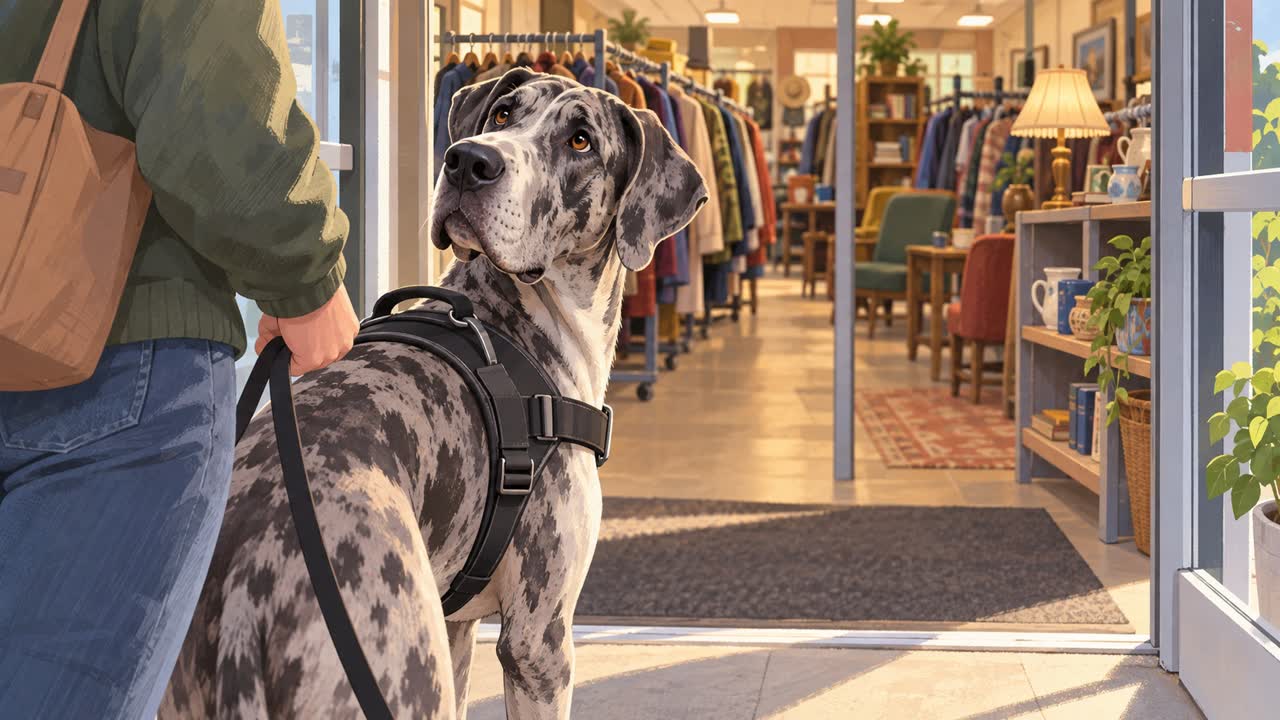
A service dog at thrift store locations may generally accompany its handler in customer areas when the dog meets the Americans with Disabilities Act (ADA) definition. A store should not apply a no-pets rule to a qualifying service dog simply because it sells used clothing, furniture, or household goods.
Thrift stores can present unusual challenges: narrow aisles, rolling racks, unstable displays, donated items on the floor, strong odors, crowded checkout lines, and customers who try to interact with the dog. Calm positioning and a clear response to staff questions can prevent many problems.
This guide addresses customer access in U.S. thrift stores. Employment accommodations, volunteer placements, housing-related resale programs, and emotional support animals may follow different rules.
Quick Overview
- A qualifying service dog may generally enter areas open to thrift-store customers.
- Staff may ask two limited questions when the dog’s role is not apparent.
- A vest, purchase certificate, registry entry, or ID card is generally not required.
- The dog must remain under control and should not block aisles or checkout lanes.
1) Prepare to Bring a Service Dog to Thrift Store Locations
Before entering, give the dog an appropriate relief opportunity and check that its leash, harness, or other working equipment fits correctly. Choose a quieter shopping time if the store is unfamiliar or the aisles are especially crowded.
Carry waste bags, a small cleanup kit, and any medication or task supplies needed during the visit. Avoid bringing unnecessary gear that could catch on racks or baskets. If the handler uses a wheelchair, walker, cart, or other mobility aid, consider how the dog will position itself in narrow spaces.
Some thrift stores operate inside older buildings with uneven floors, limited aisle width, or inaccessible entrances. Calling ahead can help identify an accessible entrance or a less crowded time, although advance notice is not ordinarily required for routine public access.
Current regulations summarize general federal principles, but state or local law may provide additional protections.
2) Answer Staff Questions Briefly and Accurately
If the dog’s service role is not apparent, staff may generally ask whether the dog is required because of a disability and what assignment it has been trained to perform. The handler can describe the trained action without sharing a diagnosis or complete medical history.
A concise answer might be: “Yes, this dog is required because of a disability and is trained to [brief task description].” Staff generally should not require the dog to demonstrate its task or make entry depend on a particular vest, certificate, registration, or identification card.
Optional identification may help some handlers organize information or feel more comfortable, but it does not replace disability-related task training and controlled behavior. A voluntary PSA check may also help organize psychiatric service-animal task information, but it is not government approval or an access guarantee.
If a greeter or cashier is uncertain, ask for a manager and keep the discussion focused on the dog’s trained role and current conduct.
3) Navigate Racks, Donations, and Checkout Areas Safely
Position the dog close enough to work without brushing against hanging clothing, baskets, lamps, glassware, or unstable furniture. Avoid letting the dog move beneath freestanding racks if leashes or equipment could become tangled.
Watch for hazards that may be easy to miss:
- Broken glass, pins, staples, or sharp hardware.
- Cleaning products or leaking donated containers.
- Food scraps, medication, or small objects on the floor.
- Top-heavy displays and furniture with moving parts.
- Hot donation areas, loading zones, or open stockroom doors.
At checkout, keep the dog out of the path of carts and customers. An end position beside the handler may reduce crowding. The dog should remain on the floor unless a trained task requires another controlled position.
A structured behavior screening may help identify skills to practice around tight aisles, dropped objects, sudden noises, and prolonged settling. It is not a legal certification.
4) Manage Distractions and Customer Interactions
Thrift-store customers may call, pet, photograph, or offer items to the dog. A calm statement such as “The dog is working and cannot be distracted” is usually sufficient. Staff can help by redirecting persistent interference.
The dog should not sniff merchandise, retrieve objects that are not part of a task, climb onto furniture, or approach other customers. If a task requires the dog to create space, guide the handler, or retrieve a specific personal item, the handler should maintain enough control to prevent contact with store property.
Strong odors, crowded aisles, squeaking carts, and shifting merchandise can make a thrift store more demanding than a conventional retailer. If the dog becomes unusually vigilant, cannot settle, or repeatedly misses familiar cues, move to a quieter area or end the visit.
A difficult environment does not change the dog’s legal status, but the handler should still prioritize welfare and reliable task performance.
5) Respond to Allergies, Fear, and Store Safety Concerns
Another customer’s allergy or fear does not automatically justify excluding a service dog. Store staff can consider practical measures such as increasing distance, opening another checkout lane, adjusting routes, or allowing one customer to finish in a particular area before the other enters.
Restrictions should be based on actual conditions, not the dog’s breed, size, appearance, or assumptions. A store may protect genuinely hazardous or staff-only locations, including compact stockrooms, donation-processing areas, loading docks, and spaces generally closed to customers.
The dog should remain under control. A leash, harness, or tether is generally expected unless it intervenes with the dog’s work or the handler’s disability prevents its use. In that situation, the handler must use voice commands, signals, or another effective control method.
6) Handle Denial or Justified Removal Calmly
If staff deny access, ask for the specific reason and whether a manager can review the decision. Clarify that the dog is task-trained and ask whether staff are applying a pet policy rather than the service-animal standard.
A store may generally require a dog to leave if it is out of control and the handler does not take effective action, or if it is not housebroken. A single alert, task response, or quiet repositioning should not automatically be treated as uncontrolled behavior.
If removal is justified, the handler should still be offered an opportunity to obtain goods or services without the dog. Depending on the circumstances, that might include returning after arranging safe care, shopping with assistance, or using another available purchasing method.
Document the date, location, staff involved, reason given, witnesses, and any alternatives offered. Serious unresolved disputes may warrant contacting company management, an appropriate disability-rights organization, a government agency, or qualified counsel.
FAQs
Can I bring a service dog at thrift store locations?
Generally, yes. A qualifying service dog may accompany its handler in customer areas of a covered thrift store, subject to limited behavior- and safety-based exceptions.
Can the store ask what my disability is?
Staff generally may not require disclosure of a diagnosis. When the dog’s role is not apparent, they may ask whether it is required because of a disability and what trained work or task it performs.
Must the dog wear a vest?
No particular vest, certificate, registration, or ID card is generally required for ADA public access. Optional identification may provide organization or peace of mind, but it does not replace training and control.
Can the dog sit on thrift-store furniture?
Usually, the dog should remain on the floor unless a trained disability-related task requires another controlled position. Merchandise furniture is not a general resting area for the dog.
What if the aisles are too narrow?
Ask whether staff can identify a wider route, move a cart, or provide reasonable assistance. The dog and handler should avoid blocking the aisle or disturbing unstable displays.
Sources
- ADA.gov: Service Animals
- ADA.gov: Service Animals FAQ
- ADA.gov: Businesses Open to the Public
- CDC: Dogs
- CDC: Pet Travel Safety
- U.S. DOJ/HUD: Reasonable Accommodations Under the Fair Housing Act
Takeaway
A smooth thrift-store visit depends on clear communication, close control, and careful navigation around crowded or unpredictable merchandise.
- Answer only the permitted service-animal questions when necessary.
- Keep the dog clear of racks, carts, furniture, and dropped objects.
- Address access concerns through specific facts rather than pet-policy assumptions.