
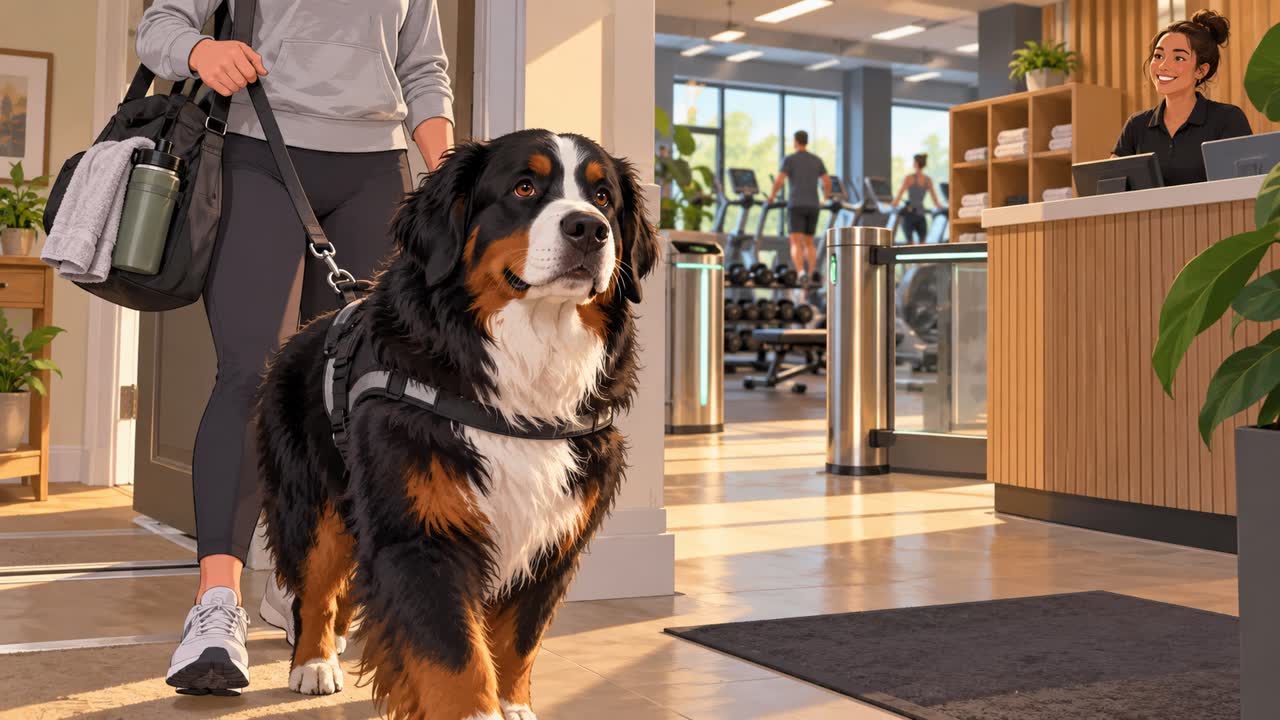
A service dog at gym front desk may generally accompany its handler when the dog matches the Americans with Disabilities Act (ADA) definition. A covered gym should not apply its no-pets policy to a qualifying service dog or require a particular vest, certificate, registration, or ID card before admitting the team.
At the front desk, staff may confirm membership, answer limited service-animal questions, and discuss a safe route through the facility. Access to a particular workout area still depends on whether the dog can remain safely positioned without interfering with equipment, other members, or the handler’s exercise.
This guide covers customer access at U.S. gyms and fitness centers. Employment accommodations, residential fitness rooms, rehabilitation facilities, pools, and organized competitions may involve different rules or safety procedures.
Quick Overview
- Train front-desk staff to separate service dogs from pets.
- Ask only the two ADA questions when the dog’s role is not apparent.
- Do not make entry depend on a vest, certificate, registration, or ID.
- Identify a safe workout position and an accessible relief route.
- Keep the dog away from moving equipment, weights, and wet surfaces.
- Address actual conduct or safety risks instead of assumptions about breed or size.
1) Check in with a Service Dog at Gym Front Desk Areas
At check-in, the handler should follow the gym’s ordinary membership and guest procedures. If the dog’s role is not apparent, staff may generally ask whether the dog is required because of a disability and what work or task it has been trained to perform.
A brief response is enough: “Yes, this dog is required because of a disability and is trained to [brief task description].” Staff generally should not ask for the handler’s diagnosis, require medical records, or demand that the dog demonstrate its task.
Current principles are summarized in the rules guide. State or local law may provide additional protections, but staff should not improvise broader questions when ordinary ADA public-access rules apply.
2) Distinguish Access from Optional Paperwork
A purchased certificate, registry entry, vest, or identification card is generally not required for ADA public access. Optional identification may help with organization or provide peace of mind, but it does not replace trained disability-related work and controlled behavior.
A voluntary service screening may help a handler organize task and readiness information. It is not government approval, and the gym should not treat it as a condition of entry or a guarantee that every workout arrangement is safe.
Front-desk notes should be limited to operational information that staff genuinely need, such as an agreed route, emergency contact procedure, or accessible location. The gym should avoid posting disability details where other members or unnecessary staff can see them.
3) Select a Safe Workout Location
Before exercising, identify where the dog will settle and how it will reach the handler if a task requires movement. The position should keep the dog close enough to work without placing it beneath moving equipment or in a path used by other members.
Common hazards include:
- Falling weights and rolling plates.
- Treadmills, stationary bicycles, rowers, and cable machines.
- Resistance bands, jump ropes, and loose straps.
- Fast-moving group classes and personal-training circuits.
- Cleaning chemicals, spilled drinks, and wet locker-room floors.
A wall-side mat or marked position may provide a predictable resting place, as long as it does not block an aisle, emergency exit, or accessible route. Staff can help identify a quieter station during peak hours without unnecessarily separating the handler from ordinary gym services.
The public access rules provide general context, but the safest positioning decision depends on the equipment, layout, task, and handler’s needs.
4) Manage Locker Rooms, Classes, Pools, and Saunas
A service dog may generally accompany its handler into customer areas, including a locker-room route, when it can do so safely. The handler should keep the dog away from wet floors, open showers, benches used for changing, and other members’ belongings.
For a group class, ask the instructor where the dog can stay without being struck or surrounded by moving participants. An edge position may work better than the middle of a crowded studio.
Under ADA guidance, service animals generally may be present on a pool deck but may be excluded from the water. Saunas, steam rooms, and similar environments can also present heat and welfare risks. The handler may need a safe plan that does not involve leaving the dog unattended or placing responsibility for the dog on gym staff.
If a gym is part of an apartment or residential complex rather than a public membership facility, applicable housing rules may require a different accommodation process.
5) Respond to Allergies, Fear, and Distractions
Another member’s allergy or fear does not automatically justify excluding a service dog. Staff can consider distance, different equipment stations, class placement, staggered schedules, ventilation, or other reasonable arrangements that give both people meaningful access.
Other members should not pet, call, feed, photograph, or deliberately distract the dog. Front-desk staff and trainers can reinforce this boundary without asking the handler to explain private medical information.
The dog should not approach members, roam between machines, sniff gym bags, or retrieve shared equipment unless a specific trained task requires controlled movement. Breed, size, or appearance alone should not be treated as evidence of danger.
If the gym permits pets during special events, management should prevent uncontrolled animals from interfering with the service-dog team. A pet-friendly policy does not reduce the need for safe, reliable access.
6) Handle Behavioral or Safety Incidents Fairly
If the dog barks, moves toward equipment, or disrupts another member, staff should assess the actual event. A brief, trained alert differs from repeated, uncontrolled barking, lunging, or running through the workout area.
Under ADA public-access principles, a business may generally require removal when a service dog is out of control, and the handler does not take effective action, or when the dog is not housebroken. When feasible, still offer the handler the opportunity to use the gym without the dog.
For an injury, near miss, or recurring problem, record the date, location, equipment involved, observed conduct, the handler’s response, and any alternatives offered. Avoid unsupported labels when a factual description is more useful.
Before returning, the handler and gym can review positioning, timing, routes, or equipment choice. Sudden changes in the dog’s behavior or stamina may also warrant veterinary or qualified training support.
FAQs
Can I bring a service dog at gym front desk check-in?
Generally, yes. A qualifying service dog may accompany its handler through customer areas of a covered gym, subject to limited control, house-training, and safety exceptions.
What may front-desk staff ask?
When the dog’s role is not apparent, staff may generally ask whether it is required because of a disability and what trained work or task it performs.
Can a gym require certification or registration?
A purchased certificate, registry entry, vest, or ID is generally not required for ADA public access. Optional records may help with organization but do not replace task training or controlled behavior.
Can the dog stay beside exercise equipment?
Yes, if the position allows the dog to work without creating a safety hazard. The dog should remain clear of moving machinery, falling weights, cables, and busy walkways.
Can a service dog enter a locker room?
Generally, the dog may accompany the handler through customer-accessible areas. Still, the team should avoid wet surfaces, open showers, and positions that interfere with other members’ use of the space.
Can a service dog enter a swimming pool?
ADA guidance generally allows service animals on a pool deck but does not require allowing them in the water. The gym should discuss a safe arrangement for the handler and dog.
What if another member is afraid of dogs?
Staff should consider distance, equipment placement, schedules, or other practical measures rather than automatically excluding the service dog.
Sources
- ADA.gov: Service Animals
- ADA.gov: Service Animals FAQ
- ADA.gov: Businesses Open to the Public
- CDC: Dogs
- CDC: Pet Travel Safety
- U.S. DOJ/HUD: Reasonable Accommodations Under the Fair Housing Act
Takeaway
A smooth gym visit starts with correct front-desk handling and continues with an individualized plan for equipment, movement, and the dog’s welfare.
- Use the two permitted ADA questions when necessary.
- Choose a controlled position away from moving equipment and wet surfaces.
- Resolve concerns through specific safety measures rather than blanket pet rules.