
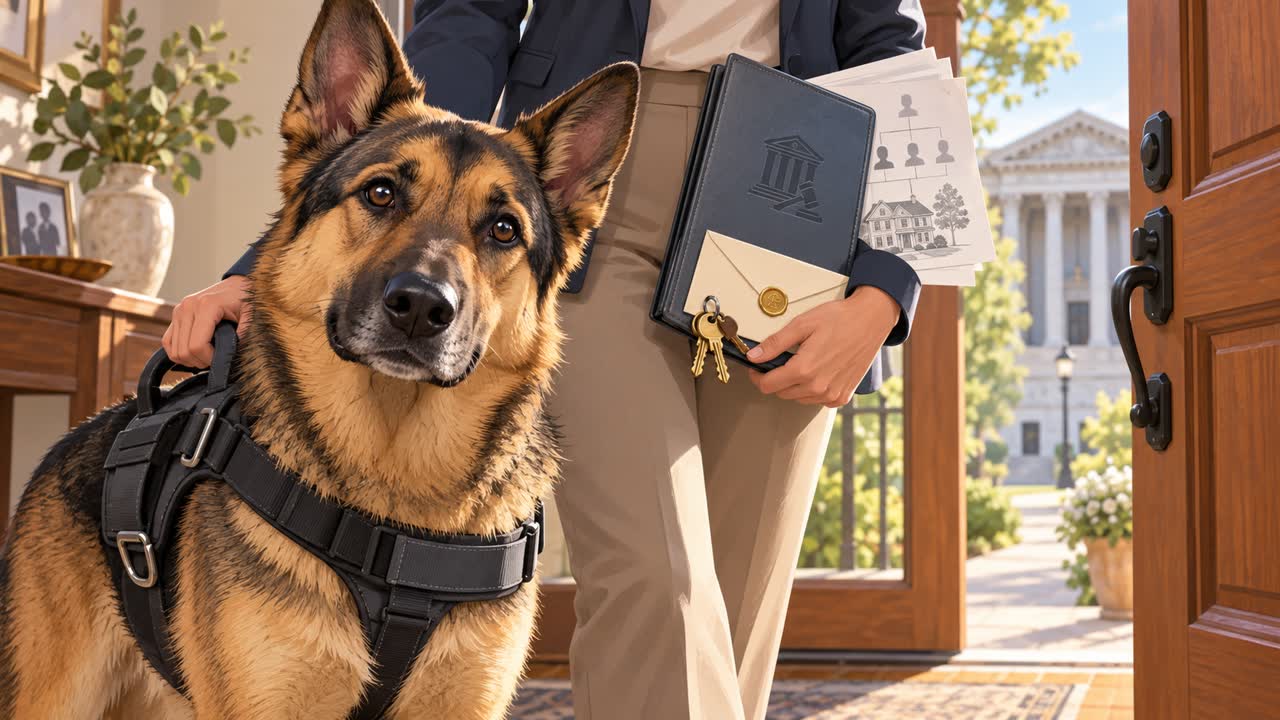
Bringing a service dog to probate court hearings usually requires planning with the court’s accessibility contact because courthouses use security screening, courtroom conduct rules, and local accommodation procedures. A person with a disability may request equal access without making purchased certification or registration the focus.
Contact the court before the hearing when possible. Confirm the accessible entrance, screening process, courtroom location, relief options, expected waiting time, and whether a separate accommodation request is required.
This guide covers practical access for parties, witnesses, beneficiaries, fiduciaries, and observers in U.S. probate proceedings. It does not provide advice about estates, guardianships, conservatorships, wills, trusts, or courtroom strategy.
Quick Overview
- Contact the court’s accessibility coordinator or clerk before the hearing.
- Confirm security screening, entrances, elevators, seating, and access to relief.
- Describe the accommodation needed without disclosing unnecessary medical details.
- Keep the dog controlled and clear of courtroom aisles, counsel tables, and evidence.
- Plan for delays, recesses, testimony, and unexpected schedule changes.
- Ask for a written response if an access request is denied or modified.
1) Plan for a Service Dog at Probate Court Hearings
Start with the court’s official website or clerk’s office and identify the accessibility or ADA coordinator. Explain that you use a service dog because of a disability and need the dog with you during the hearing and related waiting periods.
Ask practical questions:
- Which entrance provides accessible access?
- How will the dog pass through security?
- Where is the assigned courtroom?
- Is there a suitable relief area nearby?
- How early should the team arrive?
- Who should be contacted if a problem arises?
General service-animal information is available through the Knowledge Center, but local court instructions control scheduling and building procedures.
2) Use the Court’s Accommodation Process
State and local courts are generally government services rather than ordinary private businesses. Their disability-access duties and request procedures may therefore differ from the rules used by a store, hotel, or restaurant.
A court may use an accommodation form or require requests to reach a designated official by a stated deadline. Follow those instructions when they are accessible, but contact the court promptly if the hearing is scheduled too soon or an urgent probate matter leaves little time to prepare.
Describe the requested change clearly: permission for the service dog to accompany you through security, waiting areas, and the courtroom; appropriate floor space; and breaks if needed for disability access or the dog’s care.
The public access guide offers useful background, but confirm courthouse access through the court’s own procedures and applicable government-access law.
3) Prepare for Courthouse Security
Call ahead to ask how the dog’s leash, harness, medication, water, and other necessary supplies will be screened. Arrive early enough to complete security without missing check-in or the hearing.
Security staff may direct the handler and dog through a particular checkpoint or inspect equipment according to courthouse rules. Tell staff before screening if a disability affects the ability to stand, remove equipment, use a standard detector, or follow a particular instruction.
Do not treat a vest, purchase certificate, registry entry, or ID card as the sole measure of access. Optional identification may provide organization or peace of mind, but trained disability-related work, controlled behavior, and the applicable accommodation process remain central.
A voluntary service check may help organize task information before the visit. It is not government approval and does not replace communication with the court.
4) Choose a Safe Courtroom Position
Ask where the dog can settle without blocking an aisle, exit, wheelchair space, clerk’s work area, witness path, counsel table, or access to exhibits. A wall-side or end position may provide sufficient floor space while keeping the dog close enough to perform its tasks.
If the handler must approach the bench, witness stand, or lectern, decide in advance whether the dog will move with the handler. The dog generally should not be handed to court staff or left unattended.
Keep the leash and equipment clear of chairs, cables, rolling carts, document boxes, and other participants. Do not allow the dog to approach jurists, witnesses, attorneys, family members, or other animals unless a trained task requires controlled movement.
A structured behavior screening may help identify skills to practice around security sounds, crowded hallways, prolonged settling, and sudden movement. It is not legal certification.
5) Plan for Waiting, Testimony, and Breaks
Probate calendars can run late, and a short hearing may follow a long wait. Give the dog an appropriate relief opportunity before entering and bring water, waste bags, necessary medication, and a compact resting mat if permitted.
Ask how to request a recess if the handler experiences a disability-related need or the dog requires urgent care. A lawyer can raise the issue for a represented party, while a self-represented person can ask the clerk or judicial officer depending on local procedure.
If the dog performs a visible alert during testimony, respond to the trained task and inform the court briefly if a pause is necessary. Private medical details generally need not be announced in open court merely to explain that an accommodation is being used.
Probate matters may be emotional and contentious. Other participants should not pet, call, photograph, feed, or deliberately distract the dog.
6) Respond to Denial or Courtroom Concerns
If access is denied or limited, ask which official made the decision, the reason, and whether an immediate review process exists. Request a written response when feasible, especially if the proposed alternative would prevent meaningful participation.
A remote appearance, a different courtroom, a revised seating location, or a schedule change may sometimes be effective. Evaluate an alternative against the person’s actual access need rather than impose it only because bringing the dog is inconvenient.
The court may address a dog that is out of control, not housebroken, or creating a specific safety problem. Assess a brief trained alert in context; repeated disruption the handler cannot control may require removal and another means of participation.
Record dates, names, requests, responses, and alternatives offered. For unresolved issues, consider help from the court’s accessibility office, a disability-rights organization, or qualified counsel. Do not miss a hearing or filing deadline while pursuing an access complaint; ask promptly how to protect participation.
FAQs
Can I bring a service dog at probate court hearings?
Generally, a person with a disability may request to attend with a service dog. Contact the court’s accessibility coordinator or clerk because local procedures, security, and courtroom arrangements vary.
Must I notify the court in advance?
Advance contact is strongly recommended and may be required by a local accommodation procedure. If advance notice is impossible, contact the court as soon as practicable.
Can courthouse staff require certification?
A purchased certificate, registry entry, vest, or ID card does not by itself determine access. Optional identification may aid organization, but the court should use its applicable disability-access process.
Can the dog accompany me to the witness stand?
That depends on the handler’s needs, courtroom layout, and the judicial officer’s directions. Raise the issue in advance so staff can arrange a safe position and route.
What if the hearing runs late?
Bring basic care supplies and identify a relief location. Ask the clerk how to request a brief recess without losing your place or missing the case call.
Can another party object to the dog?
Another participant may raise a concern, but the court should address specific access, allergy, fear, or safety issues through an individualized process rather than assumptions.
What if the court offers remote attendance instead?
Remote participation may be effective for some people, but it should be assessed against the person’s needs, the hearing’s requirements, and whether it provides meaningful participation.
Sources
- ADA.gov: Businesses Open to the Public
- ADA.gov: Service Animals
- ADA.gov: Service Animals FAQ
- CDC: Dogs
- CDC: Pet Travel Safety
- U.S. DOT: Service Animals
Takeaway
Courthouse access works best when the handler confirms the local accommodation process, security plan, courtroom position, and break procedure before the hearing.
- Contact the court early and describe the specific access needed.
- Prepare for screening, delays, testimony, and safe courtroom positioning.
- Request prompt review if a restriction would prevent meaningful participation.