
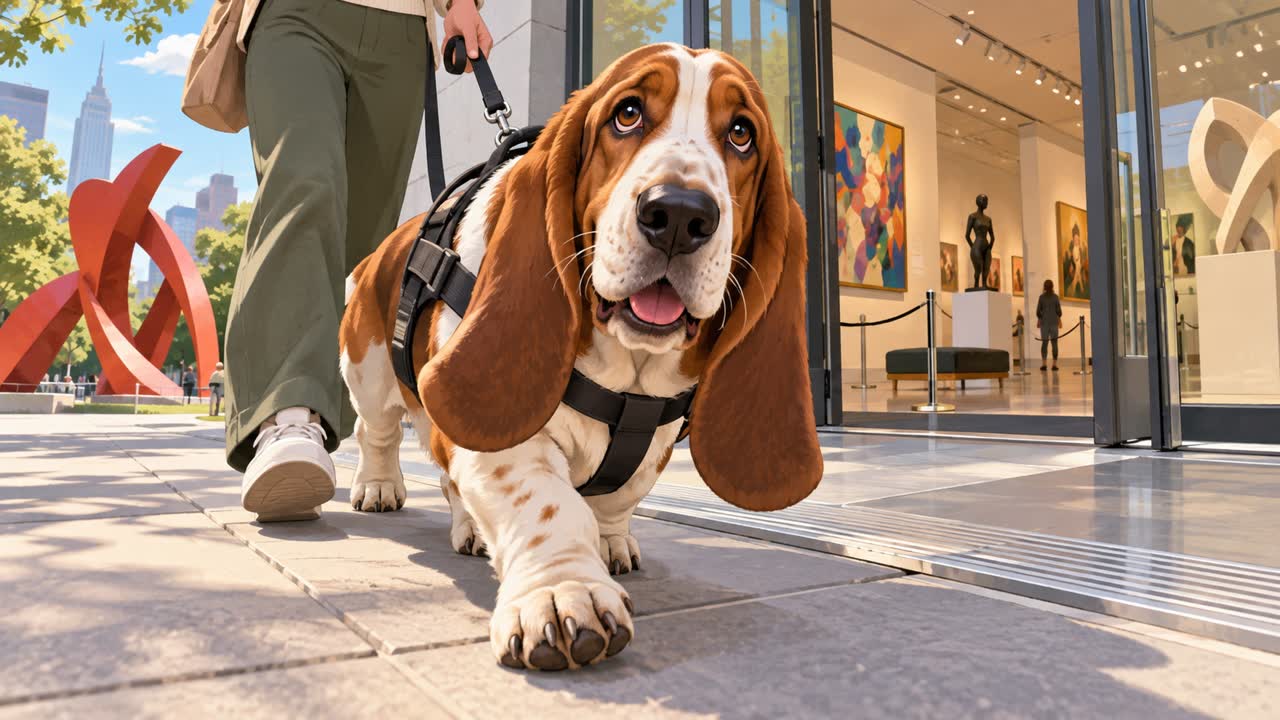
A service dog at museum locations may generally accompany its handler through public visitor areas when the dog meets the Americans with Disabilities Act (ADA) definition. A museum should not apply its no-pets policy to a qualifying service dog simply because it displays valuable objects, operates timed entry, or offers guided tours.
Museums do present practical challenges that differ from an ordinary store: quiet galleries, narrow exhibit paths, low lighting, crowds, interactive displays, security screening, and rooms with closely spaced artifacts. A little planning helps protect the dog, the collection, and every visitor’s access.
This guide addresses U.S. museums open to the public. Staff-only collection areas, food-preparation spaces, animal exhibits, and special preservation zones may require separate safety analysis.
Quick Overview
- A qualifying service dog may generally enter visitor-accessible museum areas.
- Staff may ask two limited questions when the dog’s service role is not apparent.
- A vest, purchase certificate, registry entry, or ID card is generally not required.
- Plan a controlled resting position that does not block exhibits or walkways.
1) Plan for a Service Dog at Museum Visits
Review the museum’s visitor information before arrival. Check timed-entry rules, bag policies, accessible entrances, parking, elevators, security screening, gallery maps, and whether a nearby relief area is available.
Contact guest services in advance when the visit involves a long guided tour, a special exhibition, a school group, a crowded event, or an unfamiliar building. Advance notice often helps with logistics, although a routine public-access visit generally should not depend on approval of a service dog.
Give the dog an appropriate opportunity to relieve itself before entering. Bring water, waste bags, needed medication, and any equipment for normal tasks. The rules guide provides general legal context, but a safe visit depends on the actual layout and conditions.
2) Answer Museum Staff Questions Briefly
When the dog’s role is not apparent, staff at a covered museum may generally ask whether the dog is required because of a disability and what chores it has been trained to perform. The handler can answer without naming a diagnosis or providing detailed medical information.
A concise answer may be: “Yes, this dog is required because of a disability and is trained to [brief task description].” Staff generally should not require a task demonstration or make admission depend on a particular vest, purchased certificate, registry record, or identification card.
Optional identification may provide organization or peace of mind, but it does not replace trained disability-related work and controlled behavior. A voluntary service screening may help organize task information, but it is not government approval or a guarantee of access.
If a front-desk employee is uncertain, ask for a manager or accessibility contact. Keep the discussion focused on the dog’s current conduct and the visitor’s access needs rather than arguing about commercial paperwork.
3) Navigate Galleries and Exhibit Routes Safely
Choose routes with enough clearance for the handler, dog, mobility equipment, and other visitors. In narrow galleries, keep the dog close beside or slightly behind the handler so it does not brush against cases, ropes, pedestals, or other guests.
Watch for hazards that are common in exhibit spaces:
- Low barriers, display bases, cables, and projection equipment.
- Dim lighting, reflective floors, stairs, ramps, and uneven historic surfaces.
- Sudden audio, moving images, smoke effects, or interactive displays.
- Children moving quickly around exhibits or gathering near a guide.
- Security staff, carts, maintenance work, and temporary exhibit construction.
The dog should not sniff artifacts, climb onto benches, touch display cases, or enter roped-off areas. If the dog performs a trained retrieval or guiding task, the handler should maintain enough control to avoid contact with museum property.
The public access guide explains the general difference between a qualifying service dog and a pet, while a museum may still protect areas that are genuinely closed to visitors.
4) Handle Tours, Programs, and Crowded Events
A guided tour may involve standing in one location, moving through tight exhibit paths, or gathering around a case. Tell the guide the dog is working, and request a spot with enough floor space if the group will stay in a room for an extended discussion.
For lectures, films, demonstrations, or children’s programs, position the dog where it can settle without blocking exits, aisle seats, wheelchairs, or a presenter’s route. A wall-side or end position often makes it easier for the team to leave briefly if needed.
Staff and visitors should not pet, call, photograph, feed, or distract the dog. A brief statement such as “The dog is working; please give us space” is usually enough. Museum staff can help redirect repeated interference.
If a particular program includes live animals, theatrical effects, loud music, food service, or a very crowded temporary exhibit, ask whether another viewing time, route, seating location, or equivalent experience is available.
5) Address Preservation, Safety, and Animal Exhibits
A museum may enforce neutral rules that protect collections, staff, visitors, and animals. For example, a historic house may limit entry to a fragile room where no visitor can safely go, or a zoo-like exhibit may restrict animals from approaching sensitive species.
Base any restriction on the specific environment and apply it through an individualized assessment. A museum should not exclude the dog from broad visitor areas merely because it has valuable collections or because some staff members are unfamiliar with service-animal rules.
Ask whether the dog can remain with the handler just outside a restricted room while staff provides an equivalent interpretation, video, alternate route, or other meaningful access. The right arrangement depends on the site, the dog’s trained tasks, and the reason for the restriction.
A structured behavior check may help identify skills to practice in crowds, during long settling periods, in low-light environments, and around unexpected sounds. It is not legal certification or a substitute for responsible handling.
6) Respond to Allergies, Fear, or Behavior Concerns
Another visitor’s allergy or fear does not automatically justify excluding a service dog. Museum staff can consider distance, alternate seating, a different tour position, staggered entry, or another practical measure that allows both visitors to participate.
The dog should remain under control throughout the visit. Under ADA public-access principles, a museum may generally require removal if the dog is not housebroken or is out of control and the handler does not take effective action.
Evaluate a brief trained alert, controlled repositioning, or a quiet task response in context. Repeated barking, lunging, roaming, or interference with visitors or exhibits may require the handler to leave with the dog and discuss a safe alternative.
If access is denied, ask for the specific reason and request a manager review. Document the date, location, staff involved, observed conduct, and alternatives offered. Serious unresolved disputes may warrant contacting museum management, a disability-rights organization, an appropriate government agency, or qualified counsel.
FAQs
Can I bring a service dog at museum locations?
Generally, yes. A qualifying service dog may accompany its handler in visitor-accessible areas of a covered museum, subject to limited conduct- and safety-based exceptions.
Can a museum require certification or registration?
A purchased certificate, registry entry, vest, or ID card is generally not required for ADA public access. When the dog’s role is unclear, staff may ask two limited questions about disability-related need and trained work.
Can the dog join a guided museum tour?
Generally, yes, if the dog can remain controlled and safely positioned. Ask the guide for enough floor space and a workable route through crowded or narrow areas.
Can a museum exclude the dog from a special exhibit?
A specific restriction may be appropriate when safety, preservation, or animal-welfare concerns require it. The museum should consider meaningful alternatives rather than imposing a blanket exclusion.
What if another visitor is afraid of dogs?
Staff should consider practical arrangements such as distance, different seating, alternate tour positions, or staggered movement rather than automatically excluding the service dog.
Sources
- ADA.gov: Businesses Open to the Public
- ADA.gov: Service Animals
- ADA.gov: Service Animals FAQ
- CDC: Dogs
- CDC: Pet Travel Safety
- U.S. DOT: Service Animals
Takeaway
A successful museum visit combines equal access with careful positioning, respectful gallery behavior, and planning for the building’s real safety and preservation needs.
- Confirm practical details such as entry, screening, routes, and relief access.
- Keep the dog clear of exhibits, narrow paths, food, and other visitors.
- Address concerns through specific facts and workable alternatives rather than blanket pet rules.