
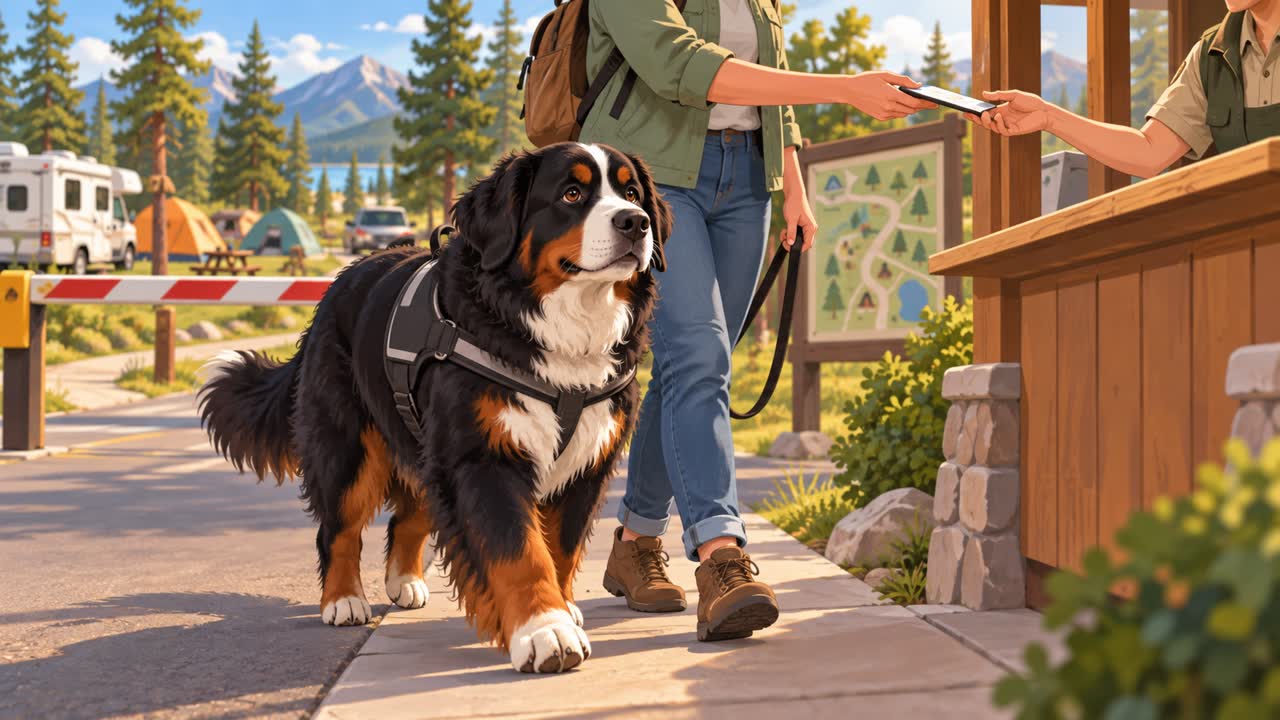
Bringing a service dog at campground check-in is generally permitted when the campground is covered by the Americans with Disabilities Act (ADA) and the dog performs trained disability-related work or tasks. A campground should not treat a qualifying service dog as a pet simply because its rules restrict pets.
Check-in is the best time to confirm campsite access, relief and waste-disposal options, wildlife warnings, shared-facility routes, and any areas with specific safety restrictions. The handler remains responsible for controlling and caring for the dog throughout the stay.
This guide focuses on arrival and on-site planning. It does not cover emotional support animals, air travel, or long-term housing accommodations, which may involve different legal standards.
Quick Overview
- Keep the check-in conversation focused on the dog’s trained work and practical campsite needs.
- Staff may ask two limited questions when the dog’s role is not apparent.
- A vest, certificate, registry entry, or ID card is generally not required for ADA public access.
- Ask about relief areas, waste disposal, wildlife, water safety, and emergency routes.
1) Prepare for Service Dog at Campground Check-In
Review the campground’s map and reservation details before arriving. Identify the check-in office, campsite type, parking arrangement, accessible routes, restrooms, showers, food-storage rules, and the distance to emergency services.
Pack the dog’s normal food, potable water, bowls, waste bags, leash or harness, medications, bedding, paw-care supplies, and veterinary contacts. Bring enough supplies for delays or an unplanned extension of the stay.
Call ahead if the campground is remote, gated, seasonal, or known for significant wildlife activity. Ask whether water is potable, whether fires or extreme weather have affected the property, and whether any trails or facilities are temporarily closed.
The knowledge hub provides broader information about service-animal travel and public settings, while the campground should provide current, site-specific conditions.
2) Handle the Check-in Conversation Clearly
If the dog’s role is not apparent, campground staff may ask whether a disability makes the dog necessary and what work or task it has been trained to perform. The handler can answer briefly without naming a diagnosis or providing a full medical history.
Staff generally should not require the dog to demonstrate its task or make access depend on a particular vest, purchased certificate, registration, or ID card. Optional identification may help with organization or peace of mind, but it does not replace trained work and controlled behavior.
A concise response might be: “Yes, this is a service dog required because of a disability. The dog is trained to [briefly describe the task].” A voluntary service check may help organize task and readiness information, but it is not government approval or an access guarantee.
Ask staff to distinguish service-dog requirements from pet rules. Confirm any necessary arrangements in writing when a misunderstanding could affect the reservation.
3) Confirm Campsite and Shared-Facility Access
A qualifying service dog may generally accompany its handler in campground areas open to guests, including the assigned campsite, registration office, shared paths, restrooms, and other guest facilities. Access does not automatically extend to staff-only maintenance buildings or locations closed to every camper.
Ask whether the assigned site has steep terrain, loose gravel, open drainage, low branches, standing water, or limited shade. If those conditions create a disability-related barrier, request an effective alternative when available.
In shared facilities, keep the dog clear of doorways, narrow aisles, food-contact surfaces, and other guests’ personal space. A campground may identify a specific safety restriction, but it should be based on actual conditions, not a general no-pets policy.
The ADA baseline is summarized in the public access rules. Federal, state, tribal, or local requirements may also affect particular public lands and facilities.
4) Plan for Wildlife, Insects, and Environmental Hazards
Campgrounds can expose a service dog to risks that do not exist in ordinary indoor settings. Ask about bears, coyotes, snakes, toxic plants, harmful algae, ticks, porcupines, and other local hazards. Follow food-storage and waste rules even when the dog is actively working.
Do not allow the dog to chase, approach, or investigate wildlife. Keep food, treats, medication, and scented care products secured according to campground instructions. Clean up waste promptly and use designated disposal points.
Check the dog regularly for ticks, burrs, thorns, paw injuries, overheating, and equipment rubbing. Avoid untreated standing water and do not assume that streams, lakes, or campsite taps are safe for drinking.
Weather can change quickly. Protect the dog from hot surfaces, severe cold, smoke, storms, and prolonged exposure. A tent or vehicle can become dangerously hot, so do not leave the dog unattended in unsafe conditions.
5) Manage Other Dogs, Noise, and Campsite Conduct
Neighboring campsites may include pets, children, generators, cooking smells, and late-night activity. Position the service dog where it can work without entering another campsite or becoming tangled in chairs, tent lines, or cooking equipment.
The dog should remain housebroken and under control. A leash, harness, or tether is generally expected unless the handler’s disability prevents its use or it interferes with the dog’s work. In that case, maintain control through voice commands, signals, or another effective method.
A service dog does not need to greet other dogs. Ask owners to keep their animals at a distance, and use a different path or departure time if an uncontrolled dog creates a risk. Report repeated problems to campground staff rather than allowing the situation to escalate.
A campground may generally require removal if the dog is out of hand and the controller does not take effective action, or if the dog is not housebroken. When feasible, the handler should still be offered campground services without the dog.
6) Prepare for Emergencies and Disputed Access
Record the campground address, campsite number, ranger or manager contact, nearest medical facility, and veterinary emergency options. In remote areas, identify locations with reliable phone service and decide how a caregiver could reach the dog if the handler were transported.
If access is denied, ask for the specific reason and whether a manager can review the decision. Keep the reservation confirmation, written policies, names of staff involved, and notes about alternatives discussed. Avoid framing the issue around paperwork; focus on the dog’s trained role and actual behavior.
If the trip includes commercial air travel, review current flight rules separately because airline procedures differ from campground access standards.
For a serious unresolved dispute, consider contacting the managing agency, an appropriate disability-rights organization, or qualified counsel. Immediate safety concerns involving wildfire, severe weather, wildlife, or medical emergencies should take priority over continuing an on-site access disagreement.
FAQs
Can I bring a service dog at campground check-in?
Generally, yes, when the campground is covered by applicable disability-access law and the dog performs trained disability-related work or tasks. Some public lands or specialized facilities may have additional rules.
Can the campground require a certificate?
A purchased certificate, registration, vest, or ID is generally not required for ADA public access. Staff may ask the two permitted questions when the dog’s role is not apparent.
Can the campground charge a pet fee?
A covered business generally should not charge a pet fee merely because a qualifying service dog is present. The handler may still be responsible for actual damage under policies applied consistently to guests.
Must the dog stay in a pet-designated campsite?
Not automatically. A service dog should not be treated as a pet, although the campground may address specific safety, sanitation, or operational conditions through an individualized approach.
Can the dog accompany me into shared restrooms?
Generally, the dog may accompany the handler in guest areas, including shared restrooms, as long as it remains controlled and does not obstruct other users.
What if another camper’s dog is aggressive?
Create distance, avoid confrontation, and report the problem to campground staff. Do not require the service dog to interact with an unfamiliar animal.
Sources
- ADA.gov: Service Animals
- ADA.gov: Service Animals FAQ
- CDC: Dogs
- CDC: Pet Travel Safety
- HUD: Information for Persons with Disabilities
Takeaway
A smooth campground arrival depends on a concise access conversation and careful planning for terrain, shared facilities, wildlife, weather, and emergencies.
- Separate service-dog access from pet policies during check-in.
- Confirm arrangements for relief, waste, water, wildlife, and emergencies.
- Keep the dog controlled and prepared for outdoor hazards throughout the stay.