
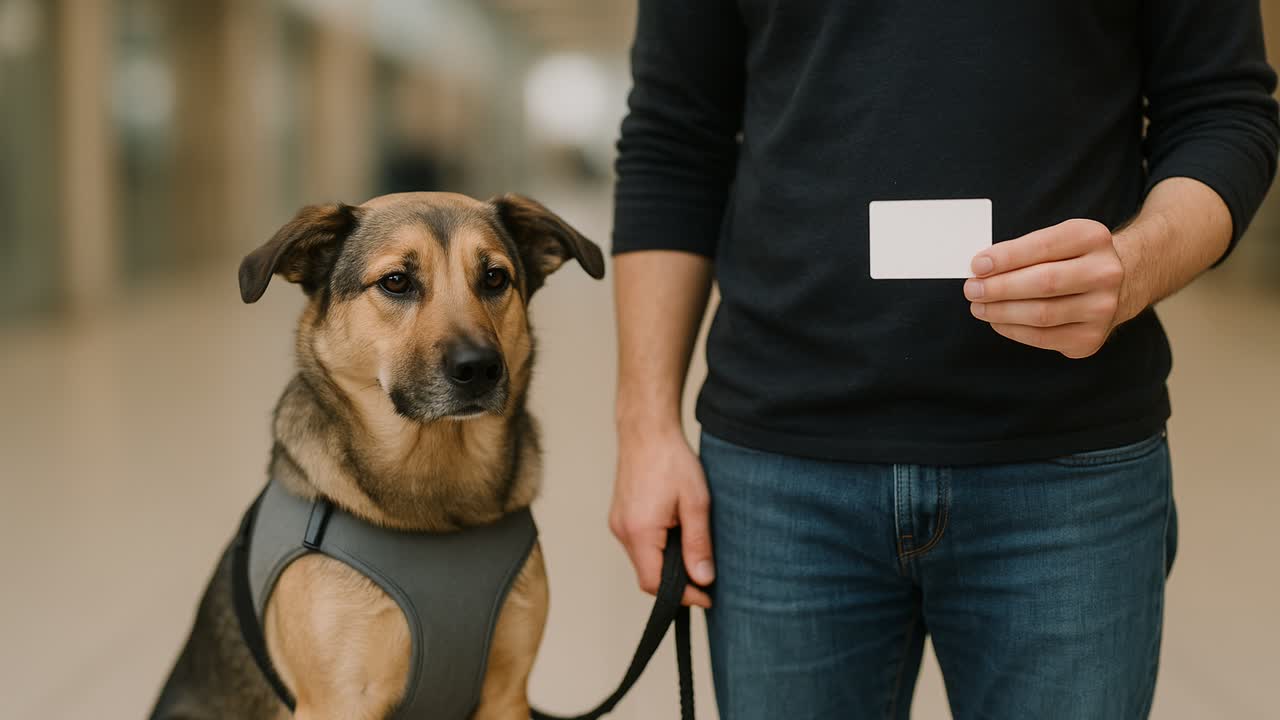
When you see a handler with a vest, patch, or card for a service dog, it can be hard to tell whether the documentation is legitimate or improvised. This article explains practical differences between commonly used service dog ID materials and counterfeit or misleading items, so handlers, business staff, and travelers can make sensible decisions that reduce delays and disputes.
Quick Overview
Many handlers use IDs, vests, or credentials to identify a working dog and make interactions smoother. At the same time, a growing market of commercially produced “service dog” cards and kits has created confusion. Focus first on behavior — a well-trained service dog works calmly and attentively — and then look at supporting items. Use documentation and ID as tools to help avoid delays: they are commonly requested by businesses, airlines, and security staff, even when other verification steps are also used.
1. What Legitimate-Looking IDs and Kits Usually Include
Real service dog handlers often carry one or more of the following items to make public access easier:
- A photo ID card for the handler showing the handler’s name and a photo (less common, but sometimes used by large programs).
- A small card or letter from a provider or trainer describing the dog’s role or training status.
- A harness, vest, or patch that clearly labels the dog as working (e.g., “Service Dog,” “Medical Alert”).
- Contact information for a trainer, organization, or the handler in case of questions.
These items vary widely in appearance. What makes them practical is clarity and consistency: readable text, a recent photo if present, and a handler who can describe the dog’s tasks calmly and briefly.
2. How Fake or Misleading Cards and Kits Differ
Fake or misleading items tend to prioritize style over substance. Warning signs include:
- Overly official-looking seals or government logos (which may be fabricated).
- Claims of official certification, national registration, or “licensed” status presented as legal proof rather than informational.
- Mass-produced kits that promise instant certification in exchange for a single purchase.
- Inconsistent or generic information (no handler name, no recent photo, stock images, or vague organization names).
These items can create the appearance of legitimacy without backing from training, behavioral reliability, or reputable providers. Staff and handlers should treat them as possible aids rather than definitive proof.
3. Behavior and Handlers: The Strongest Indicators
Behavior is the single most important cue. A genuine working dog typically:
- Is under the handler’s control (on a leash or harness and responsive to cues).
- Remains calm, focused, and unobtrusive in public spaces.
- Performs or demonstrates the task when asked in a simple way (if demonstration is appropriate and safe).
Conversely, a dog that is distracted, aggressive, or out of control is the main operational concern regardless of any card or vest. When assessing legitimacy, prioritize safety and the dog’s behavior over paperwork appearance.
4. Practical Checking Steps for Businesses and Staff
When staff need to verify a working dog while avoiding confrontation, consider this practical approach:
- Ask only two permissible, task-focused questions: (a) Is the dog required because of a disability? and (b) What work or task does the dog perform? Keep questions brief and neutral.
- Observe the dog’s behavior; a calm, focused dog that stays with its handler is a positive sign.
- Use ID materials as helpful context — readable cards, a trainer’s contact, or a visible harness — to reduce back-and-forth — but don’t treat a card as the only proof.
- If uncertainty remains and access is a safety concern, follow your organization’s policies on refusal or conditional access, and document the interaction professionally.
5. Travel and Airport Screening Practicalities
Airlines and airports often ask for documentation or advance notice to streamline screening. Many handlers find that having clear, concise materials reduces confusion and speeds processing. For step-by-step guidance on preparing for airport screening with a service dog, see our airport screening guide.
When you travel, bring recent photos of the dog, any trainer letters you rely on, and plan for extra time at security checkpoints. These habits are commonly recommended by experienced travelers and handlers to prevent last-minute delays.
6. Training, Memberships, and Third-Party Providers
Memberships in reputable training programs, letters from licensed professionals, or documented training milestones are useful supporting items. For guidance on training a service dog and common training milestones, see our short guide on how to get your dog trained.
Be careful with services that promise instant certification or national registry entries in exchange for a fee. Practical, trustworthy providers focus on behavior, public access readiness, and ongoing training rather than one-time paperwork.
FAQs
- Q: Does an ID card guarantee a dog is a real service animal?
- A: No single item guarantees authenticity. Cards and vests are helpful for identification and are commonly requested, but behavior and the handler’s brief answers about tasks are clearer indicators of a working dog.
- Q: Can a business ask to see documentation?
- A: Businesses often request documentation to reduce confusion and manage safety. In many practical situations, clear supporting materials and calm behavior make interactions smoother. Use only brief, task-focused questions when verifying.
- Q: Are there reputable ID providers?
- A: Reputable providers emphasize training, behavior, and clear records. If a provider’s service centers on selling immediate credentials without behavioral assessment, treat that offering with caution.
- Q: What should handlers carry to avoid delays?
- A: Recommended items include a recent photo of the dog, a short trainer letter or document describing the dog’s tasks, and a clear harness or patch. These items are commonly requested and help reduce back-and-forth during checks.
Sources
- Overview, resources, and guidance on service animals: Knowledge center.
- Training and preparation resources: Training guide.
- Public access and etiquette guidance: Service dog etiquette.
- Travel and screening guidance: Airport screening guide.
Takeaway
Cards, vests, and certificates can be useful tools to reduce delays, but they are part of a bigger picture. Prioritize the dog’s behavior, and the handler’s clear, task-focused answers. Use concise documentation to smooth encounters, choose reputable trainers and providers, and prepare for travel or public access interactions to avoid the common complications that arise from poorly produced or misleading credentials.