
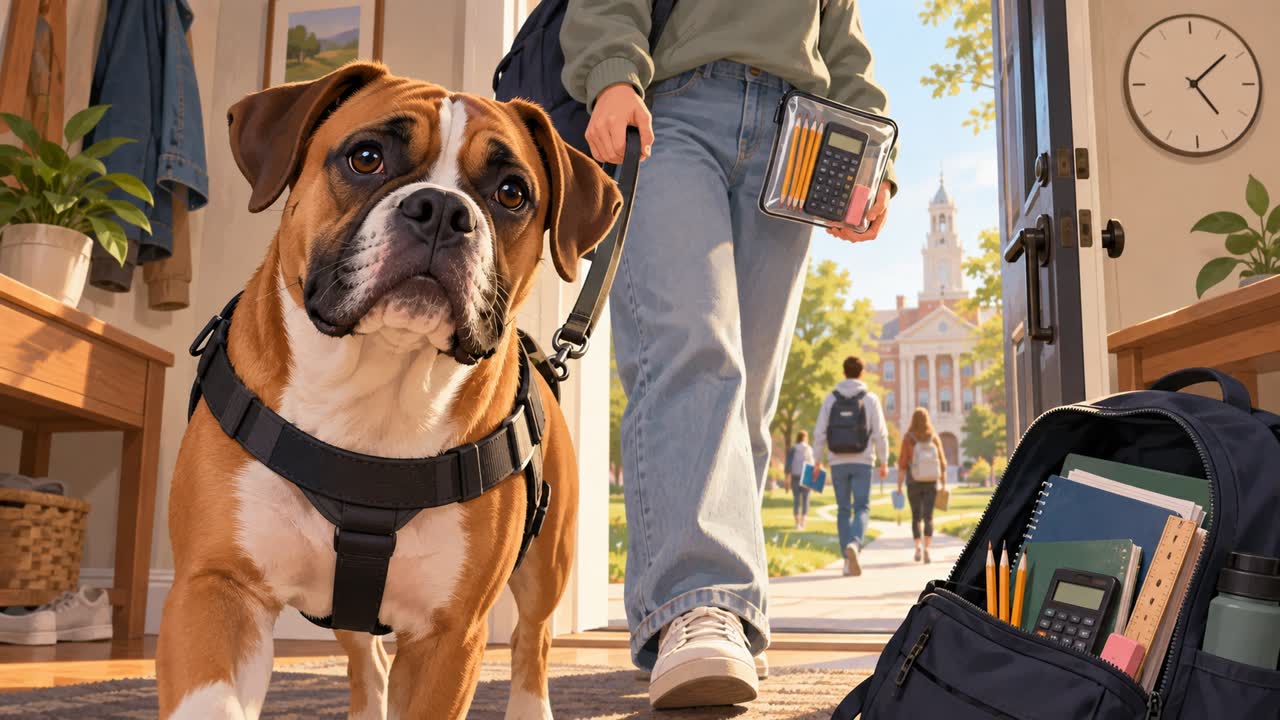
Bringing a service dog during college exams is generally permitted when the dog meets the Americans with Disabilities Act (ADA) definition and remains under control. The dog may usually accompany the student into classrooms, testing centers, and other areas where the student is allowed to go.
Exam-day access is different from academic testing accommodations such as extra time, reduced-distraction seating, breaks, or assistive technology. A service dog’s presence generally concerns disability access, while changes to exam conditions may require a separate request through the college’s disability services process.
Early coordination can prevent last-minute confusion about seating, dog placement, relief breaks, security procedures, and what a proctor may ask.
Quick Overview
- A qualifying service dog may generally accompany a student into an exam room.
- The dog must be trained to perform disability-related work or tasks.
- Colleges generally cannot condition public access on a special vest, ID, certificate, or registry.
- The student should contact disability services before high-stakes or unfamiliar exams.
1) Access for a Service Dog During College Exams
Public colleges are generally covered by ADA rules for state and local government entities, while private colleges open to the public are generally subject to ADA public-accommodation requirements. Other federal, state, or local disability laws may also apply.
A service dog may generally enter an exam location with its handler if students are ordinarily allowed in that space. This can include a classroom, lecture hall, disability testing center, or check-in area. Access should not depend on whether the college has a pet-friendly policy because an ADA-covered service dog is not treated as a pet.
There can be limited exceptions in areas where a dog would create a legitimate safety concern or fundamentally alter the program. Any restriction should be based on actual conditions in the specific location, not generalized assumptions about dogs. The applicable public access rules provide a useful starting point.
2) Contact Disability Services before Exam Day
A student does not necessarily need to seek permission each time a service dog enters an ordinary campus space. Still, advance communication is practical when an exam involves assigned seating, security screening, laboratory conditions, clinical facilities, or a third-party testing center.
Contact the disability services office or exam coordinator and explain that a trained service dog will accompany you. Ask about:
- The room layout and assigned seat.
- Space for the dog to settle safely.
- Check-in and security procedures.
- Permitted relief breaks and the nearest relief area.
- Emergency alarms and evacuation routes.
- How concerns from other test takers will be managed.
Keep the message focused on logistics. General background from the Knowledge Center may help a student prepare, but the college remains responsible for applying the rules to its own testing environment.
3) Separate Dog Access from Testing Accommodations
A service dog’s presence does not automatically grant extra time, unscheduled breaks, a private room, or modified exam procedures. If the student needs those changes, the student should follow the college’s process for academic accommodations.
For example, a dog may be trained to alert to a medical change, interrupt a disability-related behavior, retrieve medication, or provide another trained response. If responding to an alert requires leaving the room, taking medication, or pausing the exam clock, the student should discuss those procedures before the test.
The college may request appropriate disability-related documentation for academic accommodations when the need is not apparent. That process is distinct from demanding a service dog certificate as a condition of entering an ordinary exam room. A voluntary service screening may help organize task and readiness information, but it is not government approval or a substitute for the college’s accommodation process.
4) Plan Seating, Control, and Exam-Room Behavior
Choose a position where the dog can work without blocking an aisle, emergency exit, or another student’s workspace. A seat near a wall or at the end of a row may provide more settling space. The dog should usually remain on the floor unless a trained task requires another controlled position.
The ADA generally expects the dog to be harnessed, leashed, or tethered unless that equipment interferes with its work or the student’s disability prevents its use. In that situation, the student must maintain control through voice commands, signals, or another effective method.
Practice quiet settling for the expected exam duration. The dog should not wander, solicit attention, sniff other students, vocalize repeatedly, or interfere with testing materials. The student remains responsible for supervision, water, relief needs, and cleanup.
5) Understand What Proctors may Ask
When it is not obvious that the dog is a service animal, staff may generally ask two questions:
- Is the dog a service animal required because of a disability?
- What work or task has the dog been trained to perform?
A proctor generally should not ask for the student’s diagnosis, require the dog to demonstrate its task, or demand a particular ID card, registration, vest, or certificate. Optional identification can sometimes reduce confusion or provide peace of mind, but it is not always legally required and does not replace training or proper conduct.
A concise response can protect privacy: “Yes, this dog is required because of a disability and is trained to [briefly describe the task].” If staff continue the discussion in front of other students, ask to speak privately with the testing coordinator.
6) Prepare for Disruptions and Disputes
A college may generally require a dog to leave if it is out of control and the handler does not take effective action, or if it is not housebroken. If removal is justified, the student should still have an opportunity to complete the exam without the dog, subject to reasonable testing and rescheduling procedures.
Another student’s allergy or fear does not automatically justify excluding the service dog. The college should consider the needs of both students and explore solutions such as greater separation, different seating, or comparable testing rooms.
Bring the disability services office’s contact information and any written testing plan. Record significant problems factually, including the time, location, staff involved, questions asked, stated reason for a restriction, and effect on the exam. Use the college’s accessibility or grievance process promptly if the issue is not resolved.
Students living on campus should address residence-hall arrangements separately. The legal and administrative questions involved in campus housing may differ from classroom access, so review relevant housing guidance rather than assuming the exam-room process covers both settings.
FAQs
Can I bring a service dog during college exams?
Generally, yes. A qualifying service dog may accompany its handler in an exam room where the student is permitted, provided the dog remains under control and does not create a specific, legitimate safety issue.
Must I register the dog with my college?
A college generally cannot make ordinary ADA public access depend on a purchased registration or certificate. However, notifying disability services in advance can prevent logistical problems and may be necessary for separate academic accommodations.
Does the dog automatically qualify me for extra exam time?
No. Extra time and other changes to testing conditions usually require a separate academic accommodation. Discuss the functional need and requested adjustment with disability services before the exam.
Can my service dog sit on a chair during the exam?
Generally, the college does not have to allow the dog on furniture. The dog should normally remain on the floor unless another position is necessary for a trained task and can be managed safely.
What if my dog gives a medical alert during the test?
Follow your safety plan. If you may need to pause, leave the room, take medication, or receive assistance, arrange those procedures with the testing office beforehand so proctors know how to respond.
Sources
- ADA.gov: Service Animals
- ADA.gov: Service Animals FAQ
- CDC: Dogs
- CDC: Pet Travel Safety
- HUD: Information for Persons with Disabilities
Takeaway
Exam access is easier when the student separates the dog’s right to accompany them from any additional testing accommodations and confirms practical arrangements before test day.
- Coordinate seating, relief breaks, alerts, and emergency procedures early.
- Keep the dog controlled, quiet, and positioned away from aisles and other students.
- Document approved accommodations and address disputes through the college’s accessibility process.