
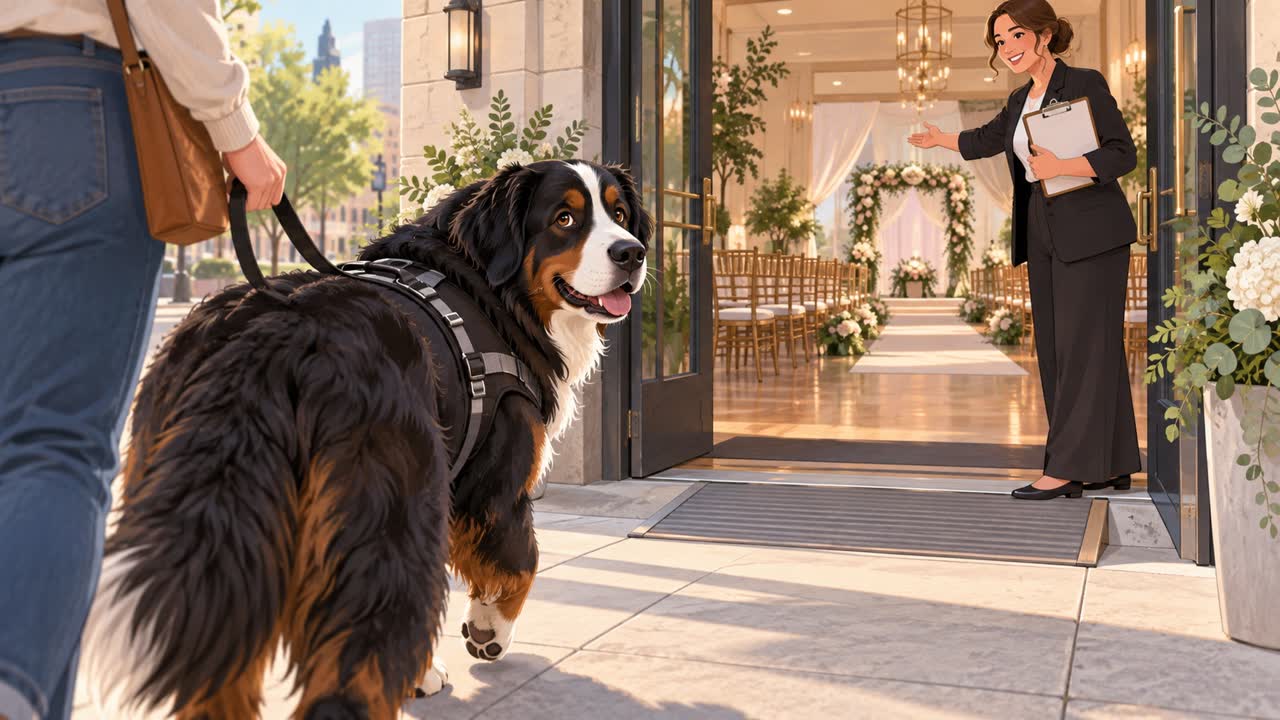
A walkthrough is the right time to identify practical concerns before the wedding day: narrow aisles, food-service zones, loud sound checks, outdoor relief areas, crowded entrances, and safe places for the dog to settle. Planning these details does not mean asking the venue to “approve” a qualifying service dog.
This guide focuses on access and logistics during a venue tour. It does not cover pets participating in a ceremony or general pet-friendly wedding policies.
Quick Overview
- A qualifying service dog may generally enter client-facing areas of a covered wedding venue.
- The venue may ask two limited questions when the dog’s role is not apparent.
- A vest, ID card, certificate, or registry listing is generally not required for ADA public access.
- The dog must remain under control and should not block aisles, exits, or staff work areas.
1) Access for a Service Dog During Wedding Venue Walkthroughs
Hotels, banquet halls, event centers, restaurants, museums, and similar commercial venues are often places of public accommodation under the ADA. A service dog may generally accompany its handler in the venue’s public and client-facing spaces.
The dog does not receive broader access than the handler. If a kitchen, maintenance room, staff corridor, construction area, or storage space is closed to clients, the service dog can usually be excluded from that area as well.
Some facilities may have different legal considerations, including certain religious organizations or genuinely private clubs. State and local laws may provide additional protections. A general public access guide can help the parties identify the applicable baseline before the tour.
2) Tell the Venue What is Useful, not Your Full Medical History
Advance notice is not always required for ordinary public access, but it can make a scheduled walkthrough smoother. A short message to the coordinator can state that a trained service dog will accompany you and ask whether any areas on the tour involve active construction, food preparation, animals, or unusual safety conditions.
If the dog’s role is not apparent, venue staff may generally ask:
- Does a disability make the presence of a service animal required?
- What task or work has the dog been trained to perform?
The handler can answer without naming a diagnosis or providing detailed medical information. Staff generally should not require a task demonstration or demand a particular certificate, registration, vest, or ID card. Optional identification may offer organization or peace of mind, but it does not replace trained tasks and controlled behavior.
Handlers who want to organize task and readiness information before meeting venue staff may use a voluntary PSA check. It is not government approval and does not guarantee access.
3) Inspect the Route from Arrival to Departure
Walk the route the handler expects to use on the wedding day. Start with parking or drop-off, then check entrances, elevators, ceremony seating, reception areas, restrooms, outdoor spaces, and the planned exit route.
Look for surfaces that may affect footing, including polished floors, gravel, temporary rugs, stairs, and wet grass. Confirm that decorative arches, floral displays, cords, candles, and signs will not narrow the route or interfere with the dog’s working position.
Ask where the dog can settle without blocking an aisle or emergency exit. An end seat, wall-side position, or space under a table may work, depending on the dog’s tasks and the room layout. The handler should keep access to the dog without placing the dog on venue furniture.
A concise rules guide may help couples and coordinators separate legal access questions from optional wedding-day preferences.
4) Plan Around Food, Noise, Crowds, and Other Animals
Wedding venues can change dramatically between a quiet walkthrough and a full event. Ask about catering carts, buffet lines, dropped food, band equipment, photography flashes, smoke effects, and crowded transitions between ceremony and reception areas.
A service dog may generally remain in dining areas, but it should stay away from food-contact surfaces and employee-only kitchens. The handler should plan a controlled position during meals and prevent the dog from eating food from the floor.
If the venue hosts animals, such as resident dogs, horses, or ceremony pets, discuss separation and routes in advance. Likewise, staff and guests should not pet, feed, call, or photograph the dog in ways that interfere with its work.
Sound checks can be especially useful. If amplification, fireworks, or other effects may affect the dog or handler, identify a quieter route or temporary retreat. The goal is not to isolate the team, but to create an effective backup plan.
5) Confirm Care, Relief, and Emergency Arrangements
The handler is responsible for supervising, feeding, watering, and cleaning up after the dog. Venue employees are not ordinarily required to walk or care for a service animal.
During the walkthrough, identify an appropriate relief area and the shortest accessible route to it. Ask whether gates will remain unlocked and whether another event could block the route. Bring water, waste bags, and any equipment needed for the expected weather.
The wedding-day plan should identify a trusted person who can assist with logistics if the handler becomes ill or temporarily cannot care for the dog. That person should understand the dog’s commands and boundaries but should not distract the dog from disability-related tasks.
Families may use a tracking app to organize contact details, task notes, relief timing, and relevant records. Such records are practical planning tools, not proof that overrides ADA requirements or venue safety rules.
6) Resolve Venue Concerns before Signing or Finalizing Plans
If the coordinator objects, ask for the specific concern. A general no-pets rule, concern about shedding, or preference for an animal-free event is not the same as an individualized safety issue involving a service dog.
If the dog is uncontrollable and the handler does not act effectively, or if the dog is not housebroken, a venue may generally ask for removal. If removal occurs, the business should still offer the handler an opportunity to receive its services without the dog.
When allergies or fear affect another person, the venue should consider workable separation rather than automatically excluding the service dog. Seating distance, separate preparation spaces, adjusted routes, or scheduling changes may address both needs.
Put agreed logistics in writing, including the relief area, ceremony seating, reception placement, emergency route, and coordinator contact. If a dispute remains unresolved, preserve emails and notes stating who made the decision, what reason was given, and what alternatives were discussed.
FAQs
Can I bring a service dog during wedding venue walkthroughs?
Generally, yes, when the venue is covered by the ADA and the dog performs trained disability-related work or tasks. The dog may usually accompany you in the same client-facing areas you are invited to inspect.
Do I need to notify the wedding venue in advance?
Advance notice is not generally required for ordinary public access, but notifying the coordinator can help address construction, food-service, animal, and seating logistics before the tour.
Can the venue ask for a service dog certificate?
A particular certificate, registration, or ID card is generally not required for ADA public access. Staff may ask the two permitted questions when the dog’s role is not apparent.
Can the dog enter the venue’s kitchen?
Not ordinarily. A service dog may generally enter customer dining spaces, but employee-only food-preparation areas that are closed to clients remain restricted.
Can the venue charge a pet fee?
A covered business generally cannot impose a pet surcharge simply because a service dog is present. It may apply its usual damage policy if the dog causes actual damage and the policy applies equally to other customers.
Sources
- ADA.gov: Service Animals
- ADA.gov: Service Animals FAQ
- CDC: Dogs
- CDC: Pet Travel Safety
- HUD: Information for Persons with Disabilities
Takeaway
A wedding venue walkthrough should confirm both lawful access and the practical details that let the service dog work safely throughout the event.
- Inspect entrances, seating, food-service zones, relief areas, and emergency routes.
- Keep access discussions focused on trained tasks, control, and actual conditions.
- Record agreed wedding-day arrangements so staff and the handler share the same plan.