
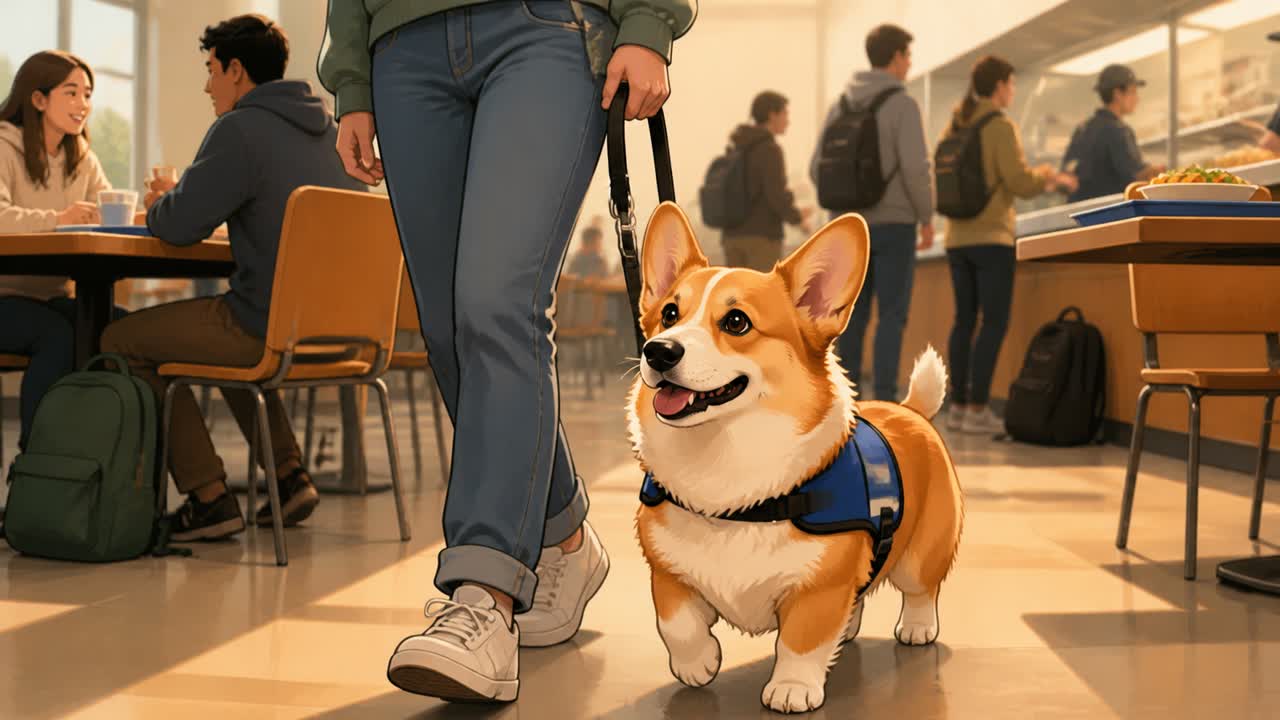
A service dog in campus dining halls is generally allowed to accompany a disabled handler into the same dining areas where students, staff, guests, or customers are allowed. The key question is whether the dog is a service animal under the ADA and whether it is under control in the dining setting.
This article focuses on dining halls, cafeterias, food courts, and meal-plan spaces on U.S. college campuses. It is not the same as housing approval, classroom accommodations, student support animal requests, pet policies, or employee workplace accommodations, though these issues can overlap on campus.
For most handlers, the best path is practical: know the basic access rule, understand the two allowed questions, keep the dog’s behavior dining-room appropriate, and work with disability services when the situation involves a student accommodation plan.
Quick Overview
- Service dogs are usually allowed in campus dining areas open to students, customers, or the public.
- Dining staff may usually ask only whether the dog’s presence is necessary because of a disability and what assignment the dog is trained to accomplish.
- Staff should not demand a certificate, ID card, registry number, medical diagnosis, or task demonstration as a condition of entry.
- Staff may remove a service dog if it is out of control, not housebroken, or creates a legitimate safety problem.
1) What a Service Dog in Campus Dining Halls can Usually Do
A service dog may usually accompany its handler through entrances, serving lines, seating areas, payment stations, drink areas, and other parts of a campus dining hall where students or guests are allowed. The dog should stay with the handler and should not sit on chairs, eat from tables, wander through the room, block traffic, or interact with other diners.
This applies whether the college runs the dining hall directly or contracts a food-service company. However, the exact legal framework can depend on whether the school is public or private and how it operates the space.
For a broader campus-access baseline, it helps to compare dining situations with a public access guide rather than treating every meal as a special exception.
2) What Dining Staff may Ask
When the need for the service dog is not obvious, staff may generally ask two questions: whether the dog’s presence is necessary because of a disability and what assignment the dog is trained to accomplish.
Good campus training for dining employees should focus on those two questions and on behavior-based concerns. Optional ID, a vest, or organized records may help a handler communicate calmly, but those items do not replace the ADA definition of a service animal.
Students who are unsure whether their dog fits the ADA definition can review a basic service check before relying on public-access rights in a dining hall.
3) Food Safety, Allergies, and Other Diners
Food safety matters, but it usually depends on where the dog is and how the dog behaves. A service dog in the customer dining area is different from a dog entering a commercial kitchen, buffet-prep area, dishwashing station, or other employee-only food-preparation space. Dining halls can usually keep service animals out of spaces where customers are not allowed.
Allergies or fear of dogs do not automatically justify excluding a service dog from the dining hall. Staff may need to make practical adjustments, such as offering separated seating when possible or helping both students use the space without unnecessary conflict. The answer should be based on access, safety, and reasonable operations, not on embarrassment or assumptions.
The dog’s conduct still matters. Barking repeatedly, lunging, begging for food, sniffing plates, jumping on people, or blocking service lines can create a real problem in a crowded dining hall. A handler who prepares for those conditions reduces friction for everyone.
4) When a Campus Dining Hall can Ask the Dog to Leave
A campus dining hall may usually ask that a service dog be removed if the dog is out of control and the handler does not take effective action, or if the dog is not housebroken. Removal should be about the dog’s behavior, not the handler’s disability or the staff member’s personal preference.
If the dog must be removed, the handler should still be offered service without the dog when feasible. For example, the dining hall might allow the student to get a meal to go, return without the dog, or work with a manager on another immediate solution. The response should solve the access issue without turning it into a punishment.
Handlers can prepare by practicing tight-line movement, settling under a table, ignoring dropped food, and moving through noisy lines. A simple behavior check can help identify weak spots before a busy dinner rush exposes them.
5) Student Documentation and Campus Disability Services
Public dining access and student accommodation files are related but not identical. A student may have ADA public-access rights in a dining hall and still need separate documentation for housing, classroom modifications, meal-plan exceptions, or other school-managed accommodations.
For students, the most useful records are usually practical and factual: a task list, training history, vaccination records where relevant, emergency contacts, and any disability-services documentation the school appropriately requests for non-public-access accommodations. A clinician’s letter may matter for some housing or academic processes, but it should not be treated as a dining-hall entry ticket.
If a dining conflict keeps happening, the student should document dates, names, what was said, what questions were asked, and how the dog behaved. Then the student can bring the issue to disability services, dining management, or student affairs with a clear record instead of a vague complaint.
6) How to Handle a Challenge Calmly
A calm script is often more useful than a stack of papers. A handler might say: “This is my service dog. He is trained to assist with a disability by performing specific tasks. He will stay under my control and out of the food-service area.” That answers the access issue without oversharing private medical information.
If the employee asks for a certificate or ID, the handler can respond politely: “I understand why you’re asking. Under ADA service animal guidance, certificates and registrations are not usually required for public access. A manager may ask the two allowed questions.”
For campus teams, a short policy page, staff training, and a consistent manager escalation path prevent most problems. The school’s goal should be predictable access, sanitary food service, and respectful handling of disability-related conversations. The knowledge hub can also help handlers and decision-makers separate dining access from nearby issues like housing, travel, and documentation.
FAQs
Can a service dog in campus dining halls go through the serving line?
Usually yes, if the serving line is open to students or customers and the dog remains under the handler’s control. The dog should not contact food, counters, utensils, or other diners.
Can the dining hall require a service dog certificate?
Usually no. Staff should not make entry depend on a certificate, registry, ID card, vest, or online listing. They may generally ask the two ADA service-animal questions when the need is not obvious.
Can non-task-trained support animals enter campus dining halls?
Not under the ADA public-access rule for service animals. A housing or campus-support request is a separate accommodation issue and does not automatically create dining-hall public-access rights.
Can a service dog sit on a dining chair?
That is usually inappropriate in a food-service setting. The dog should normally stay on the floor, under the table, beside the handler, or otherwise out of walkways and food-contact areas.
What if another student is allergic to dogs?
The school should look for a practical way for both students to use the dining space when possible. Allergies alone do not usually justify excluding a service dog from a public dining area.
Sources
- ADA.gov: Service Animals
- ADA.gov: Service Animals FAQ
- CDC: Dogs
- CDC: Pet Travel Safety
- HUD: Information for Persons with Disabilities
Takeaway
Campus dining halls should treat service dog access as a practical ADA compliance issue, not as a paperwork contest. The strongest approach is clear staff training, controlled dog behavior, and responsible record-keeping in situations where documentation actually matters.
- Dining access usually follows public-access principles in student and customer areas.
- Certificates, IDs, and registries are not usually required for entry.
- Behavior, control, and calm communication prevent most dining-hall conflicts.