
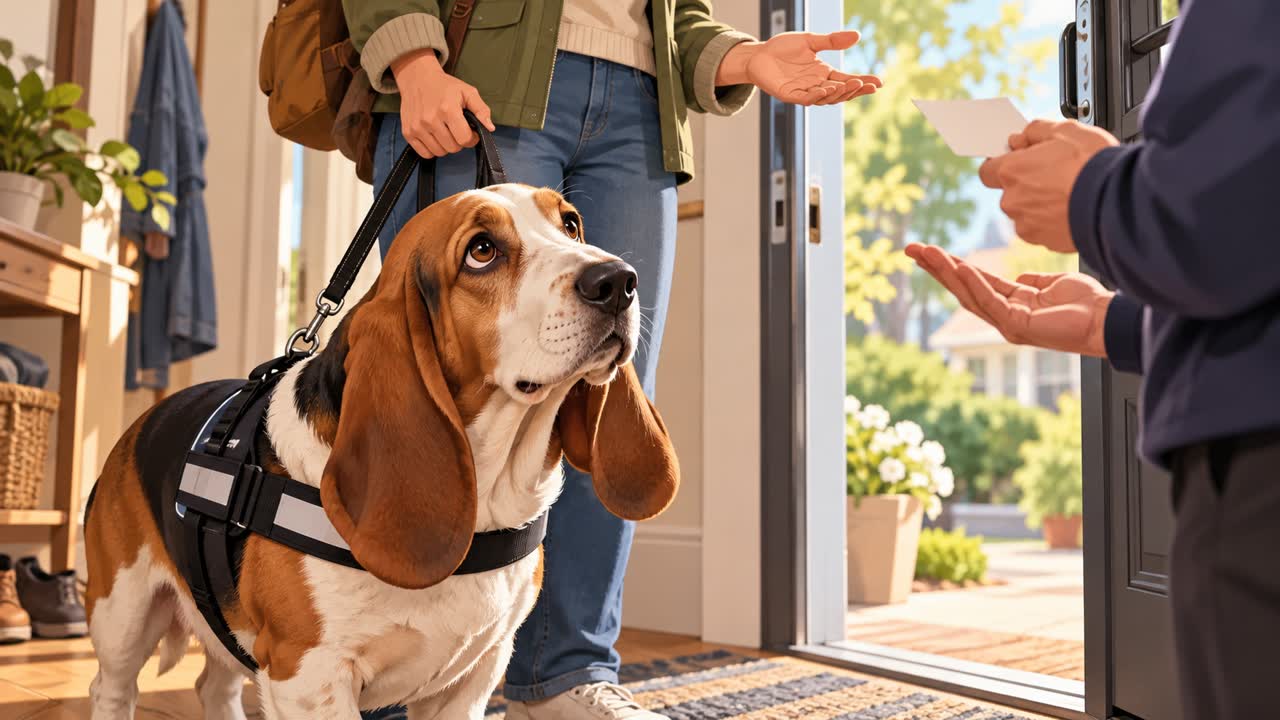
What to say when asked for service dog papers depends on where you are. In many U.S. settings, focus on the dog’s trained, disability-related work and controlled behavior, not a purchased certificate, registry listing, vest, or ID card.
Different settings follow dissimilar processes. A restaurant or store may have different rules from a workplace, apartment, airport, school, medical office, or international trip. Before responding, identify the setting and keep the conversation focused on the immediate access question.
This guide provides general U.S. educational information. It does not replace individualized legal advice, employer accommodation procedures, housing requirements, airline rules, or country-specific travel requirements.
Quick Overview
- Stay calm and answer only the questions that apply to the setting.
- In many public businesses, staff may generally ask only whether the dog is required because of a disability and what work or task it performs.
- You usually do not need to disclose a diagnosis, demonstrate a task, or provide a registry card.
- Keep the dog under control, housebroken, and clear of aisles, tables, equipment, and other people.
1) Start with a Calm Answer when Asked for Service Dog Papers
If a staff member asks for papers, begin with a short response rather than a long explanation. You might say: “This is my service dog. The dog is required because of a disability and is trained to perform a disability-related task.”
If the setting is a business open to the public and the dog’s role is not obvious, staff may generally ask two questions: whether the dog is required because of a disability and what functions the dog has been trained to perform.
Answer truthfully and briefly.
General information about service-animal rules is available through the regulations. The most useful response remains calm, accurate, and matched to the actual setting.
2) Know the Difference between Public Access and Other Settings
A restaurant, store, hotel, museum, or similar public-facing business is not the same as a workplace, apartment, school, airline, or foreign border crossing. The practical question may be access at one moment, or it may be an accommodation process that needs written information and more time.
At work, an employer may need information related to an accommodation request, particularly when a disability-related need is not obvious. At home, a housing provider may have a separate process for evaluating a disability-related animal request.
Air travel also involves separate procedures. Airlines may have current forms, advance-notice requirements, behavior standards, and route-specific rules that do not apply to a local restaurant or store. Review the relevant flight rules before traveling rather than relying on a general public-access answer.
When in doubt, ask what process they are using. A simple question such as, “Is this a public-access question or an accommodation request?” can clarify what information is actually needed.
3) Use Simple Scripts that Protect Privacy
A prepared script can help when an unexpected question creates stress. Keep it short enough to say while managing the dog, standing in a line, or moving through a busy entrance.
For a public business, you might say: “The dog is a service animal required because of a disability and is trained to perform a specific task.” If staff ask for a certificate, you might add: “I do not have a government-issued service-dog card.
If the person continues asking for personal medical information, you can redirect the conversation: “I can explain the dog’s trained task, but I do not need to discuss my diagnosis.” Keep your tone neutral and avoid escalating a misunderstanding into a public confrontation when a supervisor can help.
The public access rules provide general context for these conversations. They do not remove the handler’s responsibility to keep the dog controlled and address any actual behavior or safety issue.
4) Do not Confuse Paperwork with Readiness
A purchased certificate, registry listing, vest, or identification card may help some handlers stay organized or feel more secure. However, those items do not themselves establish public access, guarantee entry, or replace trained disability-related work.
The most reliable preparation is practical: clear task training, controlled public behavior, current veterinary care, a safe travel or access plan, and accurate information about what the dog does. The dog should be housebroken, responsive to the handler, and able to remain calm around ordinary public distractions.
A voluntary service check may help organize task and readiness information. It is not government approval, legal proof, or a substitute for an individualized accommodation discussion.
If you carry optional materials, do not present them as required legal proof. A calm explanation of the dog’s actual trained work is more credible and less likely to confuse what the law requires.
5) Address Real Behavior or Safety Concerns Directly
Being asked for papers is different from being told that the dog is blocking an aisle, barking repeatedly, jumping on someone, relieving itself indoors, or creating a specific safety issue. In those situations, focus first on correcting the immediate problem.
Move the dog to a safer position, shorten the leash, clean up a mess, create distance from another person or animal, or leave the environment if the dog cannot regain control.
Make an honest assessment after the incident. The dog may need more training, a quieter route, a shorter outing, veterinary attention, or a different handling plan. Forcing a stressed or unready dog through demanding public environments can put the handler, dog, and others at risk.
Stay focused on the individual dog’s behavior rather than trying to win an argument about paperwork. Responsible handling often resolves the immediate concern more effectively than a lengthy legal debate.
6) Document Repeated Denials or Unresolved Problems
If a staff member denies access solely because you do not have papers, ask for a manager or supervisor when it is safe to do so. State the facts briefly, avoid blocking an entrance or disrupting other customers, and keep the dog under control during the conversation.
Afterward, record the date, time, location, names or descriptions of staff involved, what was said, the dog’s behavior, and any resolution offered. Save relevant emails, written policies, receipts, or appointment confirmations.
For an ongoing workplace, housing, school, or healthcare issue, submit a written request and follow the organization’s established accommodation process. Explain the practical access need and the dog’s trained role, while sharing only information relevant to the request.
If a situation remains unresolved, consider contacting an appropriate disability-rights organization, government agency, campus office, human-resources contact, or qualified attorney. The correct next step depends on the setting and the applicable rules.
FAQs
What should I say when asked for service dog papers?
You can calmly state that the dog is required because of a disability and is trained to perform a specific disability-related task. In many public businesses, that is the relevant information when the dog’s role is not obvious.
Do I need a certificate or registration card for my service dog?
No particular purchased certificate, registry entry, vest, or ID card generally determines public access. The key issues are trained disability-related work and controlled behavior.
Can a business ask for my diagnosis?
In many public-access settings, staff may generally ask whether the dog is required because of a disability and what work or task it performs. A diagnosis is usually not part of that brief conversation.
Can a business ask me to demonstrate the dog’s task?
Staff generally should not require a demonstration of the dog’s trained work. Instead, you can provide a short, truthful description of the task.
What if the dog does not wear a vest?
A vest is not generally required for public access. The dog should remain controlled, housebroken, and able to perform its trained work safely in the setting.
Sources
- ADA.gov: Businesses Open to the Public
- ADA.gov: Service Animals
- ADA.gov: Service Animals FAQ
- CDC: Dogs
- CDC: Pet Travel Safety
- U.S. DOT: Service Animals
Takeaway
When asked for service-dog papers, a short, truthful explanation of the dog’s trained disability-related work is usually more useful than unnecessary personal information or commercial paperwork.
- Match your response to the setting: public access, work, housing, school, or travel.
- Keep the dog controlled and address any real behavior concern promptly.
- Document repeated denials and use the appropriate accommodation process when needed.