
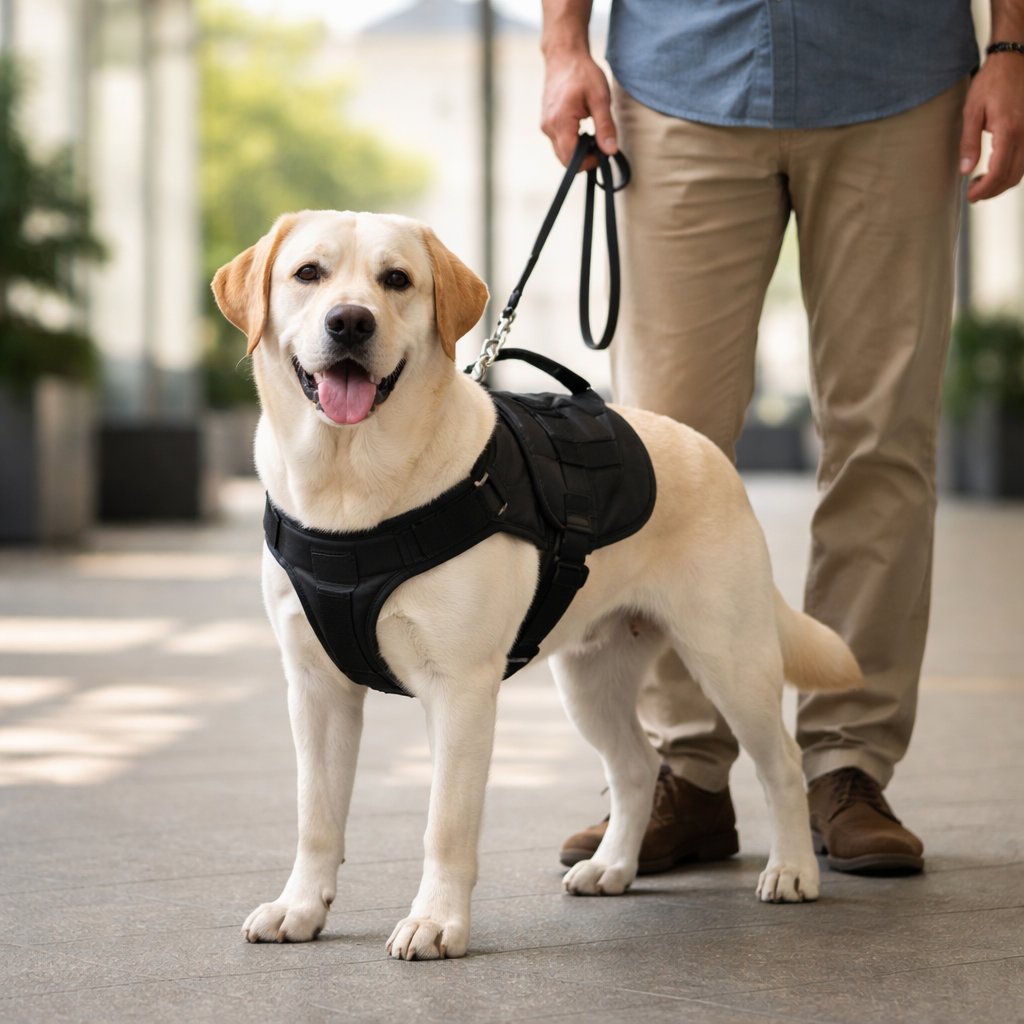
What is a service animal? In practical terms, a service animal is an animal trained to perform specific, useful tasks that help a person manage a disability in everyday life. This article offers an educational overview (not legal advice) to help you understand what typically makes an animal a service animal – and what does not.
Quick overview
- A service animal performs trained tasks that directly assist with a disability-related need.
- Comfort alone isn’t the same as a trained task (even if the comfort is very real and helpful).
- Public settings require reliability: calm behavior, focus, and safety around people and distractions.
- Training is practical and skill-based, not based on a label or gear.
What “Service Animal” Means in Real Life
When people ask, “What is a service animal,” the most useful, everyday definition is task-focused: a service animal is trained to do specific actions that reduce the impact of a person’s disability. The key idea is that the animal does something observable and repeatable (a task), not just provides general comfort by being present.
Practical examples of trained assistance (depending on the person’s needs) can include guiding, retrieving items, alerting to specific cues, interrupting harmful behaviors, or providing steady support during a medical or psychiatric episode. The exact tasks vary widely because disabilities and daily-life barriers vary widely.
What It is not: Common Misunderstandings
Many animals are beloved, well-behaved, and emotionally supportive—and still not a service animal in the practical sense described above. Here are common points of confusion:
- Not the same as a pet with excellent manners: Good behavior is important, but task training is the defining feature.
- Not defined by a vest, harness, or badge: Equipment can help with handling and signaling “do not distract,” but it does not create task ability.
- Not the same as emotional support by presence alone: Emotional support can be valuable; the distinction is whether the animal is trained to perform disability-related tasks.
If you want a clear, practical comparison, see service dog vs emotional support animal (ESA): the practical difference.
Task Training: What “Trained to Help” Typically Looks Like
Task training is usually deliberate and structured. A trainer or handler breaks down a helpful behavior into small steps, practices it across settings, and builds reliability under real-world conditions.
- Specific cue → specific response: The animal learns to respond consistently to a cue (verbal, hand signal, or environmental/physiological change).
- Proofing: The behavior works not only at home, but also in different rooms, at different times of day, and gradually in more distracting environments.
- Generalization: The animal can perform the task for the handler in varied real-life situations, not only during “training time.”
This is one reason service-animal work is often described as both skills (tasks) and manners (public behavior): the two have to function together.
Public Behavior: Calm, Safe, and Non-Disruptive
A practical service animal in public should be safe, under control, and focused enough to work around everyday stimuli like food smells, children, carts, elevators, and other animals. Even a perfectly trained task can’t help if the animal is overwhelmed, reactive, or frequently distracted.
For a helpful framework of what “ready for public access” often involves, see public access training: the 5 core skills every service dog needs.
How the Public Should Interact (and not interact)
Because service animals are working, the safest default is to treat them like essential medical support equipment: do not interfere. Interactions that seem friendly—talking to the animal, reaching to pet, offering treats, making kissy noises—can disrupt focus and create safety risks for the handler.
- Do: Give space, keep your own pets away, and speak to the handler (not the animal) if you need to communicate.
- Don’t: Pet, call, feed, or try to “test” the animal’s training.
For a simple, practical refresher, read service dog etiquette in public: a guide for the general public.
Practical Checklist: Signs an Animal is (or isn’t) Functioning as a Service Animal
This checklist isn’t a legal test—just real-world indicators that often separate trained working behavior from a pet accompanying someone.
- Likely functioning as a service animal: Stays close to the handler, remains neutral to strangers, ignores food/other animals, recovers quickly from surprises, and performs trained tasks on cue or when needed.
- Red flags in public settings: Frequent barking/whining, lunging, begging for attention, wandering to greet others, stealing/licking food, repeated pulling, or signs of fear/aggression.
It’s also worth noting that even genuine working animals can have off days. The practical focus should be safety, control, and minimizing disruption —especially in crowded or high-stimulation environments.
FAQs
- What is a service animal, in one sentence?
A service animal is trained to perform specific tasks that help a person manage disability-related challenges in daily life. - Is providing comfort or emotional support a task?
Comfort can be meaningful and therapeutic, but “comfort by presence alone” is generally not the same thing as a trained, disability-mitigating task in the practical sense described here. - Do service animals have to be perfectly behaved in public?
Perfection is unrealistic, but they should be reliably safe, under control, and able to work through common distractions without disrupting others. - Can a service animal be trained for psychiatric needs?
Yes—some are trained for tasks that help with psychiatric or neurological disabilities (for example, interrupting harmful behaviors or guiding a person to a safe place). The practical hallmark is still task work: trained, repeatable. - Should I pet a service animal if it seems friendly?
It’s best not to. Even friendly attention can break focus. When in doubt, give space and interact with the handler instead.
Takeaway
If you’re trying to understand what a service animal is, focus on two practical pillars: trained tasks that mitigate disability-related barriers and reliable, non-disruptive behavior in real-world settings. Clear expectations and respectful public interaction help keep teams safe and effective.