
This article is an educational overview and not legal advice. Laws and policies can vary by location and may change.
The term service animal is used in many different ways online. Some people mean “a dog that helps me emotionally.” Others mean “an assistance animal trained to perform tasks.” Those are different categories, and mixing them up leads to confusion and problems.
This guide is a practical definition plus a training roadmap: what a service animal is, what it is not, what service-level behavior looks like, and how to tell if your dog is a realistic candidate.
Service Animal: Practical Definition
A service animal is trained to perform disability-related tasks that reduce functional barriers in everyday life.
Examples of Task-Style Help (examples only):
- Retrieving dropped items or bringing medication
- Trained interruption of escalating panic behaviors
- Trained routines like “find exit” or “go to car”
- Trained daily-living support behaviors (lights, phone, etc.)
What a Service Animal is NOT
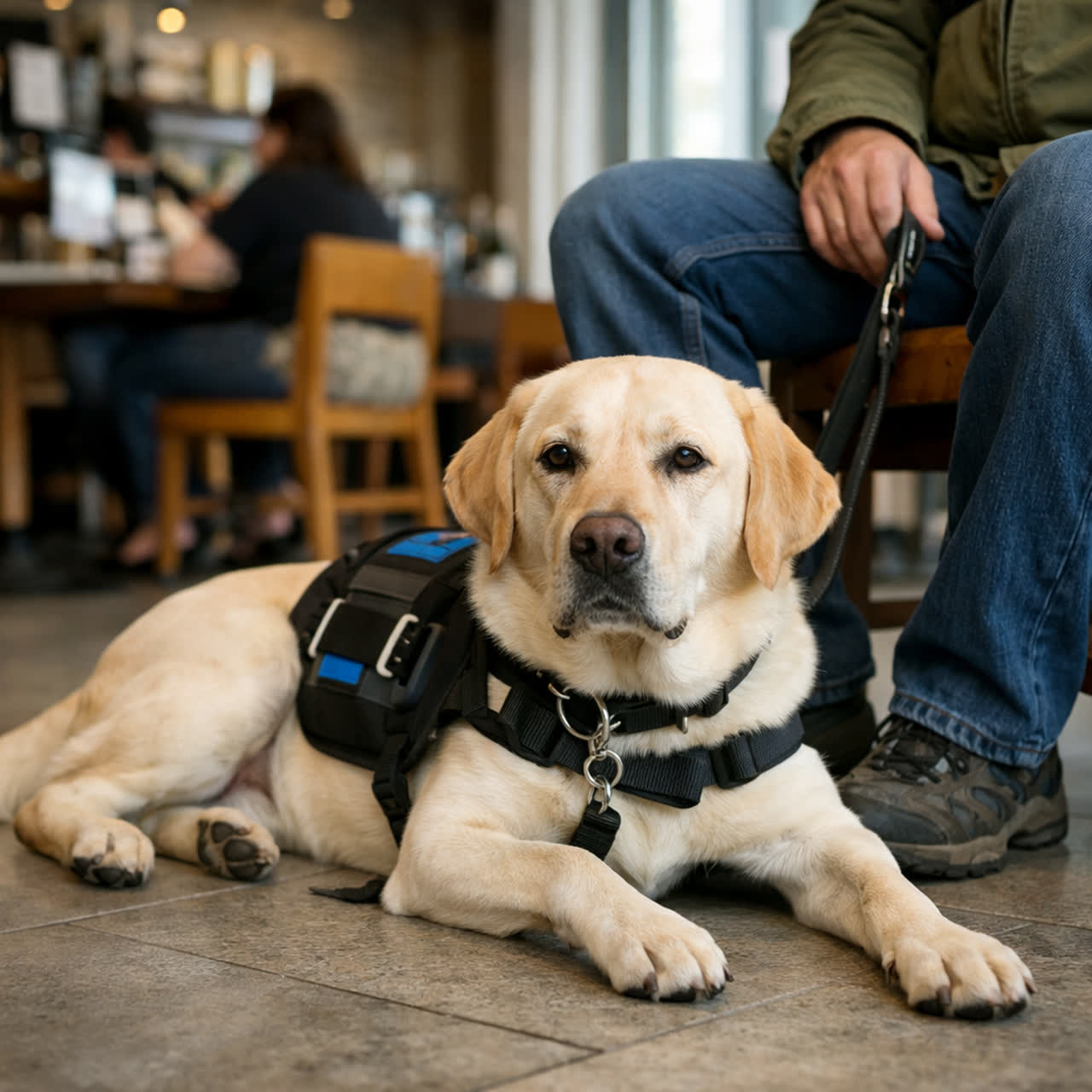
- A pet with a vest or harness
- A dog that is simply friendly or calm at home
- Automatically the same as an emotional support animal (ESA)
- A dog that is fearful, reactive, or overwhelmed in public environments
Why the Distinction Matters
Service Reliability has Two Layers
- Task training: The dog can perform trained behaviors consistently.
- Public behavior: The dog can remain calm, neutral, safe, and controllable in distracting environments.
That public-behavior layer is what public access training builds and proves.
What “Service-Level” Public Behavior Looks Like
- Loose leash walking (no pulling toward people/dogs/food)
- Automatic check-ins (dog keeps the handler in mind)
- Neutrality around strangers and other dogs
- Settle on cue and relax for long periods
- Fast recovery after surprises
Suitability: Can any Dog do Service Work?
No. Suitability is a welfare issue. Some dogs are fantastic companions but dislike crowds, tight spaces, or constant novelty.
Green flags you usually want:
- Stable temperament and fast recovery
- Comfort in new places (surfaces, noise, crowds)
- Neutral social behavior (not reactive, not frantic greetings)
- Motivation to work (food/play) without stress
Red flags (often deal-breakers for service work):
- Reactivity (barking/lunging/freezing)
- Chronic stress in public (can’t settle, constant scanning)
- Shut-down behavior (looks calm but is overwhelmed)
Realistic Training Roadmap
- Evaluation (temperament + resilience)
- Foundations (focus, leash skills, impulse control, settle)
- Public access training (proofing across environments)
- Task training (step-by-step + proofing)
- Maintenance (ongoing practice prevents regression)
FAQs
- How long does training take? Usually months, not weeks.
- Is calm enough? Calm helps, but tasks + proven reliability define service work.
- Where do I start? Start with foundations and public access training.
Next Step
If you’re comparing categories, read service dog vs ESA and service animal vs ESA. Then build calm reliability through public access training before you add complex task routines.
Service Animal vs Pet Training (what changes?)
Pet training usually aims for convenience: the dog behaves at home and on normal walks. Service-animal training aims for reliability under pressure. That means training isn’t just “teach a cue once.” It’s building behavior that still works when the environment is busy, noisy, and unpredictable.
For example, a pet dog might sit when asked in the kitchen. A service-level dog must sit calmly in a queue while food smells, people pass close by, and another dog barks in the distance — without escalating.
How Proofing Works (why it takes months)
Proofing is the process of taking a behavior and making it work across:
- Places: Home, street, shop entrance, transport, waiting room
- Distractions: People, dogs, food, noises, tight spaces
- Duration: Seconds → minutes → long settle periods
- Distance: Far away from triggers → gradually closer
This is why service training is structured and gradual. Without proofing, dogs look trained only in “easy” contexts.
Safety and Welfare (the dog must enjoy the job)
A working dog should not be “white-knuckling” through public environments. The goal is a dog that can stay relaxed, recover quickly, and work without constant pressure. If the dog is consistently stressed, the ethical choice is to change the plan — sometimes that means a different role for the dog.
Mini Self-Check (is my dog ready?)
- Can my dog settle for 5–10 minutes in a new place?
- Can my dog ignore a stranger walking past without trying to greet?
- Can my dog recover after a loud noise within a few seconds?
- Can my dog take food/play and remain engaged outside?
If most answers are “not yet,” start with foundations and public access training before you add task complexity.
Common Questions People Ask
- Do service animals have to be perfect? No dog is perfect, but reliability means the dog is safe and predictable across many environments.
- Is advanced obedience required? Not “sport obedience,” but the dog must have strong foundations and a stable settle.
- What is the hardest part? Proofing skills in real places. That’s why public access training is a major project on its own.
Final Takeaway
A service animal is defined by trained function (tasks) plus real-world reliability. If you build the foundations first, everything becomes easier and safer for the dog.