
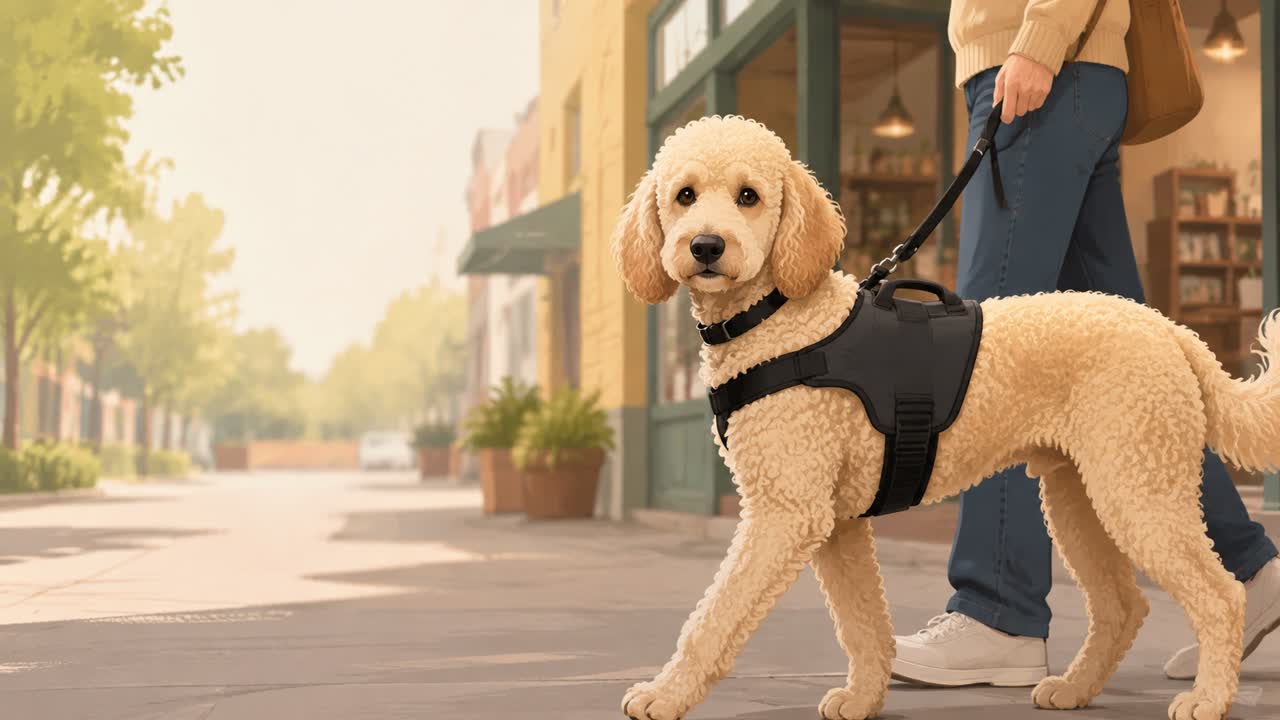
Service dog settle-under-table training is the practical skill that helps a working dog rest quietly at a handler’s feet in restaurants, classrooms, offices, waiting rooms, and other tight public spaces.
This article is focused on the training behavior itself: how to teach a reliable under-table settle, how to proof it in real environments, and how to avoid common mistakes. Under the ADA, public access depends on the dog being trained to perform disability-related work or tasks and staying under control in public settings.
A polished settle can also reduce friction. Staff are less likely to worry about tripping, barking, begging, blocked aisles, or food safety when a dog is calmly tucked out of traffic. For handlers reviewing broader legal basics, the knowledge hub can help place this skill in context.
Quick Overview
- “Settle under table” means the dog lies quietly in a specific tucked position until released.
- Start at home before practicing in public spaces with food, noise, and foot traffic.
- Reward calm body language, not just the final down position.
- Use a mat, leash guidance, and a clear release cue to prevent creeping or popping up.
1) What “Settle Under Table” Should Look Like
A reliable under-table settle has three parts: the dog moves into position, lies down with the body mostly out of the walkway, and remains relaxed until released. The dog should not sniff plates, solicit attention, bark at passing people, block servers, or crawl toward dropped food.
For many handlers, the best position is a tucked down between the handler’s feet, under the chair, or beneath the table edge where the dog is protected from traffic.
This skill is different from a general “down-stay.” A down-stay may be trained in an open room with few distractions. A service dog settle has to work near food, chair legs, dropped napkins, rolling carts, children, and people who may not notice the dog.
2) Build the Behavior at Home First
Start with a low-distraction table at home. Place a small mat or towel where you want the dog’s chest and front paws to land. Reward low, near the floor, so the dog learns that the good stuff happens in the settled position.
Keep the first sessions short. Add duration slowly, then add normal household distractions: eating a snack, moving a chair, opening a cabinet, or having someone walk past. Avoid turning every mistake into a dramatic correction, because the finished behavior should feel boring and predictable.
A clear release cue matters. Use a word such as “free,” “break,” or another consistent cue before the dog gets up. Without a release cue, many dogs guess when the exercise is over, especially when a person stands up, food appears, or another dog walks by.
3) Add Public-Access Standards before Public Pressure
Before moving into busy restaurants or offices, check whether the dog has the foundation skills that make a settle fair to ask for. A handler who is still evaluating readiness can use a structured service check to think through whether the dog’s work, tasks, and public behavior are lining up responsibly.
The ADA does not require a service dog to be professionally trained, certified, or identified with a vest. But public access does require control. If a dog is barking repeatedly, lunging, wandering, taking food, or unable to settle, a business may have a valid concern even if the dog performs important tasks elsewhere.
Good settle training protects the handler, the dog, and the public. If a staff member asks whether the dog is a service animal required because of a disability and what task the dog is trained to perform, a settled dog reinforces the handler’s calm explanation.
4) Practice in Layers: Place, Duration, Distraction, Distance
Do not jump from the kitchen table to a packed dinner rush. Build the skill in layers. First change the place: a patio, quiet lobby, empty classroom, or outdoor bench. Then increase duration. Then add distractions such as food smells, dropped items, people passing close by, and chairs scraping.
Distance is a separate skill. Some handlers need the dog tucked tightly against their legs. Others need the dog to settle slightly to the side because of a wheelchair, cane, medical equipment, or balance needs. Practice the position that actually fits the handler’s body and task needs, not a generic internet-perfect pose.
Reward the dog before frustration appears. Early signs of struggle can include chin lifting repeatedly, scanning the room, shifting hips, pawing, licking the floor, or creeping forward. These signs do not mean the dog is failing. They mean the session may be too long, too loud, or too distracting for the current stage.
5) Service Dog Settle under Table Training in Restaurants and Offices
Restaurants and offices are where service dog settle under table training often matters most. In restaurants, the dog must ignore food and servers. In offices, the dog may need to stay quiet through meetings, rolling chairs, dropped pens, and people entering the room. Both settings reward preparation.
For restaurant practice, choose a quiet time first. Ask for a table with enough floor space if possible, guide the dog into position before ordering, and reward calm moments before food arrives. Keep the leash short enough to prevent wandering but loose enough that the dog is not being physically pinned into place.
For office practice, rehearse the full routine: entering, greeting no one unless invited, moving under the table or desk, settling during conversation, and exiting without rushing. That discussion is different from ordinary customer-facing public access rules.
6) Track Progress and Fix Common Problems
A simple training log can be more useful than a certificate-style folder. Note the date, location, duration, distractions, what went well, and what needs work. These records help handlers see patterns: maybe the dog settles well at breakfast but struggles at dinner, or handles quiet offices but not rolling carts.
If the dog pops up whenever food arrives, practice with low-value food at home and reward remaining down. If the dog startles under tables, practice around chair legs and foot movement before returning to busy settings.
Handlers can also use a behavior check to think through whether the dog’s public manners are strong enough for higher-distraction environments. The most trustworthy proof of training is consistent behavior over time, supported by records, task clarity, and honest evaluation.
FAQs
Is service dog settle under table training legally required?
No specific “under table” cue is named as a legal requirement. However, service dogs in public places generally need to remain under control. A reliable settle is one practical way to prevent blocked aisles, food interference, and disruptive behavior.
How long should a service dog be able to settle?
Build toward the real situations the handler needs. A short medical appointment may require 20 minutes, while a class, meeting, or meal may require longer. Increase duration gradually and give the dog appropriate breaks.
Should I use a mat?
A mat can be very helpful during training because it gives the dog a clear target. Over time, many handlers fade the mat or use it only for longer settings such as offices, classrooms, or travel waiting areas.
Can a business ask my dog to leave if it will not settle?
Under ADA guidance, a business may ask that a service animal be removed if the dog is out of control and the handler does not take effective action to control it, or if the dog is not housebroken. A brief reset is different from ongoing disruption.
Do I need a service dog certificate for restaurants?
The ADA does not require service dogs to have a certificate, ID, vest, or professional training program for public access. Optional organization tools may give some handlers peace of mind, but they do not replace task training and controlled behavior.
Sources
- ADA.gov: Service Animals
- ADA.gov: Service Animals FAQ
- CDC: Dogs
- CDC: Pet Travel Safety
- HUD: Information for Persons with Disabilities
Takeaway
A strong under-table settle is one of the most practical service dog public-access skills because it keeps the dog calm, safe, and out of the way while the handler participates in daily life.
- Train the behavior in small layers before expecting restaurant-level reliability.
- Focus on calm control, task readiness, and records rather than certificate-first thinking.
- Use real-world practice notes to decide when the dog is ready for harder environments.