
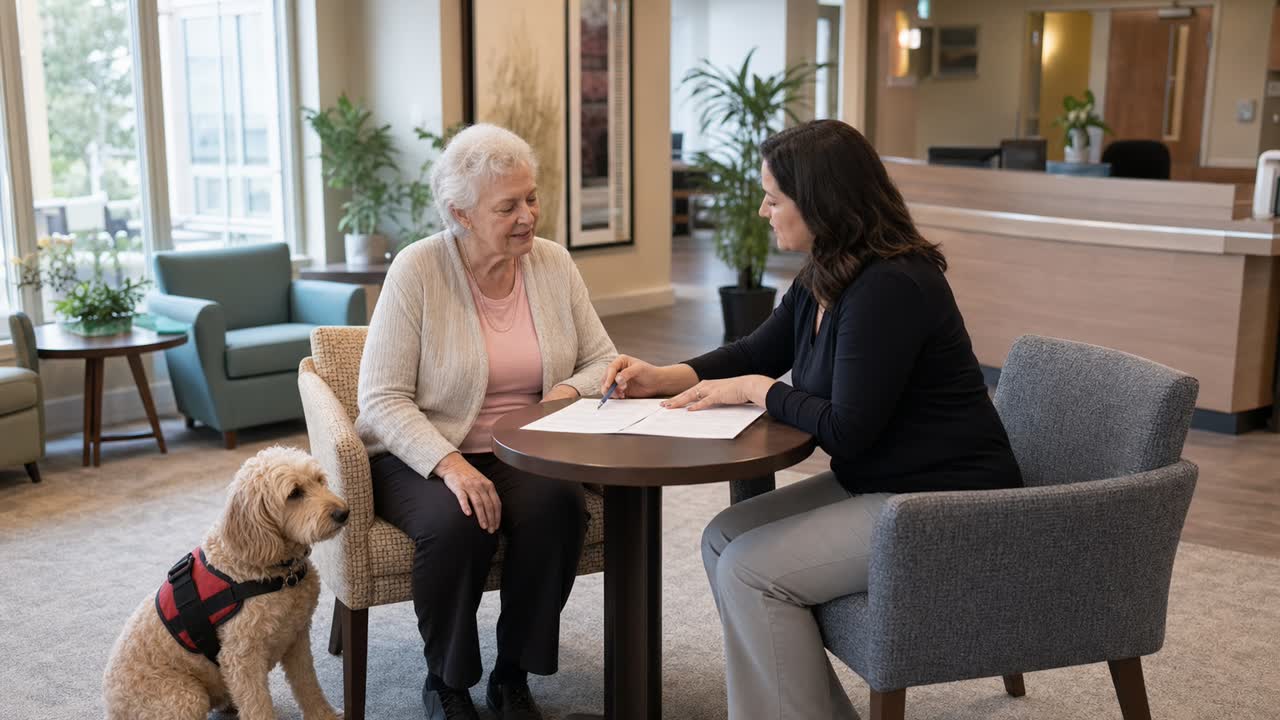
Senior apartment housing can create a confusing mix of housing rules, community policies, and day-to-day social friction. A service dog may be completely normal in one building and be heavily questioned in another, especially when staff members are used to ordinary pet rules instead of disability-accommodation rules. That makes this topic less about winning arguments and more about understanding the right lane early.
In most cases, the core issue is housing, not retail-style public access. A resident who relies on a trained service dog is usually asking for a housing accommodation, not trying to prove that the dog should be treated like a pet with exceptions. Reviewing the broader housing rules first can help you frame the conversation correctly.
This article focuses on senior apartment housing for service dog handlers, not on paid registries, instant certificates, or ID-card shortcuts. In a housing setting, calm communication, a clear explanation of the accommodation request, and organized records usually matter more than optional status products. If the animal in question is actually an emotional support animal rather than a task-trained service dog, that is a different path and may need a separate ESA review.
Quick Overview
- Senior apartment housing usually raises housing-accommodation questions, rather than ordinary pet-policy questions.
- A service dog should be discussed as a disability-related need, not as a paid exception to a no-pets rule.
- Clear records, practical routines, and respectful communication often reduce friction faster than arguing.
- Pet fees, breed restrictions, and weight limits may need a different analysis when a valid accommodation request is involved.
- If the disability or need is not obvious, housing staff may sometimes ask for reliable support information.
- Senior communities can also raise practical issues like elevators, dining rooms, shared lounges, neighbors, and emergency planning.
1) What Makes Senior Apartment Housing Different from a Normal Pet-Policy Conversation
Age-restricted apartment communities often operate like ordinary residential housing, but they usually have more staff oversight and more resident questions than a standard rental building. Managers may worry about falls, noise, shared dining areas, allergy complaints, or the dog disturbing other residents.
The mistake many handlers make is treating that friction as if it were a public-access fight. Usually it is not. The better starting point is to keep the discussion inside the housing lane: this is a resident asking for a disability-related accommodation connected to where they live. It helps to save lease language, accommodation emails, and follow-up notes in one place, whether that is a folder or a simple tracking app.
2) The First Questions Housing Staff Usually Ask
In practice, senior apartment staff usually want to know whether the animal is connected to a real accommodation request, whether the dog can live safely in the building, and whether the resident is prepared to manage the dog responsibly. Those are not all the same question. A dog may be entirely appropriate as an accommodation and still require good planning around elevators, toileting routines, common hallways, and quiet hours.
If the disability and the dog’s role are obvious, the process may remain simple. If they are not obvious, the community may ask for reliable information that supports the accommodation request. That is where organized daily living habits and a calm documentation plan become useful. What helps most is usually a short, consistent set of records rather than a pile of unrelated paperwork.
3) Pet Fees, Breed Rules, and Community Policies in Senior Housing
One of the most common points of tension is the building’s ordinary pet policy. A senior apartment may have pet rent, a deposit, a weight cap, or a breed rule that staff members are used to applying automatically. In a service-dog housing situation, the real question is whether the resident is requesting a disability-related accommodation and how the property should handle that request.
That does not mean every rule disappears. Communities can still care about sanitation, damage, direct threats, and uncontrolled behavior. But there is a difference between managing actual conduct and treating a service dog as just another pet.
4) Documentation that is Actually Useful in Senior Apartment Housing
The most useful documentation is the kind that matches the decision being made. For housing, that often means reliable information supporting the resident’s accommodation request when the disability or need is not obvious. It can also include clear records that show the dog is well managed in daily life.
What usually helps less is random paperwork collected from the internet with no connection to the housing request. Optional certificates or ID cards may look official, but they often do not answer the question the property is actually trying to resolve. A cleaner approach is to prepare a short, well-organized housing packet and keep it up to date. The broader Knowledge Center can help you keep related topics separated.
5) Common Friction Points in Senior Communities and How to Handle Them
Senior apartment buildings often generate a few predictable flashpoints: neighbors who are afraid of dogs, residents who try to pet or feed the dog, staff members who are unsure about common-room access, and concerns about barking, elevators, or toileting routes. These issues are usually easier to solve through routine than through a lecture.
It helps to decide in advance which entrance you will use most often, where the dog will settle when maintenance workers come inside, and how you will respond if another resident complains. Another frequent issue is backup planning. If the resident is hospitalized or has a temporary health setback, who handles the dog? Having a named helper and written care notes can reassure staff that the situation is being managed competently.
6) When to Escalate and When to Keep it Simple
Not every awkward conversation needs a formal dispute — many problems in senior apartment housing stem from uncertainty, not hostility. If a leasing agent or resident-services worker seems confused, start by clarifying the housing-accommodation issue in writing and keeping the tone factual.
Escalation makes more sense when the community keeps applying pet fees after the accommodation request is clear, refuses to process the request at all, demands irrelevant proof, or creates barriers that go beyond ordinary building operations. At that point, a careful record of dates, names, emails, and policy language becomes important.
FAQs
Can a senior apartment charge pet fees for a service dog?
That can depend on the housing-accommodation analysis and the facts of the request. Still, a service dog should not automatically be treated exactly like an ordinary pet just because the building has a pet policy. The key is to keep the discussion inside the housing-accommodation lane.
Do I need a certificate or ID card for senior apartment housing?
Usually that is not the strongest place to focus. In housing, what matters more is clear accommodation-related information and practical credibility, not collecting optional status products that may not answer the property’s real questions.
What if other senior residents are afraid of dogs?
That concern should be handled respectfully, but it does not automatically settle the question of accommodation. Practical steps like route planning, boundaries, and communication can reduce conflict while the building works through the issue.
Can staff ask for documentation?
Sometimes they may ask for reliable support information when the disability or the need for the animal is not obvious. The exact limits depend on the setting and facts, so it helps to keep your housing packet focused and relevant rather than overloading the conversation.
What if my situation is really about an ESA, not a task-trained service dog?
That is a different category and should be handled separately. Mixing ESA and service-dog language can create confusion, so it is better to identify the correct path early.
Sources
- HUD: Information for Persons with Disabilities
- HUD: Assistance Animal Notice Fact Sheet (PDF)
- ADA.gov: Service Animals FAQ
- ADA.gov: Service Animals
Takeaway
-
Service dog questions in senior apartment housing are usually easier to address when everyone treats them as housing accommodations rather than pet-policy arguments. The strongest approach is calm communication, relevant records, and routines that demonstrate the dog can live responsibly in the community.
- Frame the issue as housing, not as an ordinary pet exception.
- Use focused records and practical planning instead of random paperwork.
- Escalate only when the building continues to block the accommodation path after the issue is clearly explained.