
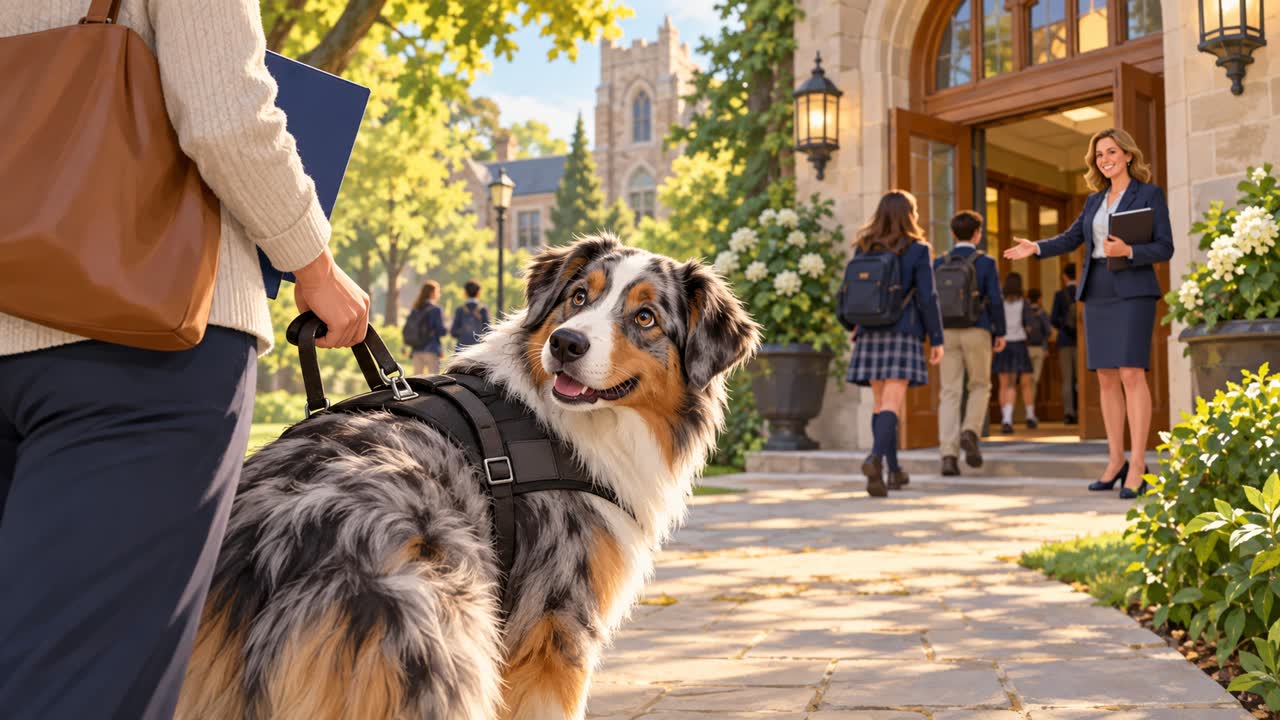
A family addressing a service dog in private school admissions should raise the issue early enough to plan access, while keeping the discussion separate from the student’s academic qualifications. The school should evaluate applicable disability law, the dog’s trained work, and the practical school environment rather than relying on a general no-animals policy.
Coverage can vary. Many nonreligious private schools are subject to federal disability-access requirements, while religious organizations may be exempt from certain ADA provisions. Schools receiving federal financial assistance may have additional obligations, and state or local law may offer broader protection.
This guide focuses on admissions communication and enrollment planning—not ordinary public access at stores or restaurants. Families facing a disputed decision should obtain advice specific to the school and jurisdiction.
Quick Overview
- Ask for the school’s disability-access contact and written process early.
- Describe the dog’s trained disability-related tasks without oversharing medical details.
- Keep the student’s admission merits separate from implementation planning.
- Discuss classrooms, transportation, meals, laboratories, athletics, relief areas, and emergencies.
1) Understand Service Dog Rules in Private School Admissions
The first question is which laws apply to the particular school. A nonreligious private school may be covered as a place of education under the ADA. A school controlled by a religious organization may fall within a federal religious-entity exemption, although state or local disability laws may still apply. Receiving federal financial assistance can add requirements.
Because coverage is fact-specific, families should avoid assuming that rules for a public school, college, or retail business transfer unchanged to every private school. Ask the admissions office who handles disability access and whether the school receives federal funding. Review relevant regulations, then confirm the current rules with the school or a qualified adviser.
Even when a particular federal provision does not apply, a school may voluntarily provide access through its own inclusion policies. Record any agreement clearly before enrollment.
2) Raise the Request without Turning It into an Admissions Test
The student’s academic application and the service-dog implementation plan serve different purposes. Admissions staff assess the student under the school’s ordinary criteria. Disability-access staff determine how approved participation can work safely and effectively.
A parent or student can write:
My child uses a trained service dog because of a disability. The dog is trained to [briefly describe disability-related work or tasks]. We would like to discuss how the dog can accompany the student during the school day if admitted, including classroom placement, transitions, meals, transportation, relief breaks, and emergency procedures. Please identify the appropriate accessibility contact and any applicable process.
This message gives the school useful notice without supplying an entire medical history. If the school requests information, ask what decision the information will support, who will receive it, and how it will be kept confidential.
3) Prepare Task, Handling, and Support Information
A service dog must be individually trained to execute work or tasks related to a disability under the ADA definition. Families should be ready to describe those tasks in practical terms. Examples might include retrieving an item, alerting to a medical change, guiding the student toward assistance, or interrupting a specific disability-related behavior.
Clarify who will control the dog during the school day. An older student may handle the dog independently. A younger student or one with particular support needs may require an agreed arrangement involving trained school personnel or another responsible adult. The law does not generally require a school to provide routine feeding, walking, grooming, or supervision of the animal, so responsibilities should be explicit.
A voluntary service screening may help organize task and readiness information. It is not government approval, a substitute for individualized review, or a guarantee of admission or access.
4) Walk through the Full School Day
Before enrollment is finalized, map the student’s likely schedule from arrival to dismissal. Discuss classrooms, assemblies, hallways, cafeterias, restrooms, libraries, playgrounds, laboratories, athletics, field trips, and after-school programs.
The plan should address:
- Where the dog will settle without blocking aisles or exits.
- How the student will reach a suitable relief area.
- Who responds if the student or dog needs assistance.
- How fire drills, lockdowns, and evacuations will work.
- Whether buses or third-party transportation require coordination.
- How substitutes and event staff will learn the essential plan.
Some spaces may present specific hazards, such as laboratory chemicals, machinery, food-preparation zones, or athletic equipment. The school should evaluate actual conditions and possible modifications rather than automatically applying a campus-wide exclusion.
5) Address Behavior, Allergies, and Classroom Concerns
The dog should remain housebroken and under control. Unless a leash, harness, or tether interferes with trained work or the student’s disability prevents its use, the dog will generally use that equipment. Otherwise, the handler needs another effective control method.
Families should prepare the dog for bells, crowded transitions, dropped food, energetic children, mobility equipment, and long periods of quiet settling. An optional behavior check can identify skills needing practice, but it is not a legal certification.
Address allergies or fear of dogs using facts about the affected individuals. Depending on the setting, measures may include seating distance, different routes, cleaning practices, air filtration, or scheduling changes. The school should also establish age-appropriate rules against petting, feeding, teasing, or distracting the working dog.
6) Handle Questions, Records, and Disagreements Carefully
In ordinary ADA public-access settings, staff may generally ask whether the dog is required because of an impairment and what work or task it has been trained to perform when its role is not apparent. They generally may not require a task demonstration or make entry depend on a special vest, purchased certificate, registry, or ID card. The public access guide explains that baseline.
School enrollment may involve additional disability-accommodation processes, so families should distinguish a lawful request for relevant information from a demand for commercial service-dog paperwork. Helpful records may include a concise task description, emergency contacts, veterinary information required of dogs generally, and applicable disability documentation handled through the proper confidential channel.
If the school proposes a restriction, ask for the exact legal, safety, or operational basis and the alternatives considered. Request the decision in writing. Keep application materials, emails, meeting notes, policies, and proposed plans. For an unresolved issue, consider contacting the relevant state education or civil-rights agency, a disability-rights organization, or a qualified attorney.
FAQs
Can a service dog accompany a student during a private school admissions visit?
Often, yes, when the school is covered by applicable public-access law. Coverage may differ for religious schools and other exempt entities, so confirm the school’s status and relevant state or local protections.
Should the family disclose the service dog before admission?
Early notice can support effective planning, especially when the student will need the dog throughout the school day. The family can disclose the accommodation need without providing unnecessary medical details to general admissions staff.
Can the school require a certificate or registry card?
A purchased certificate or registry entry does not automatically establish whether access is required. Optional documents may help with organization, but the analysis should focus on applicable law, trained tasks, the student’s needs, and workable implementation.
Can the school ask about the student’s disability?
The permissible inquiry depends on the context and governing law. Information requested for an accommodation should generally be relevant and handled through an appropriate confidential process, not used casually during academic evaluation.
Who handles the dog during class?
The plan should identify the handler and any necessary assistance. Schools are generally not responsible for routine animal care, although disability-related support duties may require an individualized analysis.
What if another student has a severe allergy?
The school should evaluate both students’ needs and consider practical measures such as separation, alternate routes, cleaning, ventilation, or scheduling. The decision should rely on specific evidence rather than assumptions.
Sources
- ADA.gov: Service Animals
- ADA.gov: Service Animals FAQ
- CDC: Dogs
- CDC: Pet Travel Safety
- HUD: Information for Persons with Disabilities
Takeaway
Private-school planning works best when the family identifies applicable coverage, separates admissions from accommodation logistics, and develops a written plan for the complete school day.
- Contact the appropriate disability-access decision-maker early.
- Explain trained tasks and handling needs without relying on commercial paperwork.
- Document the school’s plan, restrictions, alternatives, and final decision.