
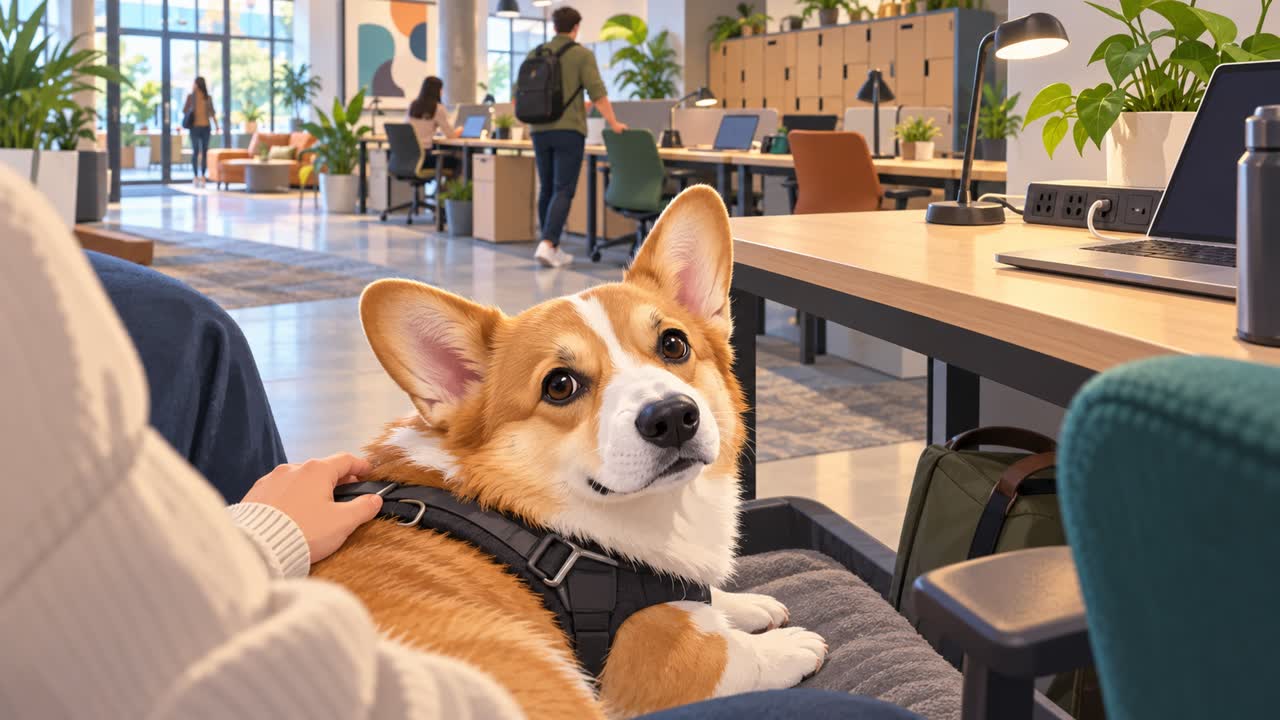
A service dog in co-working hot desk spaces may generally accompany its handler in areas open to members and customers when the dog meets the Americans with Disabilities Act (ADA) definition. The practical challenge is creating a safe, workable setup in a space where desks, neighbors, noise levels, and walking routes change from day to day.
The correct process may depend on the handler’s relationship with the space. A self-employed member may rely on public-access rules. At the same time, an employee assigned to a co-working location may also need to coordinate with an employer through the workplace accommodation process.
This guide focuses on shared desks, meeting rooms, kitchens, phone booths, and common areas. It does not treat the service dog as an office pet or assume that one fixed seating plan will work every day.
Quick Overview
- Tell the operator about recurring access needs when coordination would reduce friction.
- Choose a desk with enough floor space and a clear accessible route.
- Keep the dog close, controlled, and out of aisles and neighboring work areas.
- Plan relief, water, rest, calls, meetings, and emergency evacuation.
- Address allergies or fear through distance and scheduling rather than automatic exclusion.
1) Plan for a Service Dog in Co-Working Hot Desk Spaces
Contact the site manager before the first full workday if you need a particular desk location, additional floor space, an accessible entrance, or a predictable route to a relief area. Advance notice can help with logistics, even when routine public access does not require it.
Ask how hot desks are assigned and whether you can reserve an appropriate location. A suitable desk may be near a wall or at the end of a row, with enough room for the dog to settle without extending into a walkway.
Review entrances, elevators, security gates, restrooms, kitchens, meeting rooms, fire exits, and outdoor relief routes. General regulations provide useful context, but the daily plan should reflect the actual building and membership arrangement.
2) Identify which Access Process Applies
A co-working operator offering desks and meeting space to the public may generally be subject to ADA public-accommodation requirements. When the dog’s role is not apparent, staff may generally ask whether the dog is required because of a disability and what work or task it has been trained to perform.
Staff generally should not require a task demonstration or make access depend on a particular vest, purchased certificate, registration, or ID card. Optional identification may provide organization or peace of mind, but it does not replace disability-related task training and controlled behavior.
If an employer requires an employee to work from the co-working site, the employee may also need to use the employer’s reasonable-accommodation process. The employer and space operator may have separate responsibilities, so the employee should identify who controls desk assignments, schedules, and building access.
The public access guide can help distinguish customer access from an employment accommodation.
3) Choose a Safe Desk and Settling Position
Inspect the desk area before settling in. Look for rolling chairs, exposed cables, power strips, standing-desk mechanisms, bags, food, and narrow paths. Position the dog where it can perform tasks without being stepped on or struck by a chair.
The dog should remain within the handler’s control rather than visiting neighboring desks, sniffing bags, or lying across a shared aisle. A compact resting mat can define the dog’s space if it does not create a tripping hazard.
A voluntary service check may help organize task and readiness information for shared environments, but it is not government approval or a guarantee of access.
Because hot desks change, save a short list of workable locations rather than relying on one desk. If the preferred area is occupied, staff can help identify another space with similar clearance and access.
4) Manage Shared Rooms, Kitchens, and Calls
Meeting rooms and phone booths may have limited floor space. Check whether the dog can settle without blocking the door or preventing another participant from using the room. A larger room may be appropriate when the smallest booth cannot safely accommodate the team.
In shared kitchens, keep the dog away from food-preparation surfaces and moving carts. The dog may generally accompany the handler through customer-accessible areas, but it should not enter staff-only or food-production areas closed to members.
Plan how the dog will respond during video calls, presentations, alarms, applause, or unexpected visitors. A brief trained alert differs from repeated uncontrolled barking, but the handler should take effective action when behavior becomes disruptive.
If the workday follows air travel, review the separate air travel rules. Airline requirements do not determine access inside a co-working facility.
5) Address Allergies, Fear, and Other Dogs
Another member’s allergy or fear does not automatically justify excluding a service dog. The operator should gather practical facts and consider measures that allow both people to use the space.
Possible arrangements include desks on opposite sides of the room, separate meeting times, different walking routes, increased ventilation, additional cleaning, or advance notice before shared-room use. The solution should not unnecessarily isolate or penalize either person.
Co-working spaces may also permit pets on selected days. A pet-friendly policy does not eliminate the operator’s need to address interference with a working service dog. Ask management to keep uncontrolled pets away from the service-dog team and enforce neutral conduct rules consistently.
Document recurring conflicts with dates, locations, observable behavior, and the steps you took. Avoid broad labels when a factual description will better support a practical solution.
6) Build a Full-Day Care and Backup Plan
Schedule relief, water, rest, meals, and medication around the dog’s established routine and veterinary guidance. Identify a primary relief location and a backup route for rain, construction, locked exits, or crowded events.
Bring waste bags, water, a bowl, a resting mat, cleanup supplies, and any medication or task equipment needed during the day. Do not leave the dog unattended at a hot desk while using another part of the building.
Prepare for fire alarms, elevator outages, power failures, and unexpected closures. Know which exits are accessible and whether building staff can provide instructions during an emergency without separating the team.
Review the plan if the dog struggles to settle, the relief route becomes impractical, or the space changes its layout. Persistent stress, reactivity, fatigue, or altered task performance may warrant veterinary or qualified training support.
FAQs
Can I bring a service dog in co-working hot desk spaces?
Generally, yes, when the facility is covered by applicable public-access law and the dog performs trained disability-related work or tasks. Employment arrangements may also require coordination with the handler’s employer.
Can the operator require a certificate or ID?
A purchased certificate, registry entry, vest, or ID card is generally not required for ADA public access. When the dog’s role is not apparent, staff may ask the two limited questions about disability-related need and trained work.
Can I reserve the same desk every day?
You may request a consistent or suitable desk when it is needed for safe, effective access. Whether it is handled as public-access coordination or a workplace accommodation depends on the arrangement.
What if the dog blocks a shared aisle?
Reposition the dog or request another desk with adequate floor space. A service dog should remain close to the handler without obstructing accessible routes, exits, or neighboring workstations.
Can the dog enter a meeting room or kitchen?
The dog may generally accompany the handler in member-accessible areas, subject to legitimate safety and sanitation limits. It should stay clear of food-preparation surfaces and areas generally closed to members.
What if another member has allergies?
The operator should consider distance, seating, schedules, ventilation, cleaning, or separate routes rather than automatically excluding either person.
Can a co-working space remove a barking service dog?
Removal may be permitted if the dog is out of control and the handler does not act effectively, or if the dog is not housebroken. A brief trained alert should be evaluated in context.
Sources
- ADA.gov: Service Animals
- ADA.gov: Service Animals FAQ
- ADA.gov: Businesses Open to the Public
- CDC: Dogs
- CDC: Pet Travel Safety
- U.S. DOJ/HUD: Reasonable Accommodations Under the Fair Housing Act
Takeaway
A workable hot-desk arrangement combines lawful access with flexible seating, controlled behavior, predictable care, and clear communication.
- Identify which operator or employer controls each needed adjustment.
- Choose a safe desk and backup location that preserve accessible routes.
- Address conflicts with specific, individualized measures rather than blanket exclusions.