
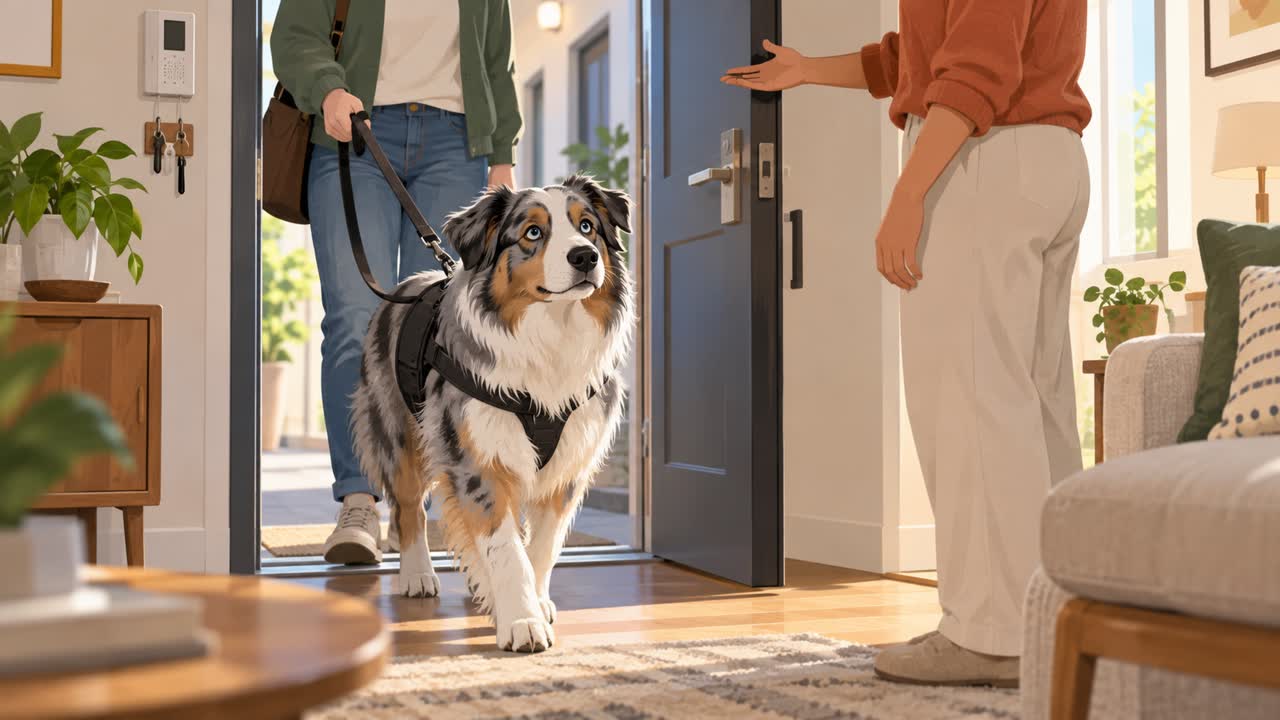
An apartment building policy for service-dog guests should distinguish a visitor’s disability-related service animal from an ordinary pet. A building’s pet ban, guest-pet restriction, breed rule, or pet fee should not automatically be applied when a resident or authorized guest needs the dog because of a disability.
The exact legal analysis depends on who handles the property, which areas the guest uses, how long the visit lasts, and which federal, state, or local laws apply. In practice, management should focus on equal access, the dog’s conduct, and any actual safety or property concern.
This guide addresses short-term visitors and guests. A person moving into the unit, staying for an extended period, or becoming an occupant may trigger separate lease, occupancy, and accommodation procedures.
Quick Overview
- Separate service-animal access from ordinary guest-pet rules.
- Do not charge a pet fee solely because a qualifying service dog visits.
- Apply neutral guest, sanitation, noise, and property-care rules consistently.
- Limit questions and documentation requests to what the applicable setting permits.
1) Write a Service Dog Guest Policy Apartment Building Staff can Follow
A useful policy begins with a clear distinction: pets are kept for companionship, while a service dog is trained to perform disability-related work or tasks. Housing law may also recognize a broader category of assistance animals, depending on the circumstances.
The policy should tell leasing staff, concierge workers, security personnel, and maintenance teams what to do when a guest arrives with a dog. It should identify who handles accommodation questions and discourage staff from debating disability details in a lobby or hallway.
A practical rule might state that disability-related animals are evaluated separately from pets, while generally applicable conduct, sanitation, and damage rules remain in effect. Current housing guidance can help management distinguish accommodation issues from ordinary pet administration.
2) Determine Whether the Visit Needs Advance Coordination
A brief social visit ordinarily should not be treated like an application to add a permanent animal or occupant to a lease. Requiring extensive advance paperwork for every short visit can create an unnecessary barrier, particularly when other guests are not required to seek approval.
Advance coordination may still be useful when the property has controlled entrances, security screening, shared resident amenities, or another known access concern. The resident can provide the guest’s expected arrival time and ask staff to be informed without disclosing more medical information than necessary.
If visits become frequent, overnight, or extended, management may ask whether ordinary occupancy rules apply. That inquiry should remain separate from the decision to accommodate a disability-related animal. The building should avoid using guest-duration rules as a disguised pet restriction.
Residents can review practical daily living tips when planning entrances, elevator use, relief routes, and interactions with neighbors.
3) Handle Questions and Documentation Appropriately
The information a property may request depends on the legal framework and whether the disability and disability-related need are apparent. A housing provider should use its established accommodation process rather than improvising demands at the front desk.
For public-facing areas governed by ADA standards, staff may generally ask two questions when the dog’s role is not apparent: whether the dog’s presence is demanded because of a disability and what task or work it has been trained to perform. They generally should not require a task demonstration or a particular vest, registration, certificate, or ID card.
Housing procedures can differ from ordinary public access. When reliable supporting information is lawfully needed, the proper decision-maker should review it confidentially rather than circulate it among building staff.
An optional ESA screening may help organize information in an emotional-support context. Still, it does not establish government approval, replace reliable documentation when required, or determine a service dog guest’s rights.
4) Apply Common-Area and Conduct Rules Fairly
A guest with a service dog may need to travel through the lobby, elevator, hallways, parking areas, and other routes available to authorized visitors. If the guest is invited to use a resident amenity, evaluate the animal issue separately from any neutral reservation or guest-limit rule.
The handler remains responsible for controlling, relieving, and cleaning up after the dog. The dog should not wander, approach residents without permission, damage property, remain unattended in the building, or obstruct exits and accessible routes.
A leash, harness, or tether is ordinarily appropriate unless it interferes with the dog’s trained work or the handler’s disability prevents its use. In that case, you may use voice commands, signals, or another effective control method.
The building may address repeated barking, uncontrolled conduct, lack of house training, or actual damage. Base any response on the individual incident rather than a blanket assumption about the dog’s breed, weight, or appearance.
5) Address Fees, Deposits, Damage, and Relief Areas
A property generally should not impose pet rent, a pet deposit, or a guest-pet fee solely because a qualifying service or assistance animal is present. The animal is not being admitted under the property’s pet program.
That does not prevent the property from seeking payment for actual damage when residents or guests would be responsible for comparable damage under neutral rules. Management should document the specific damage, repair cost, and responsible party rather than applying an automatic animal charge.
The resident or guest should ask where the dog may relieve itself and where to discard waste. If the ordinary location is inaccessible to the handler, unsafe at night, or temporarily closed, management should discuss a workable alternative.
Store accommodation correspondence, incident notes, and agreed access details securely. Documents may be organized in our app, although record storage does not determine the legal outcome.
6) Resolve Conflicts without Automatic Exclusion
Neighbors may raise concerns about allergies, fear, noise, elevator contact, or shared outdoor space. Those concerns deserve a factual response, but they do not automatically justify banning the guest’s service dog.
Practical measures may include greater distance, different elevator timing, alternate entrances, cleaning, ventilation, or a designated relief route. Management should consider both individuals’ needs rather than requiring one person to surrender meaningful access without first exploring narrower solutions.
If the dog is out of control and the handler does not take effective action, or if it is not housebroken, removal may be justified under applicable rules. The guest should still be allowed to visit without the dog when feasible, and a later visit can be reconsidered based on corrected conduct.
For unresolved disputes, request the decision and its reason in writing. The resident or guest may then contact a fair-housing organization, an appropriate government agency, or qualified counsel for guidance specific to the situation.
FAQs
What should a service dog guest policy apartment building include?
It should distinguish service and assistance animals from pets, identify the accommodation contact, explain common-area conduct expectations, prohibit automatic pet fees, and establish a process for actual safety or damage concerns.
Can a no-pets building refuse a visitor’s service dog?
A no-pets rule should not automatically exclude a qualifying disability-related animal. Management should evaluate applicable access and housing requirements along with the dog’s actual conduct.
Must the guest notify management before arriving?
Not every short visit requires advance approval. Notice may be helpful for security or access coordination, while an extended stay may require review under neutral guest and occupancy rules.
Can the building request a certificate or registration card?
A purchased certificate, registry entry, vest, or ID card does not by itself determine access. Optional identification may provide organization or peace of mind, but management should follow the information rules applicable to the setting.
Can management charge a guest-pet fee?
Management generally should not impose a pet fee solely because a qualifying service or assistance animal visits. The property may still address actual damage under consistently applied rules.
May the dog enter the lobby and elevator?
Generally, the dog may accompany an authorized guest through routes and common areas the guest is permitted to use, subject to control, sanitation, and specific safety requirements.
Sources
- ADA.gov: Service Animals
- ADA.gov: Service Animals FAQ
- ADA.gov: Businesses Open to the Public
- CDC: Dogs
- CDC: Pet Travel Safety
- U.S. DOJ/HUD: Reasonable Accommodations Under the Fair Housing Act
Takeaway
A sound guest policy protects equal access while preserving reasonable building rules for safety, sanitation, occupancy, and property care.
- Evaluate disability-related animals separately from pets.
- Use limited, confidential, setting-appropriate information requests.
- Resolve concerns through individualized, fact-based measures.