
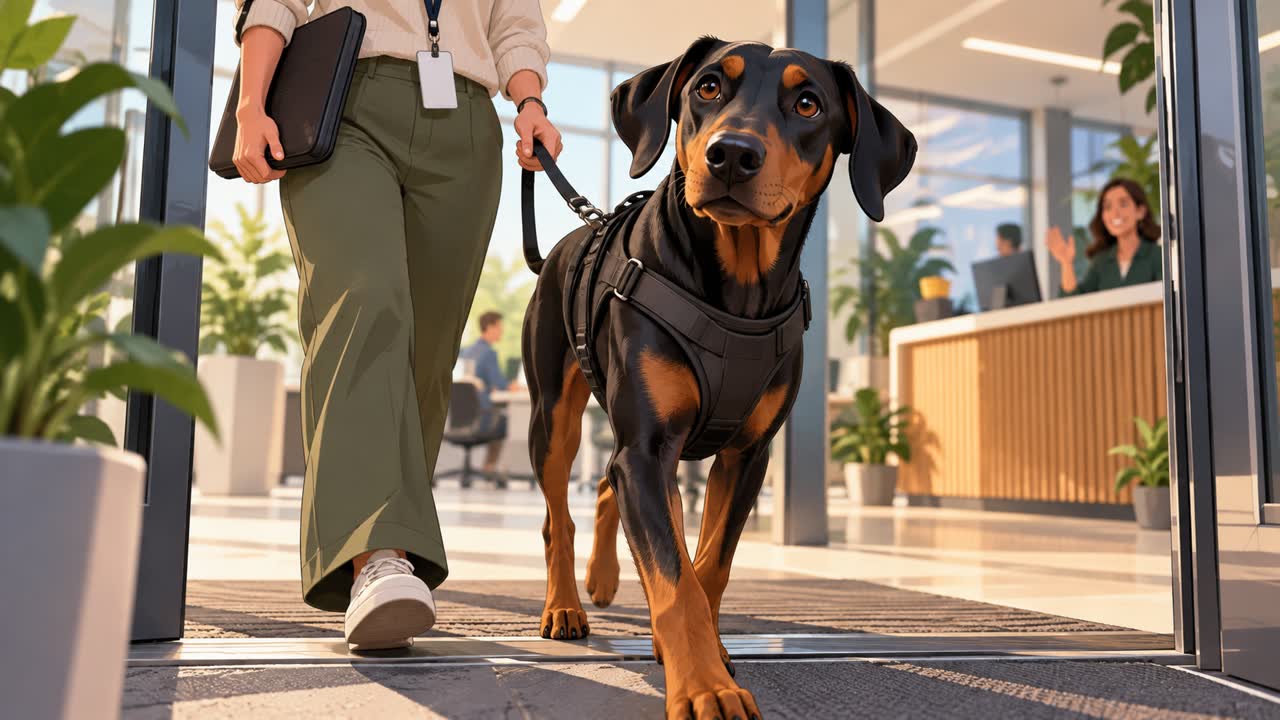
A service dog for remote worker office visits may require an accommodation discussion when a primarily remote employee is asked to attend meetings, training, team events, client sessions, or occasional days at the employer’s worksite.
Occasional office attendance creates a distinct planning issue: the employee may need the dog only for certain workplace visits, while the employer needs enough information to arrange entry, seating, building access, and a safe work area.
This guide addresses U.S. workplace visits by remote employees. It does not replace individualized advice from an employer’s accommodation team, a disability-rights organization, or qualified employment counsel.
Quick Overview
- Request the accommodation as soon as you schedule an in-person office visit.
- Describe the workplace change needed without volunteering unnecessary medical details.
- Confirm building entry, security, seating, relief access, and the day’s agenda.
- Keep the dog controlled and positioned away from shared walkways and equipment.
1) Request a Service Dog for Remote Worker Office Visits
Contact the human resources representative, accommodation contact, supervisor, or event organizer once you schedule an office visit. Explain that you use a service dog because of a disability and need the dog to accompany you during the required in-person portion of your work.
Keep the request focused on what is needed. For example, an employee might state that they need the dog with them during a planning meeting, training session, customer visit, or quarterly office day, along with an accessible entrance, a safe seating area, and reasonable relief access.
A request does not need to disclose every diagnosis, treatment detail, or personal history. General information about service animals is available through the Knowledge Center, but each workplace visit should be considered in its actual setting.
2) Separate Remote Work from In-Person Access
Working remotely may reduce office visits, but it does not mean the employee must leave a service dog behind whenever an in-person obligation arises. A required office day, team meeting, performance review, training program, or client event may require separate access.
At the same time, permission for one office visit may not answer every future question. A short meeting in a standard conference room differs from a full day involving security screening, a shared workspace, a facility tour, a meal, or travel between offices.
Ask the employer to identify the practical details early: the office address, arrival time, expected duration, visitor process, room assignments, agenda, parking, and whether a coworker will need to coordinate a relief break.
When the office is also open to customers or other visitors, the public access guide can provide general context. However, address employment accommodation questions through the employer’s individualized process rather than treating them as ordinary customer access.
3) Plan Entry, Security, and a Safe Workstation
Confirm the building entrance, check-in procedure, elevator access, security screening, and any temporary construction or restricted routes before arrival.
At the workstation or meeting room, choose a position where the dog can settle close to the handler without blocking aisles, doors, accessible routes, shared printers, cables, or emergency equipment.
Ask about practical facilities: a nearby outdoor relief route, water access, an appropriate location for a resting mat, and a plan for long meetings. The dog should not be expected to remain under a chair that is frequently moved or beside a route used by rolling office chairs and carts.
A purchased certificate, registry entry, vest, or ID card does not itself decide whether an accommodation is appropriate. Optional identification may offer organization or peace of mind, but it does not replace trained disability-related work, controlled behavior, and an individualized workplace discussion.
4) Prepare for Meetings, Visitors, and Shared Spaces
Tell the meeting organizer only what they need to arrange the space. For example, the organizer may need to reserve an accessible room, leave floor space near the employee’s seat, avoid blocking the dog’s route with catering, or notify security that the employee will arrive with a service dog.
During meetings, the dog should remain calm and close to the handler. Coworkers should not pet, call, photograph, feed, or deliberately distract the dog. A brief boundary statement such as, “The dog is working, so please give us space,” is usually enough.
For offices with frequent visitors, open-plan seating, shared desks, or client-facing areas, identify a predictable location in advance. Predictability can reduce friction for the employee and coworkers without requiring the employee to disclose private information to the whole team.
A voluntary PSA check may help organize information about a psychiatric service animal’s trained tasks and readiness. It is not government approval and does not replace the employer’s accommodation process.
5) Address Allergies, Fear, and Genuine Safety Concerns
A coworker’s allergy or fear does not automatically require excluding the service dog or the employee. The employer can consider practical arrangements such as separate seating, additional distance, a different meeting room, adjusted schedules, ventilation, or a route that reduces close contact.
Some worksites include machinery, laboratories, food-production areas, hazardous materials, sterile locations, or mandatory protective equipment. In those settings, the employer may need to discuss the actual conditions, the dog’s role, and whether a safe alternative can provide meaningful participation.
A restriction should be based on a specific, individualized safety issue, not assumptions about the dog’s breed, size, appearance, or the fact that the employee normally works remotely.
The employee should also be candid about the dog’s current readiness. If the dog is ill, injured, unusually stressed, or unable to settle safely around a demanding office environment, discuss an alternative arrangement rather than risking the dog’s welfare or a disruption.
6) Document Recurring Visits and Follow Up
After the first office visit, save the accommodation correspondence and note what worked: entry instructions, room setup, relief route, meeting length, and any support needed from security or facilities. This record can make future visits smoother without turning every office day into a new negotiation.
A tracking app may help the handler keep contact details, visit notes, routines, and relevant records organized, although recordkeeping does not determine legal access or replace an employer’s accommodation review.
If the employer changes the location, schedule, security process, or required activity, raise the issue early. A previously effective arrangement may need adjustment when the employee is asked to attend a larger event, work from a different office, travel overnight, or participate in a site visit.
If a request is denied or substantially limited, ask for the specific reason and whether another effective option is available. Keep communications factual: identify the scheduled work obligation, the accommodation requested, the barrier created by the proposed restriction, and any workable alternative.
FAQs
Can I bring a service dog for remote worker office visits?
You may request the dog as a workplace accommodation for required in-person visits. Contact the employer’s designated accommodation or human resources contact early enough to coordinate the visit.
Do I need to disclose my diagnosis?
Not as a general matter simply because you are attending the office. When evaluating an accommodation request, an employer may seek limited information in some circumstances, but the discussion should focus on the accommodation need and an effective arrangement.
Can the employer require a service-dog certificate or registration?
A purchased certificate, registry entry, vest, or ID card does not by itself determine a workplace accommodation. Optional materials may help with organization, but the employer should conduct an individualized review.
What if I only visit the office a few times each year?
Request the accommodation for those required visits. Infrequent attendance may affect the logistics, but it does not eliminate the need to address access when the employee must be present in person.
What if the office uses hot desks?
Ask for a predictable workstation or meeting location with sufficient floor space and a clear route. The arrangement should allow the dog to settle without blocking coworkers or emergency access.
Sources
- ADA.gov: Businesses Open to the Public
- ADA.gov: Service Animals
- ADA.gov: Service Animals FAQ
- CDC: Dogs
- CDC: Pet Travel Safety
- U.S. DOT: Service Animals
Takeaway
Plan occasional office visits as a practical workplace accommodation, with enough detail to preserve access, safety, confidentiality, and the service dog’s welfare.
- Request the accommodation as soon as you schedule an in-person obligation.
- Confirm entry, seating, relief access, and the day’s specific activities.
- Document what works so future office visits require less last-minute coordination.