
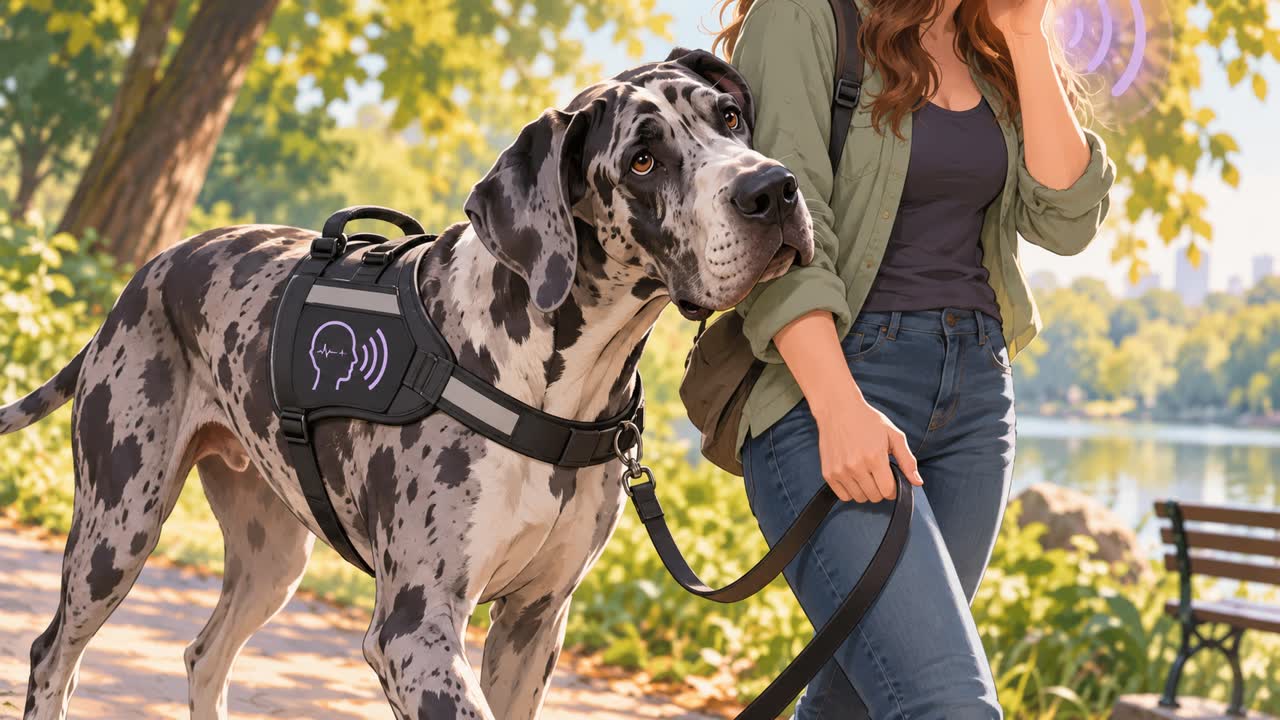
A service dog for migraine alerts may help some people whose migraine symptoms create substantial daily safety or access barriers.
People experience migraine differently. A dog may be trained to respond to an observable change, interrupt a routine, retrieve an item, guide the handler to a safer place, or bring another person for help. A dog should not replace medical evaluation, a migraine treatment plan, prescribed medication, or emergency care.
This guide explains practical planning and access considerations for U.S. handlers. It does not provide medical advice or guarantee that a dog can detect an oncoming migraine.
Quick Overview
- A service dog’s role depends on trained tasks, not a label or purchased paperwork.
- Do not rely on a dog as the only warning system for migraine symptoms.
- Track symptoms, alerts, tasks, and outcomes to discuss with clinicians and trainers.
- Build a migraine action plan that includes medication, safe space, hydration, and support contacts.
1) Define the Role of a Service Dog for Migraine Alerts
Start by identifying the disability-related problem that needs support. Migraine may involve pain, light sensitivity, nausea, dizziness, visual disturbance, cognitive changes, weakness, or other symptoms that make it difficult to work, travel, navigate safely, or seek help.
A service dog may be trained for tasks that help after symptoms begin or when the handler shows a recognizable change.
Some handlers report that a dog notices changes before a migraine becomes obvious, but individual reports do not guarantee reliable prediction. A responsible plan treats any alert as information to assess alongside the handler’s symptoms and clinician-approved migraine strategy.
General information about service animals is available through the Knowledge Center. The key question is whether the dog performs trained work that mitigates the individual handler’s disability-related limitations.
2) Build a Medical and Safety Plan around the Dog
A dog should be one part of a broader migraine plan. Work with a qualified healthcare professional on diagnosis, preventive care, medication, warning signs, and when to seek urgent evaluation. Don’t dismiss new, sudden, severe, or unusual neurological symptoms because a dog did or did not alert.
Keep a practical response plan in places the dog regularly works. It may include prescribed medication, water, sunglasses, ear protection, a charged phone, emergency contacts, a safe place to rest, and transportation options if the handler cannot drive or travel safely.
Tell trusted people what support is appropriate during a serious migraine episode. For example, a support person may need to reduce light and noise, help the handler reach a safe area, monitor a concerning change, or contact medical care based on the handler’s established plan.
Do not train the dog to make medical decisions. The dog can perform a trained response, but the handler and the healthcare professional can determine how to evaluate and treat symptoms.
3) Track Patterns without Overstating Alerts
A written log can help distinguish a true trained behavior from ordinary dog behavior. Record the date, time, environment, the dog’s behavior, the handler’s symptoms, medication taken, migraine onset, and what happened after the task or alert.
Tracking is especially useful when a handler believes the dog is noticing early changes. Over time, the record may show whether the behavior is consistent, whether it occurs in unrelated situations, and whether the response plan is actually useful.
Be cautious about interpreting every nudge, paw, stare, or behavior change as a medical alert. Dogs may react to routine changes, stress, scent, food, the handler’s movement, or environmental distractions. A log supports better conversations with a qualified trainer and clinician without making unsupported claims.
A record app may help organize symptom notes, task observations, medication lists, and emergency contacts. It is an organizational tool, not medical proof or a substitute for professional care.
4) Train Useful Tasks and Public Behavior
Task training should be individualized and safe. Start with the practical outcome needed during a migraine episode: retrieving a phone, bringing a medication pouch, leading the handler to a designated quiet space, interrupting repetitive behavior, or finding another household member.
Training should not encourage the dog to paw at painful areas, jump on the handler, pull the handler when balance is affected, consume medication, or enter unsafe spaces. A qualified trainer can help shape tasks that are clear, consistent, and appropriate for the handler’s mobility, environment, and health needs.
Public readiness matters as much as task work. The dog should remain controlled around crowds, food, noise, transit, workplaces, and medical settings. A dog that cannot settle, lunges, barks repeatedly, or becomes distressed may not be ready for demanding public environments.
A voluntary service screening may help organize task and readiness information. It is not government approval, does not establish medical need, and does not guarantee access in every setting.
5) Understand Access without Relying on Certificates
In many U.S. public settings, access depends on whether a dog is individually trained to do work or perform tasks for a person with a disability. A purchase certificate, registry entry, vest, or ID card generally does not determine public access.
When the dog’s role is not apparent, staff may generally ask whether the dog is required because of a disability and what work or task it has been trained to perform. A handler can answer briefly without disclosing a diagnosis, migraine history, medication list, or personal medical details.
For example, a handler might explain that the dog is trained to retrieve essential items or guide them to a safe place when migraine symptoms interfere with function. The specific answer should be truthful and match the dog’s actual training.
The public access rules provide general context. They do not eliminate the handler’s responsibility to keep the dog under control, housebroken, and safe in the setting being used.
6) Prepare for Work, Travel, and Difficult Days
Plan for predictable migraine triggers and demanding environments. At work, identify a low-light recovery space, a contact person, a safe route home, and a procedure for managing the dog if the handler cannot continue working.
For errands, public transit, or appointments, keep the dog’s role realistic. The handler should still have a backup plan if symptoms worsen, medication is unavailable, or the dog is tired, distracted, ill, or unable to work safely.
When traveling, check airline, hotel, destination, and transportation requirements early. Travel can disrupt medication schedules, sleep, food, hydration, and the dog’s routine. A migraine plan should account for those changes rather than relying on the dog alone.
Review the plan after a difficult episode. Ask what worked, what was unsafe, whether the dog’s task was clear, and whether medical follow-up or additional training is needed. A reliable plan evolves with the handler’s health and the dog’s welfare.
FAQs
Can a service dog for migraine alerts predict every migraine?
No. Don’t treat a dog as a guaranteed migraine predictor. Some dogs may show trained or observed responses to changes in their handler, but consider alerts alongside symptoms and a clinician-approved care plan.
What tasks can a migraine service dog perform?
Possible trained tasks include retrieving a phone or medication pouch, bringing another person, guiding the handler to a safe location, interrupting an unsafe routine, or providing another individualized response that mitigates disability-related limitations.
Does a migraine service dog need a certificate or registration?
No particular purchased certificate, registry entry, vest, or ID card generally establishes public access. The relevant issue is trained disability-related work and controlled behavior.
Should I keep a log of the dog’s alerts?
Yes. A factual record of the dog’s behavior, symptoms, timing, and outcome can help the handler assess patterns and discuss them with a healthcare professional or qualified trainer.
Can the dog replace migraine medication or medical care?
No. A service dog is not a replacement for diagnosis, medication, preventive care, or urgent evaluation when symptoms are severe, new, sudden, or concerning.
Sources
- ADA.gov: Businesses Open to the Public
- ADA.gov: Service Animals
- ADA.gov: Service Animals FAQ
- CDC: Dogs
- CDC: Pet Travel Safety
- U.S. DOT: Service Animals
Takeaway
A migraine service dog can be most useful when its tasks are specific, reliably trained, and integrated into a broader medical and safety plan.
- Do not rely on the dog as a guaranteed medical prediction system.
- Track observed alerts and task outcomes carefully.
- Keep medical care, training, public behavior, and backup planning aligned.