
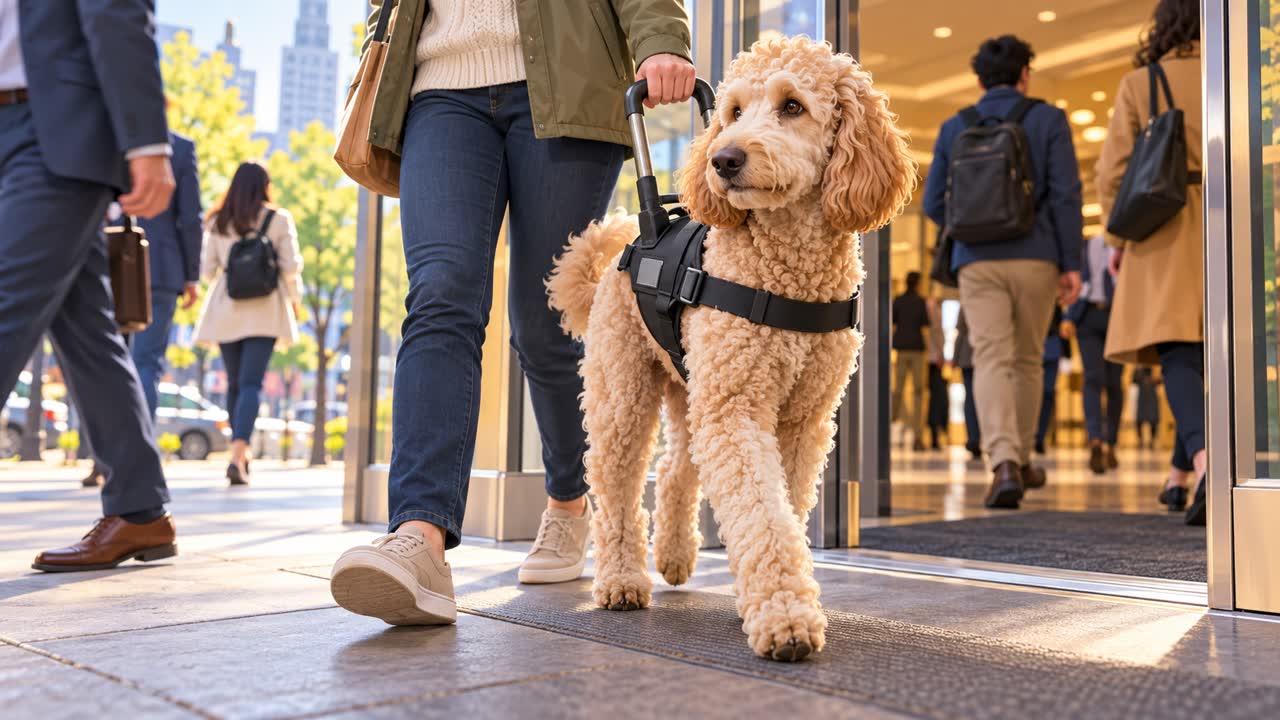
A service dog for balance support in crowded places may help a handler navigate daily environments when the dog is individually trained to perform disability-related tasks and can work safely around people, noise, tight pathways, and sudden movement.
Crowded environments create challenges that do not appear in an empty hallway or quiet home. A handler may encounter bumping, uneven flooring, narrow aisles, long lines, rolling carts, strollers, bags, and people moving unpredictably.
This guide provides general U.S. educational information. It does not replace individualized advice from a healthcare professional, physical therapist, qualified trainer, or veterinarian about balance, mobility aids, or safe service-dog work.
Quick Overview
- Use trained tasks that are safe for the handler and physically appropriate for the dog.
- Do not improvise bracing, pulling, or counterbalance work without qualified guidance.
- Plan routes, quiet times, exits, and rest points before entering crowded locations.
- Keep the dog close and clear of aisles, doors, carts, escalators, and other people’s feet.
1) Define the Role of a Service Dog for Balance Support in Crowded Places
Start by identifying the specific disability-related barrier. A person may have dizziness, weakness, an altered gait, fatigue, sensory overload, neurological symptoms, reduced awareness of surroundings, or another condition that makes moving through crowds less safe or less independent.
A service dog may be trained to guide the handler to a clear route, find an exit, retrieve a dropped mobility item, provide a trained interruption, get help, or help the handler create controlled space while moving through a crowd.
Not every dog is physically appropriate for mobility-related work.
Regulations provide general service-animal information, but the dog’s actual tasks and safe handling matter more than a broad mobility label.
2) Build a Crowd-Safety Plan Before Leaving Home
Think through the location before arriving. A grocery store, concert, medical office, transit station, festival, and airport can all create different risks. Check the route, entrances, accessible parking, elevator availability, restroom location, seating, and quiet areas where the team can pause if the environment becomes overwhelming.
When possible, choose less crowded times. Arriving early, using an appointment window, shopping during off-peak hours, or selecting a quieter entrance can reduce bumping and give the handler more room to move deliberately.
Have a clear exit plan. If the dog becomes stressed, the handler feels unsteady, symptoms worsen, or the crowd becomes too dense, leaving early may be safer than trying to push through. A successful outing is not defined by staying until every task is complete.
Bring only necessary items, and keep hands as free as possible. A heavy bag, loose leash, phone, drink, and multiple packages can make it harder to use mobility equipment, respond to a dog’s cue, or recover from a loss of balance.
3) Use Safe Positioning in Lines, Aisles, and Doorways
In a line, the dog should remain close to the handler without extending behind into another person’s path.
In stores and public buildings, avoid stopping at the center of an aisle, directly inside an entrance, near an elevator door, or at the bottom of stairs.
Use elevators or another safe route when escalators could create paw, leash, fur, or equipment hazards. Do not force a dog onto an escalator simply because the handler feels rushed or other people are waiting.
The public access guide provides general context for public settings. In crowded places, controlled positioning and awareness of others’ movement are essential for both access and safety.
4) Practice Useful Skills without Overloading the Dog
Crowded work requires more than basic obedience. The dog may need to settle near a chair, stay close through narrow spaces, stop when the handler stops, respond to directional cues, ignore food and strangers, and remain calm around carts, children, sudden sounds, and other animals.
Build difficulty gradually. Practice in quiet locations first, then add modest distractions, shorter trips, and controlled environments before relying on the dog at a packed event or during a rush-hour errand.
Watch for signs that the dog is reaching its limit: repeated scanning, pulling, panting unrelated to heat, inability to settle, avoidance, vocalizing, or loss of focus. A stressed dog may not be able to perform trained tasks safely, even when the handler needs support.
A voluntary behavior screening may help identify crowd-readiness skills to practice. It is not government approval and does not replace individual training, veterinary care, or a realistic safety plan.
5) Use Mobility Aids and Backup Support when Appropriate
A service dog may be one part of a larger mobility plan, not the only protection against falls. Depending on the handler’s needs, that plan may also include a cane, walker, wheelchair, seating breaks, medication, accessible transportation, a support person, or a physical therapist’s recommendations.
Do not alter a trained task in the moment because the crowd feels difficult. Asking a dog to pull harder, brace unexpectedly, or move through an unsafe gap can injure the dog, destabilize the handler, or put nearby people at risk.
Tell a trusted companion how to assist if the handler becomes unsteady or cannot manage the dog temporarily. The companion should understand that the dog is working and should avoid giving conflicting commands or distracting the dog from trained tasks.
Keep emergency contact information and needed medication accessible. If a fall, severe dizziness, chest pain, sudden weakness, or another urgent symptom occurs, seek appropriate medical help rather than depending on the dog alone.
6) Communicate with Staff and Other People Calmly
People in crowded places may reach for the dog, take photos, call to it, or ask questions. A short boundary statement such as, “The dog is working; please give us space,” is often enough. Move away when possible rather than trying to educate everyone in the moment.
When the dog’s function is not apparent, authorized staff may generally ask whether the dog is required because of a disability and what role it has been trained to perform. A handler can answer briefly without disclosing a diagnosis, treatment history, or detailed mobility limitations.
A purchased certificate, registry entry, vest, or ID card does not itself establish service-dog access. Optional identification may provide organization or recognition, but trained disability-related work and controlled behavior remain central.
A voluntary service screening may help organize task and readiness information. It is not medical proof, government approval, or a substitute for the handler’s own safety planning.
FAQs
Can a service dog for balance support in crowded places help prevent falls?
A trained dog may perform specific disability-related tasks that support safer movement, but the dog should not be the only fall-prevention strategy. Discuss mobility needs with qualified healthcare and training professionals.
Can my service dog brace me if I feel unsteady?
Do not ask a dog to brace or bear weight unless the task has been safely trained and is physically appropriate for that dog. Improvised weight-bearing can injure both the handler and dog.
Where should my dog stand in a crowded line?
The dog should stay close to the handler in a position that does not block the line, aisle, doorway, or another person’s path. A tucked position beside or slightly behind the handler often works well.
Does my service dog need a vest or certificate in public?
No particular purchased certificate, registry entry, vest, or ID card generally determines access. The relevant issues are trained disability-related work and controlled behavior.
What if people keep trying to pet my dog?
Use a short boundary statement, create distance when possible, and keep the dog focused on the handler. Avoid allowing repeated distractions that could interfere with the dog’s trained work.
Sources
- ADA.gov: Businesses Open to the Public
- ADA.gov: Service Animals
- ADA.gov: Service Animals FAQ
- CDC: Dogs
- CDC: Pet Travel Safety
- U.S. DOT: Service Animals
Takeaway
A service dog can support a handler in crowded places when the dog’s tasks are safely trained, the team uses controlled positioning, and the handler has a broader plan for mobility and fall prevention.
- Choose trained tasks that protect both the handler and dog.
- Plan routes, quiet times, exits, and safe stopping points before entering a crowd.
- Use backup mobility support and leave early when conditions become unsafe.