
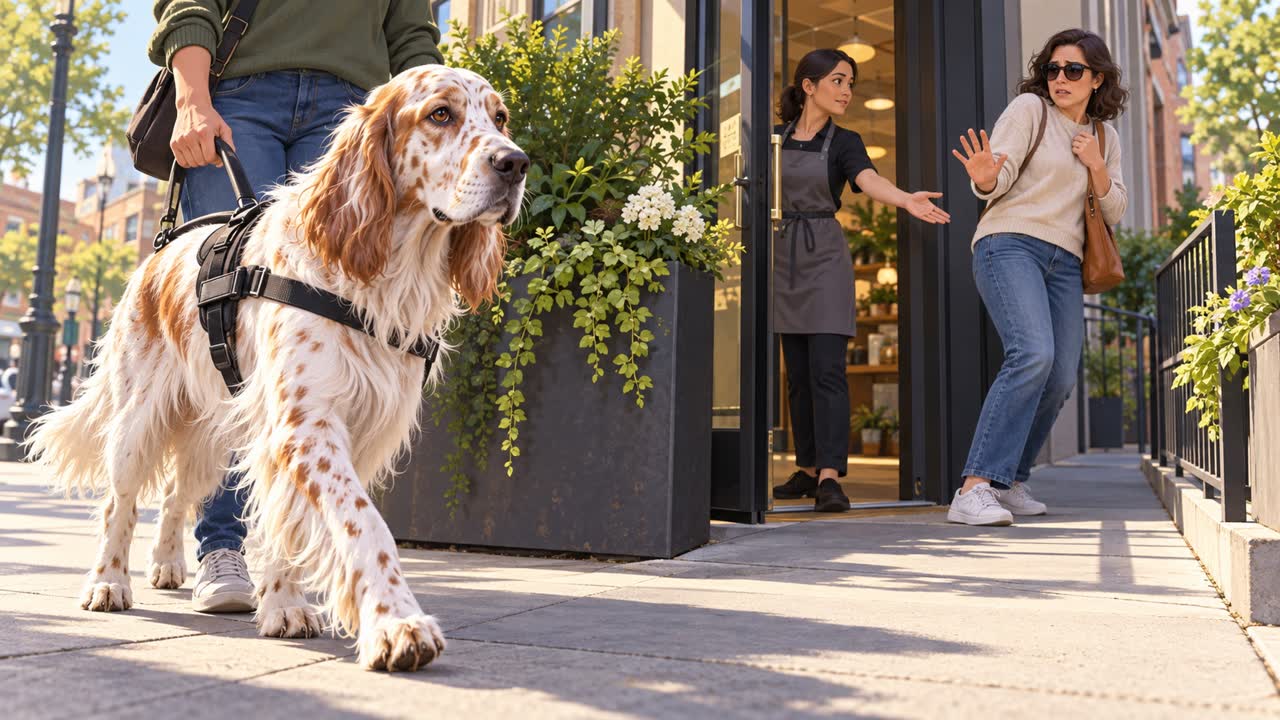
A service dog fear-of-dogs accommodation conflict arises when one person needs a trained service dog. At the same time, another person may have a serious fear of dogs that also affects access to work, housing, education, healthcare, or public services. The practical answer is usually not to declare one person’s need more important than the other’s. The responsible decision-maker should gather facts and look for an arrangement that gives both people meaningful access.
Fear alone does not automatically justify excluding a service dog. At the same time, a documented disability-related limitation should not be dismissed as ordinary discomfort. Distance, scheduling, seating, routes, barriers, and communication protocols can often reduce contact without separating the handler from the dog.
The governing process depends on the setting. A business follows public-access rules, while employers, housing providers, schools, and healthcare facilities may use different accommodation procedures.
Quick Overview
- Identify each person’s functional need without demanding unnecessary medical details.
- Separate ordinary preference from a disability-related limitation requiring review.
- Use distance, timing, routes, seating, barriers, or remote options where effective.
- Do not automatically require the service-dog handler to abandon the dog.
1) Define the Service Dog-Fear-of-Dogs Accommodation Conflict
Begin by identifying the setting, the decision-maker, and the points where the two people must share space. A brief encounter in a store is different from adjoining workstations, neighboring apartments, a semester-long classroom assignment, or recurring medical appointments.
The service-dog handler’s need concerns the dog’s trained disability-related work. The other person’s concern may range from discomfort to a clinically significant fear that substantially limits functioning. The decision-maker should avoid diagnosing either person and instead use the accommodation process appropriate to the setting.
Ask practical questions: How close must the individuals be? How often do their paths cross? Is contact predictable? Can either route or schedule change without reducing access? Current regulations provide general context, but the solution must address the actual environment.
2) Use the Correct Legal and Administrative Process
In a public-facing business, a qualifying service dog may generally accompany its handler in customer areas. Staff ordinarily cannot exclude the dog simply because another person is afraid. They may address a dog that is out of control, not housebroken, or subject to another recognized exception.
Employment conflicts should usually go through the employer’s reasonable-accommodation process. Housing providers should evaluate requests under applicable fair-housing requirements. Schools and healthcare facilities may have disability coordinators or patient-access staff who can assess both individuals’ needs.
When disability or need is not apparent, an employer or housing provider may sometimes request limited, relevant supporting information under the rules governing that setting. Public-access staff should not import those broader documentation practices into an ordinary customer interaction.
The public access guide can help distinguish customer access from settings that require a separate accommodation review.
3) Gather Facts without Forcing Unnecessary Disclosure
Speak with each person separately when possible. Ask what activity is limited, when the problem occurs, and what changes might provide effective access. Avoid requiring either person to debate private medical information in front of the other.
For the service-dog team, relevant facts may include the dog’s trained task, required proximity to the handler, settling position, movement routes, and whether distance would interfere with the task. A purchased certificate, registry entry, vest, or ID card is generally not the deciding factor.
For someone who fears dogs, relevant facts may include the required distance, whether visual contact or unexpected proximity triggers symptoms, and which entrances, rooms, or times create the conflict. The person should not be required to interact with or approach the dog as a test.
A voluntary PSA check may help organize task or readiness information for a psychiatric service animal, but it is not government approval and does not resolve competing accommodation needs.
4) Build an Arrangement that Protects Both People
Effective solutions reduce unnecessary contact while preserving each person’s access. The appropriate combination depends on the location and whether the individuals must participate at the same time.
Possible measures include:
- Workstations, seats, or waiting areas with greater separation.
- Different entrances, hallways, elevators, or relief routes.
- Staggered arrival, break, meeting, or appointment times.
- A door, partition, cubicle wall, or other visual barrier.
- Advance notice before shared-space use when appropriate.
- Remote participation for selected activities if equally effective and acceptable.
The service dog should remain under control and positioned so it does not approach the other person. The person with the fear should have a predictable route that does not require passing closely beside the dog. Neither individual should be isolated, penalized, or denied a meaningful benefit when a less restrictive option works.
5) Avoid Common Conflict-Management Mistakes
Do not treat “I am afraid of dogs” as an automatic veto, and do not respond that fear can never be a disability-related concern. Both shortcuts avoid the individualized analysis that a genuine accommodation conflict requires.
Do not require the handler to leave the dog elsewhere before determining whether separation or scheduling would work. Likewise, do not tell the other person to simply tolerate close contact, pet the dog, or participate in unrequested exposure exercises.
Avoid relying on breed, size, appearance, or stereotypes as proof of danger. Connect a specific restriction to observable conduct, an actual risk, or a documented functional limitation.
Optional records can support continuity. You may store agreements, incident notes, approved routes, and review dates in a record app, but recordkeeping does not replace a fair decision-making process.
6) Respond to Incidents and Review the Plan
If the dog moves toward the fearful person, barks repeatedly, or otherwise disrupts the arrangement, create distance first. Determine what happened before changing the accommodation. An isolated mistake, an uncontrolled pattern, and a trained task response may require different action.
If the person with the fear experiences symptoms despite the agreed separation, review whether routes, timing, signage, or communication failed. The response should focus on improving the arrangement rather than blaming either participant.
Document dates, locations, witnesses, conduct, and steps taken. Keep medical information separate from general incident reports and share it only with people who need it for the accommodation process.
Set a review date, especially when schedules, workstations, housing assignments, or treatment needs may change. If no effective solution emerges, the appropriate disability coordinator, fair-housing organization, government agency, union representative, or qualified attorney may help evaluate the dispute.
FAQs
How should a service dog fear-of-dogs accommodation conflict be resolved?
The responsible organization should assess both individuals’ functional needs and consider distance, scheduling, routes, seating, barriers, and other effective measures before excluding either person.
Can fear of dogs justify excluding a service dog?
Fear by itself generally does not justify exclusion from public areas. A disability-related fear may require accommodation, but the first approach is usually to accommodate both people rather than automatically remove the dog.
Does the person who fears dogs need medical documentation?
Documentation rules depend on the setting. An employer or housing provider may request limited supporting information when disability or need is not apparent, while ordinary public-access encounters use different rules.
Must the service-dog handler provide certification?
A purchased certificate, registration, vest, or ID card is generally not required for ADA public access. Other settings may request relevant disability-related information through their lawful accommodation procedures, but commercial certification does not determine the outcome.
Can the two people be scheduled at different times?
Yes, if staggered scheduling gives both people effective access and does not unfairly burden one person. The decision-maker should compare it with less disruptive options.
What if the dog is calm but the fear remains severe?
The organization should still consider distance, visual barriers, alternate routes, advance notice, or scheduling changes. Calm behavior reduces conduct concerns but does not erase another person’s disability-related limitation.
Sources
- U.S. DOJ/HUD: Reasonable Accommodations Under the Fair Housing Act
- U.S. DOJ: Service Animals and Assistance Animals
- ADA.gov: Service Animals FAQ
- ADA.gov: Service Animals
- CDC: Dogs
Takeaway
A workable conflict plan respects both disability-related needs and replaces blanket exclusion with specific, measurable arrangements.
- Use the accommodation process that applies to the setting.
- Reduce contact through distance, timing, routes, or barriers.
- Document the agreement and revise it when facts or conditions change.