
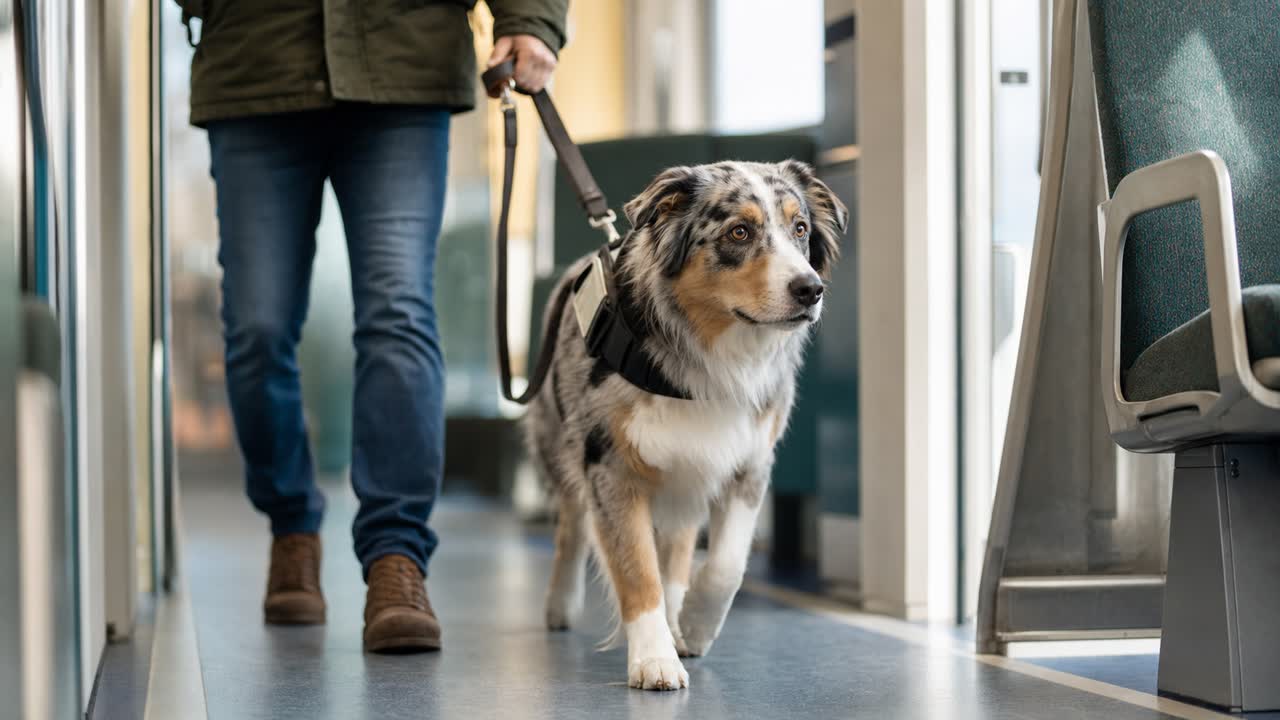
A service dog during workplace security screening should usually be handled with as little disruption as possible: the dog stays under control, the handler communicates clearly, and security staff focuses on safety without treating ordinary screening as a test of disability status. In most workplaces, the practical goal is getting everyone through the checkpoint safely while preserving access and privacy.
This topic is narrower than general workplace accommodation or airport screening. Here, the issue is what happens at the front desk, badge station, metal detector, bag check, or visitor screening point when a trained service dog accompanies an employee, contractor, or guest into the building.
Most problems come from uncertainty, not bad intent. A short explanation, a calm dog, and a few organized records can reduce friction. It can also help to review a basic rules guide ahead of time so everyone involved understands the difference between access questions and safety procedures.
Quick Overview
- A workplace can use standard security measures, but screening should be adapted as needed so that a handler can enter with a trained service dog.
- Staff should focus on safety and building procedures, not on demanding unnecessary proof, ID cards, or certificates.
- A calm explanation of the dog’s working role often resolves confusion before it escalates.
- Good behavior matters in real life: loose-leash control, focus, and quiet waiting are often more persuasive than paperwork.
1) What Security Screening Usually can and cannot Do
Workplace security teams may inspect bags, verify identity, and apply standard entry rules. That does not automatically mean they should separate a handler from a service dog, force the dog through equipment that is unsafe or confusing, or demand paperwork that the building does not normally require from others.
In many offices, security staff are not the final decision-makers on disability accommodation. They are carrying out building procedures. That is why it helps to distinguish between access control and disability review. Security may need to confirm who you are and where you are going, but broader accommodation questions often belong with HR, facilities, or an ADA coordinator.
For a practical baseline, think in terms of safety plus access. A trained dog that is under control and working alongside its handler should not be treated as suspicious simply for being present. If you want a simple refresher on access expectations, the core public access rules are a useful place to start.
2) How to Prepare before a Screening Checkpoint
The smoothest screening interactions usually happen before anyone reaches the front door. If your workplace uses turnstiles, metal detectors, wanding, bag checks, or guard stations, ask in advance how they handle service animals. That conversation can stay practical: where to enter, whether there is an alternate lane, and who to contact if a guard is unsure.
It is often smart to carry a small folder or digital note with relevant details. Some handlers keep a short task summary, accommodation email, and a simple service screening checklist so they can answer practical checkpoint questions without oversharing.
Preparation also includes the dog’s routine. A dog that has practiced waiting, ignoring strangers, moving through narrow entrances, and tolerating brief pauses is much less likely to create conflict at screening.
3) How to Handle the Moment of Screening
When you arrive, lead with a short calm script. Something as simple as, “This is my service dog. Let me know how you want to complete screening,” keeps the tone cooperative without oversharing. In most cases, security staff wants a workable process, not an argument.
If the dog’s gear contains metal, if the dog should not pass through certain equipment, or if leash handling needs to change for a moment, say so early. Ask whether the team prefers visual inspection, wanding around the handler, or another routine that keeps the dog beside you. Alternate screening is often the most practical answer.
This is where behavior becomes the real proof point. A dog that remains quiet, responsive, and close to the handler immediately reduces concern. If you are refining that side of the equation, focused behavior screening can be a useful way to identify the habits that matter most at checkpoints and other controlled entrances.
4) What to Say If Staff Ask for Paperwork or Certification
Some guards may ask for registration, certification, an ID badge, or a doctor’s letter because they think that is standard procedure. In many settings, those items are not always legally required for public-facing access questions. Still, it helps to answer without sounding confrontational.
A practical response is: “I can cooperate with building screening, but I may not have the specific paperwork you’re asking for. If needed, please get in touch with HR or the accommodation contact on file.” This keeps the conversation centered on the right decision-maker.
If you do carry optional identification or a program evaluation, that can sometimes make the interaction easier, but it should be treated as organizational support, not magic legal proof. The strongest combination is usually calm handling, a clear explanation of the task when appropriate, and prior workplace coordination, rather than a marketplace-style document.
5) Special Issues in High-Security or Sensitive Workplaces
Some environments have stricter security than a typical office: government contractors, labs, data centers, manufacturing sites, hospitals, or buildings with controlled research areas. In those places, screening may involve additional steps, escorts, restricted zones, or safety rules about where animals can and cannot go.
That does not erase access considerations, but it does mean planning matters more. The handler may need a documented route, a designated relief area, or an alternate entry procedure. In rare cases, specific safety risks may require a tailored solution rather than ordinary front-door screening.
This is also where scope matters. A service dog during workplace security screening is not the same as a general article about hiring, job interviews, or courtroom entry. The issue here is checkpoint procedure and how to avoid unnecessary denial, delay, or separation at the building entrance.
6) What to Do If Screening Goes Badly
If you are delayed or challenged, try to document facts rather than emotion first. Note the date, time, names, what was said, and what step of screening caused the problem. If possible, ask politely for a supervisor or the building’s accommodation contact.
After the incident, send a short written summary to the appropriate workplace contact. Focus on what would solve the problem next time: alternative screening, staff training, advance-notice instructions, or a clearer internal policy. Many disputes calm down once the process is clarified in writing.
If the dog was actually out of control, fix that piece honestly. If the issue was staff confusion, ask for a documented procedure so you do not start from scratch at every checkpoint.
FAQs
Can a workplace require separate screening for a service dog during workplace security screening?
Sometimes an alternate screening method is the safest option, but it should be designed to preserve access and keep the handler with the dog whenever possible.
Do I need a certificate or ID card to bring my service dog through office security?
Not always. Optional identification may help with organization or peace of mind, but calm behavior, relevant workplace communication, and proper handling are usually more important.
Should I tell security in advance?
If the workplace uses formal checkpoints, advance notice is often helpful even when it is not strictly required. It gives staff time to set up a smooth process.
Can security ask what my disability is?
Security staff should stay focused on screening and entry procedures. Detailed disability discussions are usually better handled by the workplace contact responsible for accommodations.
What records are most useful to keep?
Useful records may include accommodation emails, emergency contacts, task notes, training logs, and any internal approval documents relevant to the building.
Sources
- ADA.gov: Service Animals
- ADA.gov: Service Animals FAQ
- CDC: Dogs
- CDC: Pet Travel Safety
- HUD: Information for Persons with Disabilities
Takeaway
A service dog at a workplace checkpoint is usually easiest to manage when security staff and the handler treat screening as a practical safety process rather than a debate over labels. Advance coordination, steady behavior, and clear escalation paths reduce most problems.
- Prepare for the checkpoint before arrival, especially in higher-security buildings.
- Use practical records and calm communication instead of relying on certificates alone.
- If screening fails, document the problem and push for a written process for next time.