
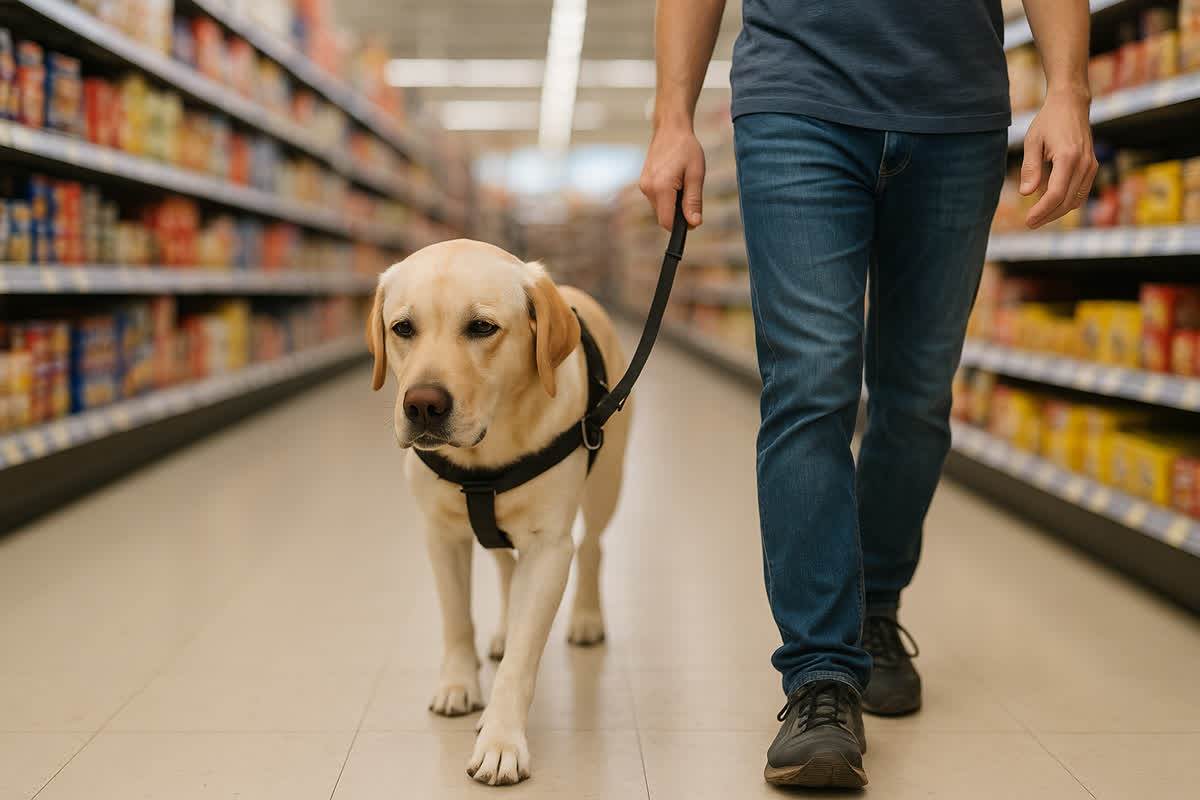
One of the fastest ways a well-trained team falls apart in public isn’t a loud noise or a crowded aisle—it’s people. Someone talks to your dog, reaches out, makes kissy noises, or tries to offer food. Even a solid dog can lose focus if these moments happen repeatedly.
This guide gives you a simple, repeatable plan for handling interruptions without escalating conflict. It’s written for real life: stores, sidewalks, hotel lobbies, airports, and waiting rooms. (Educational overview only, not legal advice.)
Service animals benefit most from consistent “ignore” routines because the standard for public behavior is higher. The goal isn’t to create a dog who never notices anything — it’s a dog who re-orients to you quickly and stays predictable.
Why Distractions Matter (and why “he’s friendly” is a problem)
Public access depends on predictability. When strangers interact with your dog, you risk:
- Broken focus (the dog scans instead of working)
- Reinforced greeting behavior (pulling, approaching, whining)
- Food-seeking (sniffing, counter interest)
- Stress stacking (the dog looks calm, but can’t settle later)
Even “positive” interactions can become a training problem. If your dog learns that eye contact with strangers pays off, you’ll see more checking-in with the environment and less engagement with the handler — the opposite of what you want.
The Goal: Protect Your Dog’s “Working Bubble”
Your job isn’t to win arguments — it’s to keep the dog working. Think “bubble”:
- Space: Create distance when possible (one step sideways helps)
- Clarity: The dog is rewarded for staying engaged with you
- Consistency: Strangers never get reinforced by the dog’s attention
In practice, this means you proactively move, body-block, and pay the dog for correct choices — before the interaction turns into a tug-of-war.
What to do in the Moment (3 scripts + 3 actions)
Pick a phrase you can say calmly every time. The calmer you are, the faster the situation ends.
Script #1 (friendly)
“Thanks—he’s working. “Please, don’t distract him.”
Script #2 (short and firm)
“Please don’t talk to my dog.”
Script #3 (exit)
“We need a little space. Thanks.”
Pair the script with one of these actions:
- Body block: Step between the person and the dog
- U‑turn: Turn and walk 5–10 steps away to reset
- Settle rep: Stop, cue “place/settle,” reward calm
Scenario Playbook (stores, airports, hotels)
1) Checkout lines and tight aisles
- Stand with the dog parallel to you, not facing the crowd.
- Use a short “settle” routine: cue → breathe → reward → repeat.
- If someone reaches down, step forward to body-block and say your short script.
2) TSA/security screening
- Assume distractions will happen: prepare a few high‑value rewards.
- Before you enter the line, do 20–30 seconds of easy engagement reps.
- After screening, take 60 seconds away from traffic to reset and reward calm.
3) Hotel lobbies and elevators
- Use corners and walls to reduce traffic on both sides.
- Elevators are tiny: keep the dog tucked in, reward stillness, and exit calmly.
- If the lobby is chaotic, don’t “push through.” Take a short break outside and re-enter.
Training Plan (make “ignore” automatic)
Don’t wait for a crowded store to practice. Use small sessions with clear criteria:
- Engagement reps: Reward eye contact around mild distractions
- neutrality reps reps: Reward “ignore” when someone passes by
- Food refusal reps: Practice ignoring dropped food and offered snacks
A simple structure:
- Warm-up (2 minutes): Easy cues your dog wins fast.
- Work (6 minutes): 10–15 reps of “ignore + reward.”
- Cool-down (2 minutes): Settle, then leave while you’re still successful.
Common Mistakes (and how to fix them)
- Explaining too much (it invites debate). Keep it short and move.
- Correcting the dog harshly for a human problem. Reset and reward instead.
- Letting the dog greet “just this once” in gear. It trains inconsistency.
- Training only in one location. Generalize slowly across multiple places.
FAQs
- Can people pet a service dog?
It’s best to assume no while the dog is working. Random petting trains the dog to accept strangers as part of the job. - What if someone offers my dog food?
Step in, body-block, say your short script, and immediately reward your dog for ignoring. Later, practice food-refusal reps in controlled setups. - What if my dog breaks focus?
Don’t panic. Create distance, do a 30–60 second reset (engagement + settle), then re-try at an easier difficulty. - How long does it take to fix distraction problems?
With consistent practice, most teams see improvement in weeks, but true stability is built over months across many environments.
Quick Summary
- Use short scripts and simple movement — protect the working bubble.
- Reward engagement and calm, especially after interruptions.
- Train “ignore” in small sessions before testing it in harsh environments.
Next step: Run one 10‑minute practice session in a mildly distracting place and aim for 10 clean “ignore + reward” reps. That one habit improves public access faster than long, stressful outings.