
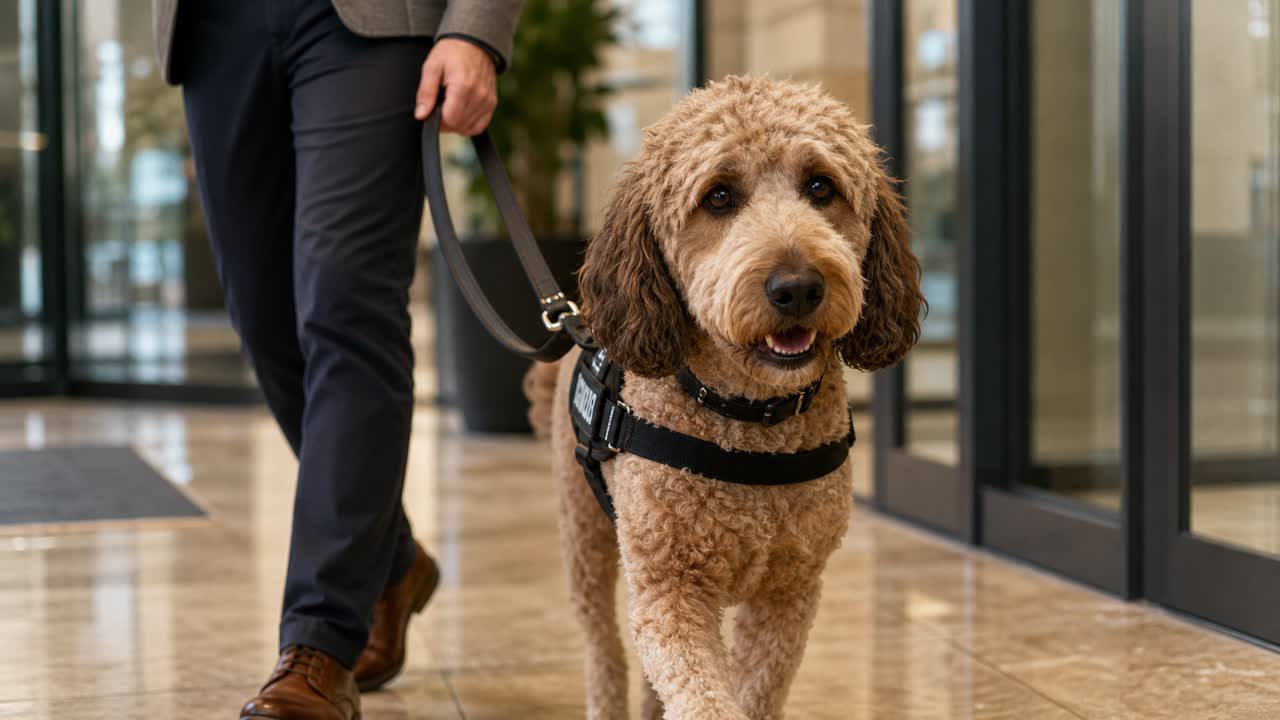
If you are wondering whether service dogs are allowed in urgent care clinics, the short answer is usually yes. Urgent care centers are generally public-facing healthcare settings, which means a trained service dog can usually accompany a person with a disability in areas where patients are normally allowed to go.
The real questions tend to be practical ones: how the dog will behave in a crowded waiting room, whether the clinic can limit access to certain treatment areas, and what staff can ask at check-in. It depends on whether the dog meets the service-animal standard and can stay under control in a medical environment.
This topic is different from air travel or housing documentation. It is mainly about public-facing healthcare access, patient flow, and safety inside a clinic. For the broader baseline, it helps to understand the usual public access guide before you arrive.
Quick Overview
- A trained service dog is usually allowed in urgent care clinics where patients are normally permitted.
- Clinic staff may focus on behavior, safety, and access needs, not on certificates, registries, or ID cards.
- A service dog may be restricted from certain spaces if a genuine medical or safety reason applies.
- Waiting rooms, triage desks, and exam areas can be harder than routine errands because of noise, stress, and tight spaces.
1)When is a Service Dog Usually Allowed in Urgent Care Clinics
In most cases, urgent care clinics must allow a legitimate service dog to accompany the handler in public and patient-access areas. The basic rule follows the familiar service-animal model: a dog individually trained to do work or perform tasks for a person with a disability.
That does not mean every dog can come into a clinic simply because the handler says the dog provides comfort. A dog that qualifies as a service animal and remains under controll will usually be treated very differently from a pet or emotional support animal.
If you want to think through whether your dog fits the usual public-facing standard before a visit, a simple service check can help you organize the basics in your own mind.
2) What can the Clinic Staff Ask at Check-In
At check-in, staff may sometimes ask the usual narrow questions used in public-access settings: whether the service animal is mandatory because of a condition and what task or work the dog has been coached to perform.
In real life, some clinic employees may still be unsure about the rules, especially if the lobby is crowded or the dog is unfamiliar to them. Long debates at the front desk rarely help when the dog is already behaving appropriately, and the clinic is trying to move patients through triage.
Optional documents may still be useful for your own organization or peace of mind, but they are not usually the center of the access question. A clinic is more likely to care whether the dog can stay quiet, close, and out of the way than whether the handler can produce extra paperwork.
3) Waiting Rooms, Exam Rooms, and Restricted Areas
One reason this topic deserves its own article is that urgent care is not the same as a grocery store or a government office. A dog that does fine on ordinary outings still needs to cope with rolling carts, crying children, coughing patients, disinfectant smells, and long waits.
In many cases, the dog can remain with the handler through check-in, triage, and the exam itself. But there may be limited situations in which a clinic restricts access to a particular area due to a real medical or safety concern.
Handlers can help a lot by planning for position and movement. A dog that can tuck under a chair, settle beside the exam table, or heel closely in a narrow hallway is far less likely to create friction than a dog that sprawls into traffic or scans every person who passes.
4) How to Prepare before the Visit
The best preparation for urgent care is practical rather than paper-heavy. If the dog performs mobility, alert, psychiatric, or retrieval tasks, picture how those tasks will work in a small exam room or a long waiting line.
It also helps to bring the basics that make medical visits easier: water if appropriate, waste supplies, and a plan for where the dog will settle if you need imaging, bloodwork, or a brief procedure.
Routine public manners matter more in urgent care than in many other settings. A dog that sniffs medical bags, vocalizes at strangers, or cannot settle during delays may create problems even if the dog does perform real tasks.
5) When a Clinic may Ask the Dog to Leave
Even a legitimate service dog can be removed if the dog is out of control and the handler does not take effective action. Repeated barking, lunging, snapping, blocking staff movement, relieving itself indoors, or interfering with patient care can all become valid reasons for the clinic to act.
The important distinction is that removal should be about the dog’s actual behavior or a genuine safety issue, not about general discomfort with dogs or a belief that all service animals need documents. In other words, the clinic should focus on what is happening in the moment, not on myths about registration.
If a problem starts, stepping aside, resetting the dog, or briefly moving to a quieter corner often helps. Calm correction protects access far better than trying to argue while the dog is still struggling in a stressful environment.
6) What to Do If Staff Seem Unsure or You Face Pushback
If staff seem uncertain, keep the conversation centered on access and behavior. If the concern is about where the dog can stand, whether the leash can stay short, or how to handle a crowded exam room, those are usually solvable problems.
It also helps to keep this topic separate from unrelated article families. This is not mainly about housing accommodation paperwork or travel forms. It is about getting through a same-day clinic visit without unnecessary friction while still respecting medical workflow and other patients’ needs.
Most visits go more smoothly when the dog is steady, the handler is prepared, and everyone stays focused on the appointment rather than turning check-in into a paperwork contest.
For related guidance, see our knowledge hub, service check, public access guide, and tracking app.
FAQs
Are service dogs usually allowed at urgent care clinics?
Yes, in most cases. A trained service dog is generally allowed in patient-access areas of urgent care clinics as long as the dog is under control and does not create a direct problem.
Can urgent care staff ask for a certificate or registration?
Not usually. Staff may ask whether the dog is a service animal and what task it executes, but access generally does not depend on presenting a certificate or registry listing.
Can the clinic keep my dog out of an exam room?
Often, the dog can stay with you in the exam room, but a clinic may limit access to a specific space if there is a legitimate medical, sterile, or safety reason associated with that area.
What if my dog is stressed by the waiting room?
If the dog struggles with close crowds, noise, or long delays, try to reset in a quieter spot if the clinic allows it. A strong settle cue and short leash handling can make a big difference.
Can a clinic remove my service dog for behavior problems?
Yes. If the dog is out of control, disruptive, or interfering with care, the clinic may have grounds to ask that the dog be removed from the setting.
Sources
- U.S. DOT: Service Animals
- CDC Yellow Book: Traveling with Pets and Service Animals
- CDC: Pet Travel Safety
- ADA.gov: Service Animals FAQ
- ADA.gov: Service Animals
Takeaway
A service dog at an urgent care clinic is usually allowed when the dog meets the service-animal standard and can work calmly in a busy healthcare environment. Most problems come from behavior, tight spaces, or confusion about the rules rather than from the core access principle itself.
- Focus on control, positioning, and calm handling in waiting and exam areas.
- Keep access discussions short and practical instead of certificate-focused.
- Plan ahead for stress, delays, and any area-specific medical restrictions.