
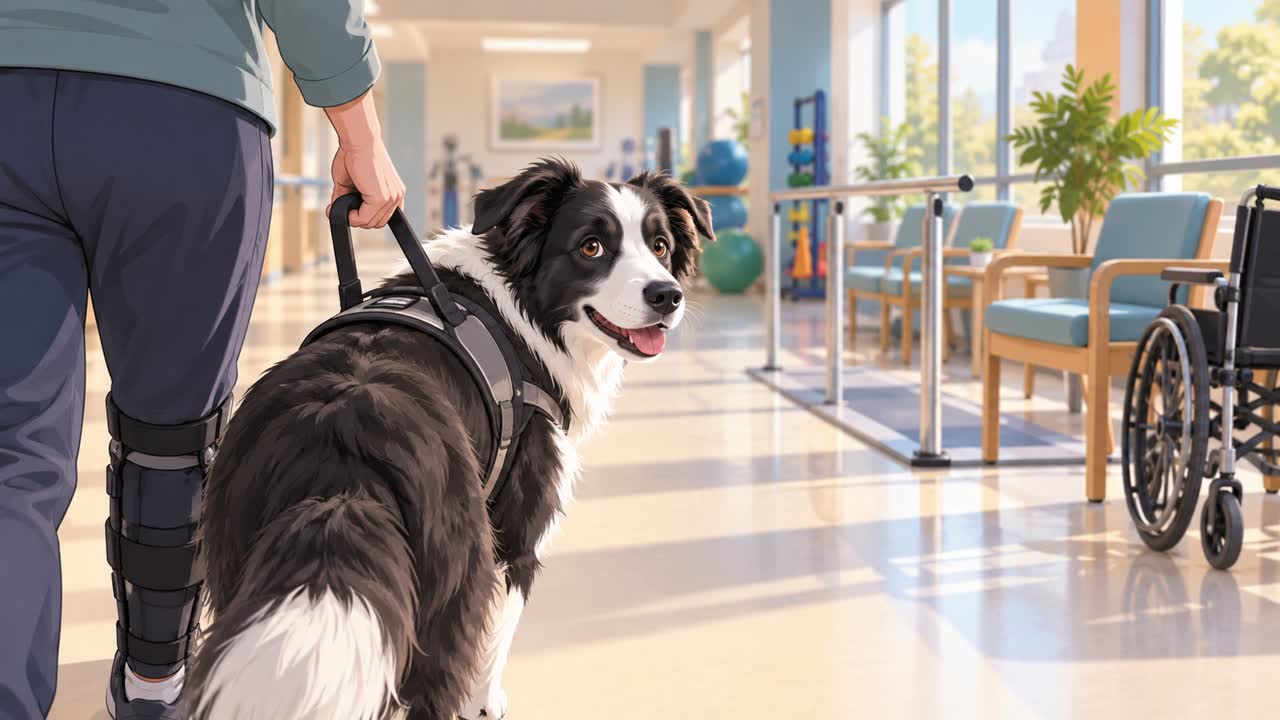
A service dog at rehabilitation hospital facilities is generally allowed in areas open to patients and visitors when the dog meets the Americans with Disabilities Act (ADA) definition and remains under control. Access is not unlimited, however. A hospital may restrict a dog from locations where its presence would create a legitimate safety concern or compromise a sterile environment.
Rehabilitation hospitals present questions that do not usually arise during a brief medical appointment. A patient may stay overnight, attend several therapy sessions, share a room, or temporarily be unable to handle the dog independently. Planning should therefore address access, daily care, therapy participation, infection control, and emergency arrangements.
This guide focuses on those operational issues rather than general healthcare access. Hospital staff and handlers should work from the individual patient’s needs and the actual conditions of each clinical area.
Quick Overview
- A service dog is generally permitted in hospital areas where patients or visitors may go.
- Access may be restricted in sterile or specially controlled locations, such as operating rooms.
- The dog must remain under control and be housebroken.
- The handler, not hospital staff, is ordinarily responsible for the dog’s feeding, supervision, and relief needs.
1) Where a Service Dog at Rehabilitation Hospital Facilities may Go
Under the ADA, a service dog may generally accompany its handler in areas where members of the public, patients, or visitors are allowed. In a rehabilitation hospital, this may include a patient room, reception area, cafeteria, hallway, consultation room, and many physical or occupational therapy spaces.
Hospitals may exclude service animals from locations where their presence could interfere with necessary sterile conditions or create a genuine safety risk. Examples may include operating rooms, certain burn-care areas, or rooms with specific infection-control requirements. A restriction should be connected to the conditions in that particular location rather than imposed across the entire hospital without an individualized assessment.
The ADA baseline is summarized in this public access guide. State law and facility-specific clinical obligations may provide additional context, so staff should confirm which rules apply.
2) Questions, Identification, and Admission Planning
If the dog’s role is not apparent, hospital staff may generally ask two questions: Is it a disability that makes a service dog required, and what labor or task has the dog been trained to perform?
Optional records may still help with organization and planning. A patient might bring a task list, veterinary contact information, vaccination records required under generally applicable local rules, and details for an emergency caregiver. These records do not replace the ADA definition or guarantee access to every clinical area.
Before a planned admission, contact the hospital’s patient advocate, accessibility coordinator, or nursing unit. A voluntary service check can help a handler organize task and readiness information, but it is not government approval and does not decide hospital access.
3) Who Cares for the Dog During an Inpatient Stay
The handler is ordinarily responsible for supervising, feeding, watering, exercising, and cleaning up after the service dog. The ADA does not generally require hospital employees to provide animal care as part of their duties.
This can become difficult when a patient has surgery, receives sedating medication, experiences a medical setback, or cannot reach a relief area. Before admission, the patient should identify one or more people who can help. The plan should include:
- Names and contact details for backup handlers.
- Feeding, medication, and relief instructions.
- A safe place for the dog during procedures.
- Transportation if the dog must temporarily leave the facility.
- An emergency veterinary contact.
If the patient cannot care for the dog and no support person is available, the hospital may need the dog removed while continuing to provide care to the patient. The patient should be given a reasonable opportunity to arrange appropriate care whenever circumstances permit.
4) Coordinating the Dog with Rehabilitation Therapy
Rehabilitation often involves gait training, transfer practice, exercise equipment, pools, or group sessions. The clinical team and handler should decide where the dog can remain without creating a tripping hazard or interfering with treatment.
In some sessions, the dog’s trained task may be relevant to therapy. For example, the team may need to account for balance assistance, item retrieval, medical alerts, or interruption of disability-related symptoms. In other sessions, the safest option may be for the dog to settle at a designated spot with a backup handler nearby.
The rehabilitation team should not direct the dog to perform unfamiliar work or use the dog as therapy equipment. Any plan involving the dog should respect its trained tasks, the patient’s treatment goals, and the safety of everyone in the room. The Knowledge Center offers broader background on service-animal roles and responsible handling.
5) Infection Control, Roommates, and Dog Behavior
A hospital may apply legitimate infection-control practices, but the presence of a dog should not be treated as an automatic infection threat. Decisions should consider the patient, the dog’s behavior, the clinical setting, and current health conditions.
The dog should be clean, housebroken, and under control. A leash, harness, or tether is generally expected unless it interferes with the dog’s work or the handler’s disability prevents its use; in that case, another effective method of control is needed.
In a shared room, another patient may have allergies, fear of dogs, or a condition requiring special precautions. The hospital should consider both patients’ needs and explore workable arrangements, such as room reassignment, increased separation, adjusted schedules, or cleaning measures. Generalized fear or mild concern alone does not automatically justify excluding the service dog.
A dog may be removed if it is out of control and the handler does not take effective action, or if it is not housebroken. If removal is necessary, the hospital should continue offering the patient medical services without the dog present.
6) Preparing for Discharge, Transfer, or a Dispute
Discharge planning should include the dog when transportation, temporary lodging, outpatient therapy, or home-health services are involved. If air transportation is part of the transition, review current air travel rules separately because airline requirements differ from hospital access rules.
If access is questioned, the handler can calmly explain that the dog is required because of a disability and describe its trained task. Ask which specific clinical or safety condition supports any proposed restriction and whether an alternative arrangement would allow the dog to remain nearby.
For serious disagreements, keep a factual record of the date, location, staff involved, stated reason for the restriction, and alternatives discussed. The patient may ask for the hospital’s accessibility coordinator, patient advocate, risk-management department, or formal grievance procedure. Legal guidance may be appropriate when an unresolved restriction materially affects care or disability access.
FAQs
Can a service dog stay in a rehabilitation hospital overnight?
Generally, a service dog may remain with an inpatient in areas where the patient is allowed, subject to legitimate safety and infection-control restrictions. The handler must arrange the dog’s routine care and backup support.
Can the dog enter physical therapy sessions?
Often, yes, but the therapy team may establish safe positioning around equipment and other patients. A restriction should reflect actual hazards or clinical conditions rather than a blanket rule.
Can hospital staff require service dog paperwork?
The ADA generally does not permit public-access decisions to depend on a certificate, registry card, or special ID. Optional training and health records can be useful for personal organization but do not replace task training or controlled behavior.
Must nurses take the dog outside?
No. Hospital personnel are not ordinarily required to feed, walk, supervise, or otherwise care for a service animal. The patient should arrange help from a family member, friend, or another caregiver if needed.
What happens while the patient is in surgery?
The hospital and patient should plan where the dog will stay during the procedure. A designated support person may need to supervise the dog or temporarily take it off-site.
Sources
- ADA.gov: Service Animals
- ADA.gov: Service Animals FAQ
- CDC: Dogs
- CDC: Pet Travel Safety
- HUD: Information for Persons with Disabilities
Takeaway
A successful rehabilitation stay depends on early coordination among the patient, clinical team, accessibility staff, and backup caregiver. Access should be individualized, while animal care and treatment safety should be planned.
- Confirm access and restricted clinical areas before admission.
- Prepare a reliable plan for feeding, relief, supervision, and emergencies.
- Address concerns using actual behavior and clinical conditions, not paperwork or assumptions.