
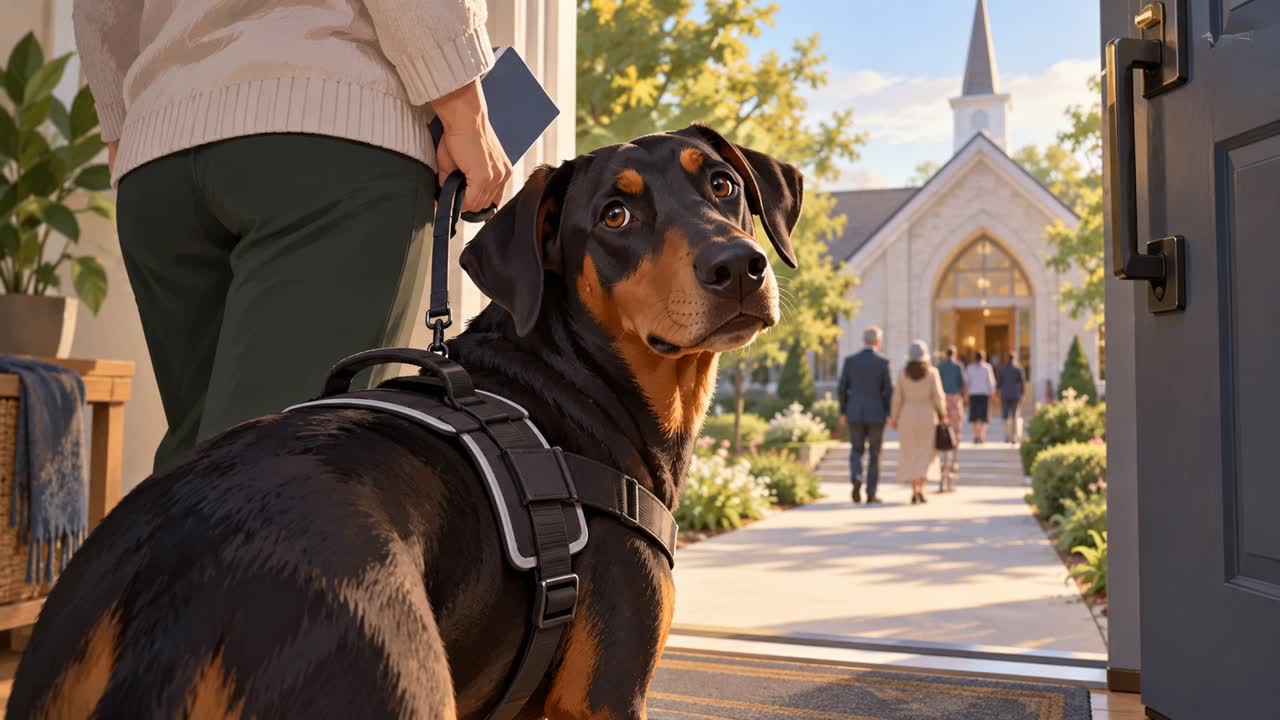
Bringing a service dog to places of worship services or events may require advance coordination because religious organizations are generally exempt from Title III of the Americans with Disabilities Act (ADA). That means the federal public-accommodation rules applying to many stores and restaurants may not require a church, mosque, synagogue, temple, or other religious organization to admit a service dog.
State or local disability laws may provide additional protections, and a worship community may voluntarily welcome service dogs even when the federal exemption applies. A calm conversation with the organization can clarify its policy and identify workable seating, relief, and safety arrangements.
This guide focuses on attending worship, study, ceremonies, and community events. Employment, school, housing, and services run by legally separate nonreligious organizations may require a different approach.
Quick Overview
- When possible, contact the organization before visiting.
- Ask whether it welcomes service dogs and whether state or local rules apply.
- Explain the dog’s trained task briefly without sharing unnecessary medical details.
- Plan seating, relief, water, crowds, music, and ceremonial movement.
- Keep the dog controlled and clear of aisles, sacred objects, and food surfaces.
- Request a practical alternative if you can’t arrange access.
.
1) Plan for a Service Dog at Place of Worship Services
Contact an administrator, clergy member, accessibility coordinator, or usher before attending. Explain that the dog performs trained disability-related work and ask about the organization’s service-animal policy.
Useful planning questions include:
- Which entrance is accessible and open for the service?
- Where can the dog relieve itself?
- Is there seating with enough floor space for the dog?
- Will the service include incense, loud music, crowds, candles, or processions?
- Are food, childcare, or animal-related activities taking place?
- Who can resolve an access question when the handler arrives?
The Knowledge Center provides general service-animal background, but the organization should provide current details about its building and services.
2) Understand the Religious-Organization Exemption
Title III of the ADA generally exempts religious organizations and entities controlled by religious organizations. This exemption can extend to worship spaces and other facilities operated by the religious organization, even when an event is open to the public.
The exemption does not mean every faith-connected location is automatically outside all disability law. State or local law may impose different requirements, and a separately operated business or nonreligious organization using the property may have its own obligations.
Because coverage is fact-specific, avoid assuming that ordinary federal public access rules apply in exactly the same way as they do at a retail store. The organization can still adopt an inclusive policy that follows similar principles voluntarily.
When the answer is unclear, ask the organization to identify its policy in writing and consider guidance from a local disability-rights organization or qualified attorney.
3) Discuss the Dog’s Role without Oversharing
A brief description of the dog’s trained task can help staff understand why the dog needs to remain with the handler. The handler does not need to begin the conversation by disclosing a diagnosis or complete medical history.
A practical statement might be: “I use a service dog trained to [briefly describe the task]. I want to attend the service and coordinate appropriate seating and relief access.”
A vest, purchased certificate, registry entry, or ID card does not by itself establish whether a religious organization must provide access. Optional identification may provide organization or peace of mind, but the discussion should focus on the dog’s trained role, controlled behavior, and the available setting.
A voluntary service check may help organize task and readiness information, but it is not government approval or a guarantee of admission.
4) Choose Safe Seating and Movement Routes
Choose a position that lets the dog perform its tasks without blocking aisles, exits, kneeling areas, mobility devices, or ceremonial movement. End seating or a wall-side location may provide enough floor space and a clear path outside.
Ask about standing, kneeling, bowing, processions, greetings, and movement for communion or other observances. Decide whether the dog will move with the handler or remain in a controlled position with an authorized person.
Keep the dog away from altars, sacred objects, candles, musical equipment, and food-contact surfaces unless the organization has approved a particular arrangement. Staff and attendees should avoid petting, calling, photographing, or feeding the dog while it works.
If another attendee has allergies or fear of dogs, consider increased distance, different seating, staggered entry, or another route. These measures can often support both people without confrontation.
5) Prepare for Sensory and Ceremonial Conditions
Places of worship may include bells, organs, amplified music, chanting, incense, crowded greetings, children, and long periods of stillness. If possible, visit during a quiet period if possible so the dog can become familiar with entrances, flooring, seating, and acoustics.
Bring water, a portable bowl, waste bags, necessary medication, and a small resting mat if useful. Give the dog a relief opportunity before entering and plan a discreet break during a long service or event.
Watch for stress, overheating, repeated scanning, difficulty settling, refusal of familiar cues, or changes in task performance. If the environment becomes too demanding, leaving early may protect the dog’s welfare and make future planning easier.
For a destination worship event involving commercial aviation, review the applicable air travel rules separately. Airline procedures do not determine access at the religious venue.
6) Respond to Denial or Unexpected Restrictions
If entry is denied, ask for the specific policy and whether a clergy member or administrator can review the decision. Keep the conversation focused on access and practical arrangements rather than debating identification documents.
Possible alternatives include attending another service time, using a different room with a live connection, joining remotely, or arranging a smaller meeting with clergy. An alternative may be useful when voluntarily accepted, but it does not answer whether state or local law provides a right to attend in person.
If the dog becomes out of control or is not housebroken, the organization may have a sound basis to require its removal regardless of whether admission was legally required. The handler should act promptly and ask whether participation can continue without the dog.
Document the date, people involved, reason given, and alternatives discussed. For a recurring or significant access problem, seek setting-specific guidance before assuming that the ADA religious exemption fully resolves the issue.
FAQs
Can I bring a service dog to place-of-worship services?
Possibly. Religious organizations are generally exempt from ADA Title III, but the organization may voluntarily allow the dog, and state or local law may provide additional rights.
Does the ADA require every church, mosque, synagogue, or temple to admit service dogs?
No. Religious organizations and entities controlled by them are generally exempt from Title III of the ADA. Other laws or voluntarily adopted policies may still apply.
Should I call before attending?
Advance contact is often helpful because it allows you to discuss the organization’s policy, seating, relief areas, ceremonies, crowds, and any state or local requirements.
Can the organization request a certificate?
A purchased certificate, registration, vest, or ID card does not by itself determine access. Optional identification may help with organization, but it does not replace task training or establish a legal duty.
What if incense or loud music affects the dog?
Ask about a quieter seating area, distance from speakers or incense, breaks, or another service time. Leave if the dog cannot work or settle safely.
Can the dog accompany me during a procession or ceremony?
That depends on the activity, available space, safety, the dog’s trained role, and the organization’s policy. Discuss the route and positioning beforehand.
What if another attendee is afraid of dogs?
Consider distance, alternate seating, staggered movement, or different routes. A planned arrangement can reduce contact while allowing both people to participate.
Sources
- ADA.gov: Service Animals
- ADA.gov: Service Animals FAQ
- ADA.gov: Businesses Open to the Public
- CDC: Dogs
- CDC: Pet Travel Safety
- U.S. DOJ/HUD: Reasonable Accommodations Under the Fair Housing Act
Takeaway
Access at a place of worship requires careful attention to the ADA religious exemption, any applicable state or local law, and the organization’s own policy.
- Contact the organization early and briefly describe the dog’s trained role.
- Plan safe seating, relief, movement, and sensory breaks.
- Request written clarification and local guidance when access remains uncertain.