
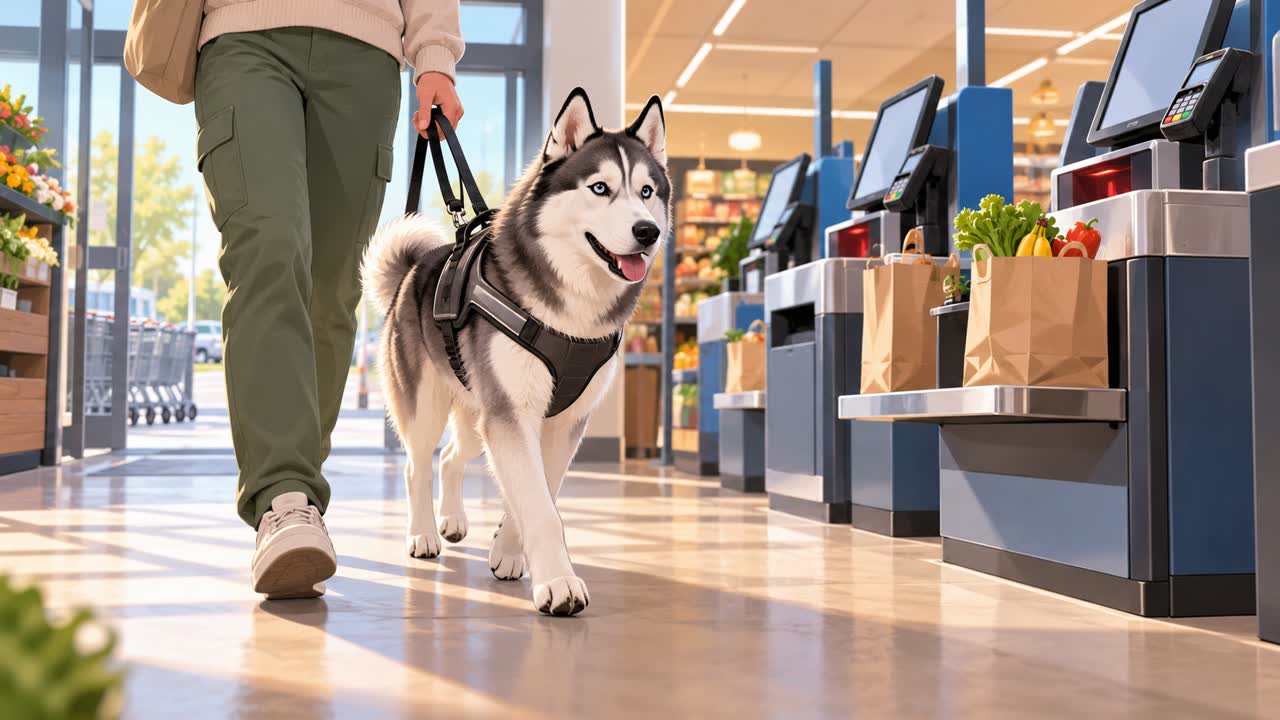
A service dog at a grocery self-checkout may generally accompany its handler through the lane when the dog meets the Americans with Disabilities Act (ADA) definition. The handler does not have to switch to a staffed register merely because a qualifying service dog is present.
Self-checkout creates specific practical concerns: narrow lanes, moving carts, dropped food, scanner cords, bagging platforms, and customers entering from several directions. A safe setup keeps the dog close enough to perform its tasks without blocking the aisle or approaching groceries.
This guide focuses on U.S. grocery-store customer access and self-checkout logistics. It does not cover employee accommodations, delivery work, or food-preparation areas closed to customers.
Quick Overview
- A qualifying service dog may generally use the self-checkout area with its handler.
- Staff may ask two limited questions when the dog’s role is not apparent.
- A vest, purchase certificate, registration, or ID is generally not required.
- Position the dog away from carts, scanner equipment, and dropped food.
- Ask an attendant for scanning, bagging, or lane assistance when needed.
- Base any restriction on actual conduct or safety conditions, not assumptions.
1) Position a Service Dog at Grocery Self Checkout
Before entering a lane, look for enough floor space for the handler, dog, cart, and mobility equipment. An end lane or accessible self-checkout station may provide a wider turning area and reduce contact with customers moving behind the team.
Position the dog beside or slightly behind the handler, depending on its trained tasks. The dog should remain clear of cart wheels, the scale and bagging platform, payment terminals, cables, and the attendant’s walking route.
If no lane offers safe clearance, ask the attendant to open a wider station or provide another effective checkout option. The goal is equal access, not forcing the team into a configuration that creates a foreseeable hazard.
Broader service-animal information is available through the knowledge hub, but the store should address the conditions at the particular checkout area.
2) Handle Staff Questions at Checkout
If the dog’s service role is not apparent, staff at a covered grocery store may generally ask whether the dog is required because of a disability and what duty it has been trained to perform. The handler can answer without disclosing a diagnosis or detailed medical history.
A concise response might be: “Yes, this dog is required because of a disability and is trained to [brief task description].” Staff generally should not require the dog to demonstrate its task or make access depend on a vest, purchased certificate, registration, or identification card.
Optional identification may provide organization or peace of mind, but it does not replace task training and controlled behavior. A voluntary service screening may help organize task information, but it is not government approval or a guarantee of access.
If a checkout attendant is uncertain, ask for a supervisor while keeping the discussion brief and out of the path of other customers.
3) Manage Scanning, Bagging, and Payment
Self-checkout often requires the handler to reach, lift, scan, bag, and pay while maintaining control of the dog. An attendant can provide reasonable help with those checkout steps when the equipment or layout is inaccessible.
Ask for assistance before unloading the entire cart if reaching the scanner, bagging scale, or payment terminal will be difficult. Staff may scan bulky products, move bags, retrieve a dropped item, or explain an accessible payment option, depending on the store’s equipment and procedures.
The dog should not stand on the bagging platform, place its paws on counters, or contact unpackaged food. A trained retrieval task involving the handler’s personal property should be performed in a controlled way that does not disturb groceries or store equipment.
The store’s public access rules should distinguish a qualifying service dog from a pet while still applying neutral sanitation and safety practices.
4) Avoid Dropped Food and Checkout Hazards
Self-checkout floors may contain grapes, candy, gum, medication, broken containers, cleaning residue, or sharp packaging. Scan the immediate area before positioning the dog and alert staff to anything hazardous.
Other common risks include carts rolling into the dog, automatic gates closing, children approaching, bags falling from hooks, and customers stepping backward without looking. Keep the leash short enough for control without wrapping it around the cart, mobility equipment, or checkout fixtures.
If the dog eats something questionable, move out of the lane, identify the product if possible, and seek veterinary or poison-control guidance appropriate to the situation. Do not delay urgent care to finish the transaction.
Travel-related preparation is a separate issue. If grocery shopping occurs during a trip, any applicable air travel rules govern the flight rather than access to the grocery checkout.
5) Respond to Interference, Allergies, or Fear
Customers may try to pet, call, feed, photograph, or step over the dog. A brief statement such as “The dog is working; please give us space” is usually sufficient. An attendant can help create room or redirect persistent interference.
Another customer’s allergy or fear does not automatically justify excluding the service dog. Staff can consider a different lane, greater distance, staggered checkout, or another practical arrangement that gives both customers meaningful access.
The dog should not approach other shoppers, sniff bags, or investigate dropped food. If a nearby pet or service animal creates a distraction, request additional distance rather than allowing the dogs to greet.
Restrictions should be based on the individual dog’s conduct or an actual safety issue, not breed, size, appearance, or lack of commercial identification.
6) Address Removal or Denial Calmly
Under ADA public-access principles, a store may generally require a service dog to leave if it is out of control and the handler does not take effective action, or if the dog is not housebroken. A quiet repositioning or brief trained alert should not automatically be treated as uncontrolled behavior.
If staff deny access, ask for the specific reason and whether a supervisor can review the decision. Clarify whether staff is applying a no-pets policy rather than evaluating a service dog under the applicable standard.
If removal is justified, the handler should generally still be offered an opportunity to purchase the groceries without the dog when feasible. A companion might take the dog outside, or staff may help preserve the transaction while the handler arranges a safe alternative.
Document the date, store, staff involved, reason given, conduct observed, and alternatives offered. A serious unresolved denial may warrant contacting company management, a disability-rights organization, an appropriate government agency, or qualified counsel.
FAQs
Can I use a service dog at grocery self-checkout?
Generally, yes. A qualifying service dog may accompany its handler through customer-accessible checkout areas, subject to limited control, house-training, and safety exceptions.
Can staff require me to use a staffed register?
Not simply because a service dog is present. Staff may offer a different register when it provides a safer or more accessible arrangement, but they should consider the handler’s access needs individually.
What may checkout staff ask?
When the dog’s role is not apparent, staff may generally ask whether it is required because of a disability and what trained work or task it performs.
Must the dog wear a vest or show identification?
No particular vest, purchased certificate, registration, or ID is generally required for ADA public access. Optional identification does not replace task training and controlled behavior.
Can an attendant help me scan and bag groceries?
Yes. Ask for help when equipment, layout, or a disability makes a checkout step inaccessible. The appropriate help depends on the person’s needs and the store’s setup.
What if food is dropped near the dog?
Move the dog away and notify staff so they can remove the item.
. Seek prompt veterinary guidance if the dog consumes something potentially harmful.
Can the store remove a barking service dog?
Removal may be permitted if the dog is out of control and the handler does not take effective action. A brief trained alert should be evaluated in context.
Sources
- ADA.gov: Businesses Open to the Public
- ADA.gov: Service Animals
- ADA.gov: Service Animals FAQ
- CDC: Dogs
- CDC: Pet Travel Safety
- U.S. DOT: Service Animals
Takeaway
A safe self-checkout visit combines equal access with deliberate positioning, practical assistance, and close attention to food and cart hazards.
- Choose a lane with enough space for the complete service-dog team.
-
Ask an attendant for help with scanning, bagging, or payment when needed.
- Resolve concerns through actual conduct and specific safety facts.