
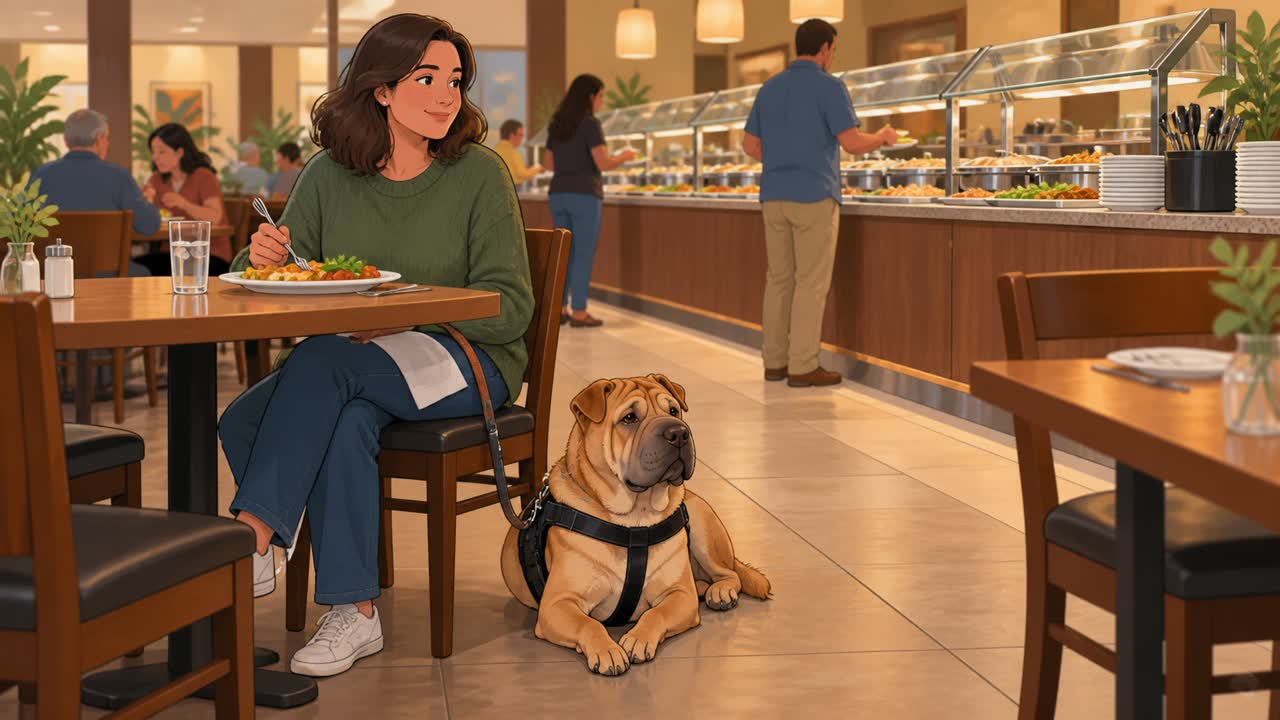
Bringing a service dog to buffet restaurant locations is generally permitted in customer dining and self-service areas under the Americans with Disabilities Act (ADA). A restaurant cannot exclude a trained service dog simply because food is displayed or local health rules normally prohibit pets.
The practical challenge is navigating the buffet while keeping the dog under control and away from food-contact surfaces. This guide focuses specifically on buffet-line access, food safety, staff questions, and conflict prevention—not general restaurant etiquette.
Federal ADA rules provide the baseline. State or local laws may offer additional protections, so handlers and restaurant operators should also review applicable public access rules.
Quick Overview
- A service dog may generally accompany its handler in restaurant areas open to customers, including a buffet line.
- Health codes that exclude pets do not ordinarily justify excluding an ADA-covered service animal from customer areas.
- The dog must remain under control and should stay on the floor unless its trained task requires another position.
- Staff may ask two limited questions when the dog’s status is not apparent.
- Staff cannot require a certificate, registration card, identification card, or demonstration of the dog’s task.
1) Where a Service Dog can Go in a Buffet Restaurant
Under the ADA, a service dog may generally enter the same customer-facing areas its handler may use. That normally includes the dining room, ordering counter, beverage station, checkout area, and buffet line.
The dog does not receive access to employee-only spaces merely because it is a service animal. A commercial kitchen, food-storage room, or other area closed to customers remains restricted. The useful distinction is between a customer selecting food from a buffet and entering a food-preparation area.
Restaurants are subject to sanitation rules, but those rules generally do not override the ADA in customer areas. A service dog is not treated as a pet for this purpose. Broader explanations of service-animal access and related topics are available through the Knowledge Center.
2) Navigating the Buffet Line Safely
A buffet creates tighter spaces and more exposed food than table service. The handler should position the dog where it can work without approaching serving dishes, utensils, carts, or other diners.
Depending on the dog’s tasks and the available space, practical options may include:
- Keeping the dog in a close heel beside the handler.
- Placing the dog in a controlled stand or down-stay while selecting nearby items.
- Using a tray, plate carrier, or mobility aid that the handler can manage safely.
- Asking whether an employee can provide ordinary assistance with carrying a plate or identifying dishes.
A handler can ask for assistance, although the exact response may depend on staffing, safety, and what constitutes a reasonable modification in the circumstances. Restaurant employees are not responsible for supervising, feeding, or caring for the dog.
3) Behavior and Food-Safety Expectations
The dog should remain under control throughout the visit. The ADA generally expects a harness, leash, or tether unless that equipment would interfere with the dog’s work or the handler’s disability prevents its use. In that situation, control must be maintained through voice commands, signals, or another effective method.
At a buffet, good positioning matters. The dog should not sniff displayed food, lick serving surfaces, block an aisle, jump on patrons, or eat food from the floor. It should not sit on restaurant chairs, benches, or tables. These expectations protect sanitation and reduce unnecessary disputes without imposing special paperwork requirements.
Handlers preparing for busy public settings may find a structured behavior screening useful for identifying practical training gaps. It does not replace the ADA definition or determine legal access.
4) Questions Restaurant Staff may Ask
When it is not obvious that a dog is a service animal, restaurant staff may generally ask only:
- Is the dog a service animal required because of a disability?
- What work or task has the dog been trained to perform?
Staff should not ask for a diagnosis, demand medical records, require a special vest, or ask the dog to demonstrate its task. They also cannot make entry depend on a purchased certificate, registry listing, or identification card.
The handler can answer briefly by describing the trained task without disclosing private medical details. A voluntary service check may help someone organize information about tasks and readiness, but it is not government approval and does not create public-access rights.
5) When a Restaurant may Require the Dog to Leave
A restaurant may generally ask for removal when the dog is out of control, and the handler does not take effective action, or when the dog is not housebroken. Examples could include repeated uncontrolled barking, lunging toward diners, or persistently reaching for buffet food.
Removal should be based on the individual dog’s actual behavior—not breed, size, assumptions about shedding, another customer’s fear, or a generalized concern about animals near food. Allergies and fear of dogs ordinarily do not automatically justify denying access. Staff should consider practical separation when both individuals need accommodation.
If removal is justified, the restaurant should still allow the handler to obtain food or services without the dog present. Staff should address the behavior calmly and avoid turning the interaction into a public argument.
6) Preventing and Handling Access Disputes
Handlers can reduce friction by choosing a quieter arrival time, keeping the dog close, and planning how to carry food. Training logs, a current task list, and veterinary records may be useful for personal organization, travel, or program discussions, although restaurants generally cannot require them for ADA access.
If challenged, a concise response often works best: “This is a service dog required because of a disability. The dog is trained to perform a specific disability-related task.” The handler can then describe the task in practical terms.
Restaurant managers should focus on the two permitted questions and the dog’s present conduct. If uncertainty remains, moving the conversation away from the buffet line can reduce embarrassment and congestion. Both sides should document serious incidents factually, including the date, location, questions asked, conduct observed, and proposed resolution.
FAQs
Can I bring a service dog at buffet restaurant locations?
Generally, yes. An ADA-covered service dog may accompany its handler in restaurant areas open to customers, including self-service buffet areas, as long as the dog remains under control and is housebroken.
Can a restaurant exclude the dog because food is uncovered?
Not solely for that reason. Food-safety rules that prohibit pets do not ordinarily authorize excluding a service dog from customer areas. The dog may still be kept out of employee-only kitchens and food-preparation spaces.
Must I show a service dog certificate at the entrance?
No certificate, registration, vest, or ID card is generally required for ADA public access. Optional records can provide organization or peace of mind, but they do not replace task training and controlled behavior.
May my service dog sit on a restaurant chair?
Generally, no. The ADA does not require restaurants to allow service animals on customer seating or tables. The dog should usually remain on the floor unless a disability-related task requires a different controlled position.
Can staff make me leave if another customer is allergic to dogs?
An allergy does not automatically justify excluding the service dog. Staff should try to accommodate both customers, such as by increasing distance or seating them in different areas.
What if I cannot carry a plate while handling my dog?
You may ask whether an employee can help carry a plate or select items. Explain the specific help needed. Whether a particular modification is required can depend on the circumstances, but a calm, focused request is usually the best starting point.
Can the restaurant charge a cleaning fee?
A restaurant cannot impose a surcharge merely because a service dog is present. It may generally apply its usual damage policy if the dog causes damage and the same policy applies to other customers.
Sources
- ADA.gov: Service Animals
- ADA.gov: Service Animals FAQ
- CDC: Dogs
- CDC: Pet Travel Safety
- HUD: Information for Persons with Disabilities
Takeaway
A buffet restaurant should generally admit a task-trained service dog to customer areas while the handler maintains control and protects food-service boundaries. Clear positioning, concise communication, and behavior-based decisions can prevent most conflicts.
- Customer access generally includes the buffet line, but not employee-only kitchens.
- Training and control matter more than optional identification or paperwork.
- Staff should use the ADA’s two-question framework and address actual conduct.