
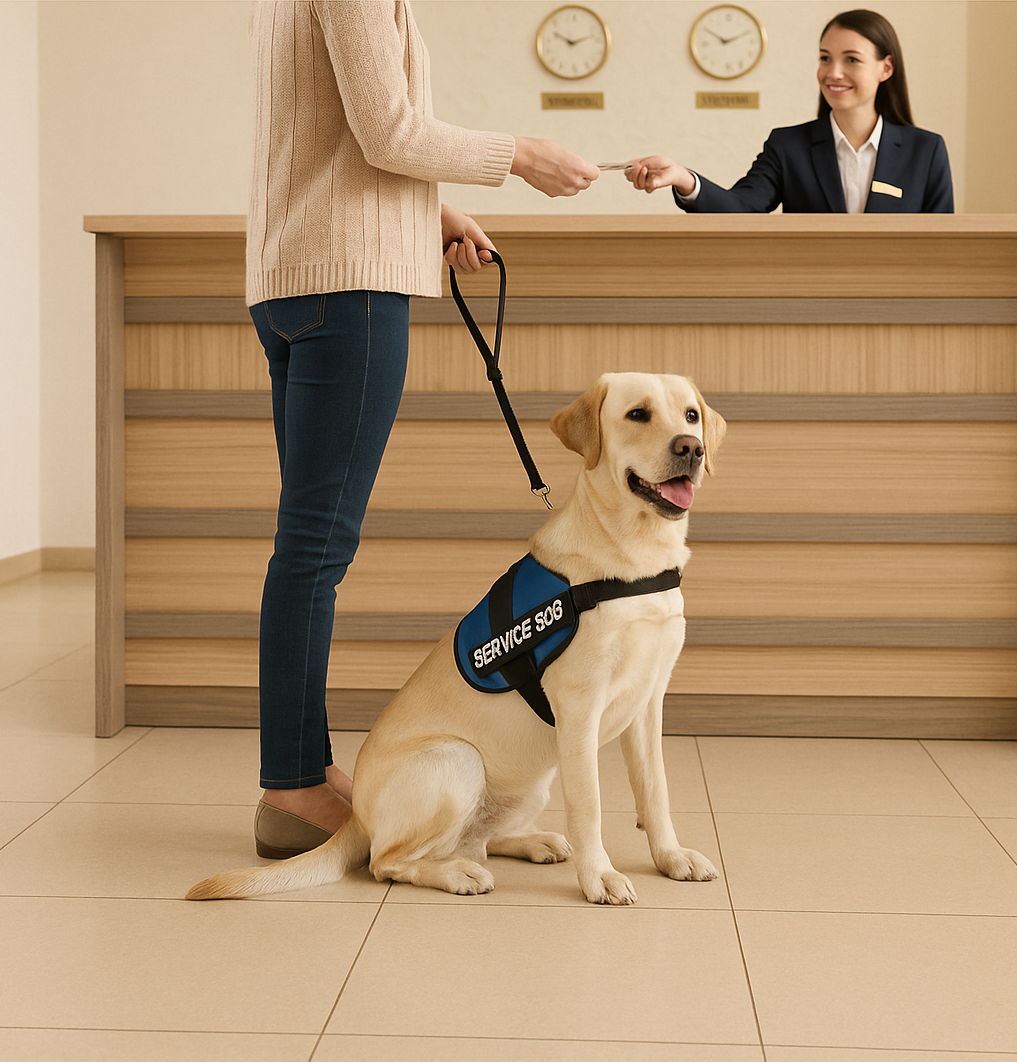
Traveling with a service dog can feel overwhelming if you’ve never done it before. One of the most common concerns handlers have is how their service animals and hotels fit together — will the hotel allow the dog, what proof is needed, and are there any hidden costs? The good news is that in the United States, Canada, and the UK/EU, service dog teams have strong protections when it comes to hotel stays. Still, the details differ slightly depending on where you are, and knowing them ahead of time makes your trip much smoother.
In the United States, the Americans with Disabilities Act (ADA) requires hotels — from budget motels to luxury resorts — to accept service dogs. This applies to all places of public accommodation, including both pet-friendly and “no pets” hotels. Hotels cannot charge pet fees for service dogs, cannot ask for documentation or certification papers, and cannot restrict you to “pet-designated” rooms. The only questions staff are legally allowed to ask are: (1) is the dog required because of a disability, and (2) what work or task has the dog been trained to perform? Emotional support animals (ESAs), however, are not covered by the ADA and may be treated differently by hotels.
In Canada, access rules for service animals and hotels are largely handled at the provincial level. Ontario’s Accessibility for Ontarians with Disabilities Act (AODA), for example, requires hotels to admit service dogs that are trained and clearly identified. Some provinces issue identification cards or registries for service animals, which can make check-in smoother. Like in the U.S., hotels cannot charge extra fees for a service dog, though ESAs are not given the same automatic access rights.
For the UK and EU, hotel policies often connect back to whether the service dog was trained by a recognized program such as Assistance Dogs UK (linked to ADI and IGDF standards). Hotels must accommodate assistance dogs, even if pets are not usually allowed. Commonly, dogs are expected to wear their working vest or harness as visible identification. While ESAs do not have the same legal protection in the UK or EU, many hotels will accept them at their discretion, usually with additional fees or restrictions.
Regardless of the region, the handler has responsibilities too. A service dog should be well-behaved, quiet, and house-trained in the hotel environment. Barking through the night, damaging property, or being left alone in the room can result in fees or being asked to leave. Packing familiar items — a mat, travel water bowl, and favorite toy — helps your dog settle in quickly.
When booking, it’s always smart to let the hotel know you’ll be arriving with a service animal. While you don’t need to provide documentation, advance notice helps the staff prepare and prevents awkward conversations at check-in. For international travel, especially into the UK or EU, bringing along proof of vaccinations, microchip details, and program training letters can make border crossings and hotel stays easier.
In the end, service animals and hotels go hand in hand when you know your rights and prepare properly. Laws are designed to protect service dog teams, but a little planning on your part ensures both you and your dog enjoy a stress-free stay.