
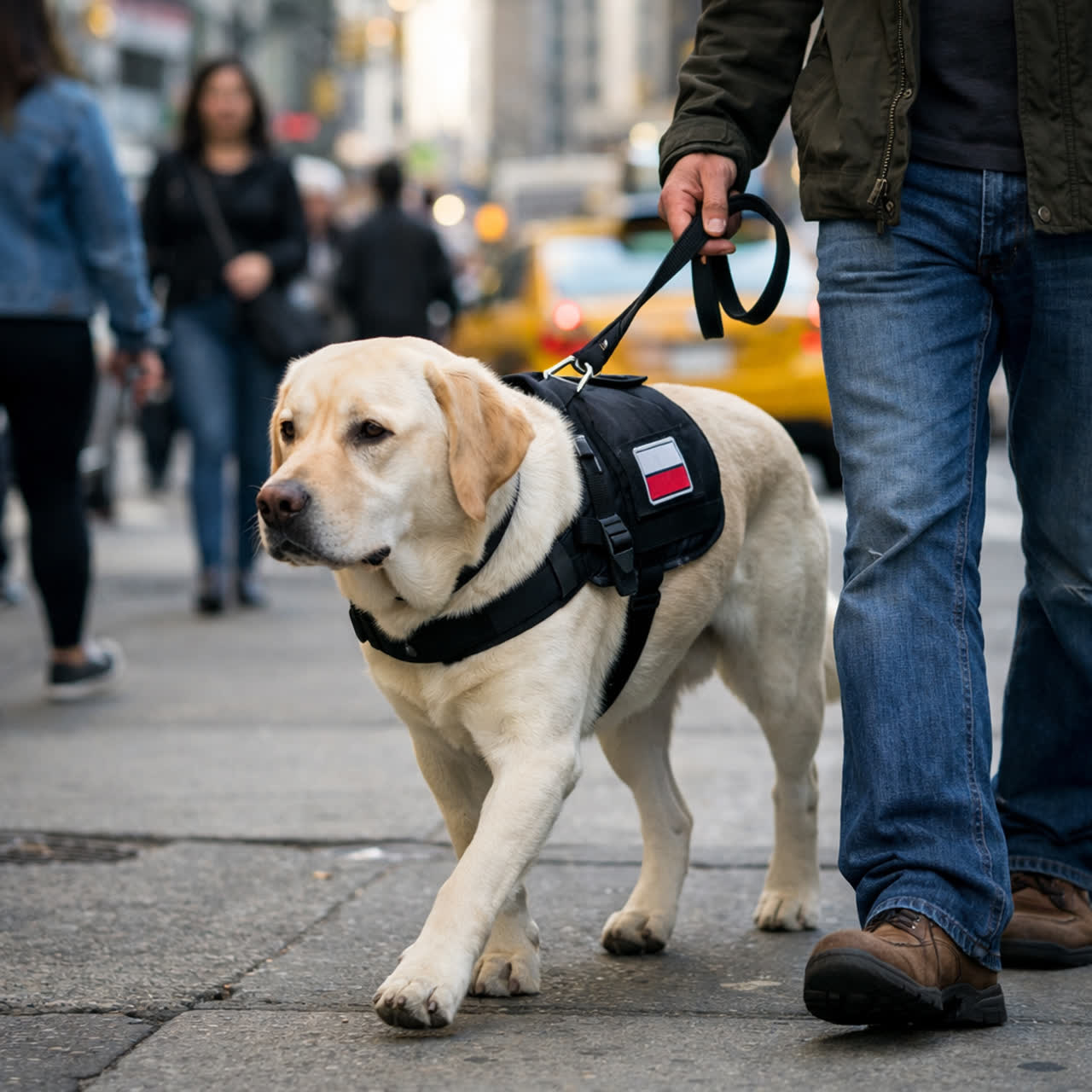
Public access training is the part of service dog training that most people never see — and it’s the part that prevents problems in real life.
Task work matters, but tasks only help if the dog can stay calm, focused, and predictable in the environments where the handler actually needs support: shops, public transport, waiting rooms, busy streets, elevators, and cafes.
This article breaks down the five core public-access skills every service-dog-level team needs, how to train them, and the common mistakes that make dogs “look trained” at home but fall apart in public.
Related reading: if you’re still unsure what qualifies as a service animal (vs. ESA), start here: What Is a Service Animal? A Practical Definition and Service Animal vs ESA: Real-World Differences.
Quick Checklist (what a good public access looks like)
- Dog is neutral to strangers, dogs, food, and noise
- Dog can settle for long periods without constant cues
- Dog maintains loose leash and automatic check-ins
- Dog can recover fast from surprises (drops, loud sounds, tight spaces)
- Handler can manage the dog without conflict or repeated corrections
The 5 Core Public-Access Skills
1) Neutrality: “I see it, but I don’t need to interact”
Neutrality is the foundation. A public-ready service dog does not need to greet strangers, stare at other dogs, sniff every smell, or investigate every sound. The dog can notice the world without engaging with it.
Training goal: The dog chooses the handler as the default point of reference.
How to train it:
- Reinforce attention: Pay for check-ins (eye contact or head turn) before the dog escalates into staring/pulling.
- Use “Permission cues”: Teach that greeting is only allowed on a clear cue (and the default is “no greeting”).
- Build distance first: Neutrality is trained at a distance where the dog can still think. Close distance later.
Common mistakes: Letting the dog “say hi” to everyone (creates expectation), correcting the dog after it is already over threshold, training only in low-distraction places.
2) The Default Settle: Calm Off-Switch in any Environment
A service-dog-level dog must be able to do nothing. That’s not laziness — it’s a skill. The dog should settle under a table, beside a chair, or on a mat without constant reminders.
Training goal: The dog relaxes on cue and then maintains calm behavior until released.
How to train it:
- Start at home: Short settle reps with frequent reinforcement.
- Add duration gradually: Reward calm breathing, hip-shift, head-down, soft eyes.
- Generalize: Practice in new places (hallways, cars, outside a shop), then in more challenging environments.
Common mistakes: Expecting long duration too early, only rewarding at the end (dog gets restless), reinforcing tension (rewarding while the dog is still scanning or stiff).
3) Loose Leash+Automatic Check-Ins (movement with manners)
Public access is not “heel at all times.” It’s controlled movement. The leash should stay loose, and the dog should naturally check in without being nagged.
Training goal: The dog walks in a practical position and keeps the handler in mind.
How to train it:
- Reinforce the position you want (beside, slightly behind, etc.).
- Teach turn patterns: The handler changes direction → the dog follows → reward.
- Train “stop means stop”: when the handler stops, the dog stops without forging.
Common mistakes: Walking in the same route every time, relying on corrections, and ignoring the dog’s arousal level (a dog can’t offer loose leash if it’s over-excited or stressed).
4) Distraction Resistance: Food, People, other Dogs, Sudden Events
In real life, distractions happen without warning: A dropped sandwich, a dog barking behind a fence, kids running past, a shopping cart appearing from nowhere.
Training goal: The dog maintains behavior through distraction, or recovers quickly after a startle.
How to train it:
- Train “leave it” as a pattern: Notice → disengage → reward.
- Practice controlled setups: You control the difficulty, distance, and duration.
- Proof with realistic distractions: Shopping carts, doors, elevators, buses, slippery floors.
Common mistakes: Proofing only once or twice, going too close too fast, using punishment that increases stress and reduces recovery ability.
5) Clear Communication Under Stress: Cues that Still Work Outside
Many dogs look perfect at home and “forget everything” outside. Usually, the problem isn’t intelligence — it’s that cues were never proven under real distraction and stress.
Training goal: The dog can respond to key cues even when in challenging environments.
Key public-access cues to proof:
- Sit/down/stand (position changes)
- Stay/wait (impulse control)
- Place/settle (off-switch)
- Come/recall (when appropriate and safe)
- Emergency “let’s go”/disengage cue
Common mistakes: Repeating cues (teaches ignoring), training only in one environment, pushing duration instead of clarity, and skipping reward systems in public.
How Long Does a Public Access Training Take?
It depends on the dog’s temperament, age, prior learning, and the consistency of training. In practice, you should think in months, not weeks. The goal is not a “good day” — it’s stable behavior across many days and many places.
Red Flags: Signs a Dog is not Ready for Public Access
- Frequent scanning, panting, or inability to settle
- Pulling to greet or investigate
- Reactivity to dogs or people (barking, lunging, freezing)
- Shut-down behavior (the dog looks calm but is actually overwhelmed)
Next Step
Pick one skill (heel, settle, or ignore) and run a 10–15 minute “micro-session” in a mildly distracting place (parking lot, quiet store entrance, lobby). End while the dog is still successful.
- If the dog can’t settle: Lower the difficulty (more distance, fewer people), shorten the session, and reward calm breathing+stillness.
- If the dog pulls to greet: Practice “look at me”+heel for 3–5 steps, reward, then release—repeat.
- If the dog is overwhelmed: Leave. That’s not failure—it’s good handling and protects your progress.
Quick Summary
- Public access is built on repeatable skills (not luck).
- Train in small steps: distance → duration → distractions.
- Measure success by calm, controllable behavior across locations.
If you want, I can turn this into a simple weekly plan (3 short sessions per week) based on your dog’s age and current level.