
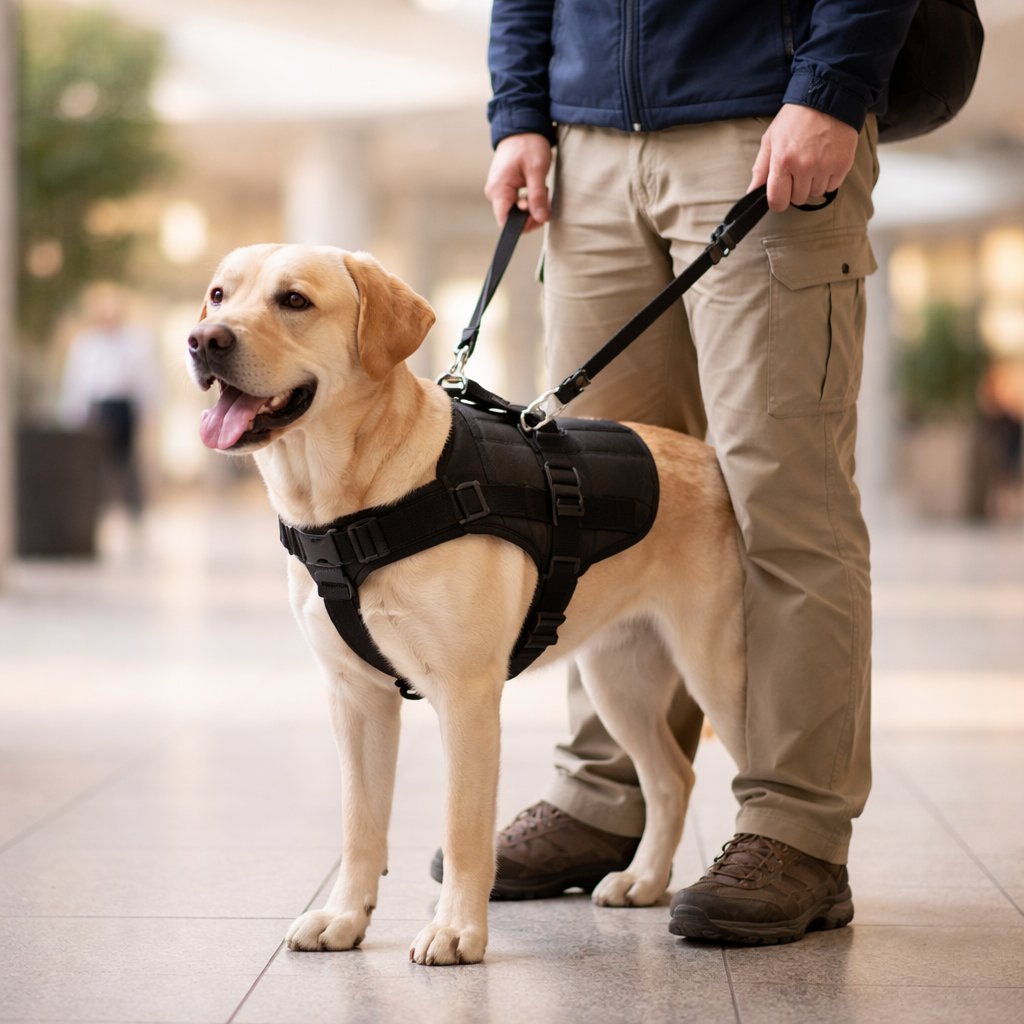
Public access training helps a service dog work calmly, safely, and predictably in everyday places like stores, sidewalks, offices, and transit. This article is an educational overview — training needs can vary by dog, handler, and environment.
Quick Overview (the 5 core public access skills):
- Neutral behavior around people and dogs (no greeting, no lunging, no fixating)
- Loose-leash walking with position control (including automatic stops and turns)
- Settle and stay under tables, in lines, and during long pauses
- Reliable response to cues (sit/down/stand, recall, leave it, “place”)
- Environmental confidence with carts, noises, tight spaces, and novel surfaces
1) Neutral Behavior: Calm Around People, Dogs, and Attention
One of the most important outcomes of public access training is neutrality: your dog can notice distractions without engaging them. Neutral behavior reduces risk, supports focus, and helps your dog conserve energy for task work.
- Goal: The dog stays with the handler even when someone talks to them, gestures, or passes closely.
- Train it: Reward check-ins (eye contact or head turn back to you) and calmly move away if the dog becomes fixated.
- Helpful cue: “Leave it” (disengage from people/food/animals) paired with a reward for returning attention.
If you’d like a handler-friendly way to manage interruptions, see this simple public access plan for when people interrupt.
2) Loose-Leash Walking with Predictable Positioning
Loose-leash skills are not just about “no pulling.” They’re about safe navigation: the dog maintains a consistent position, avoids blocking aisles, and can adjust smoothly to narrow spaces or sudden stops.
- Goal: A loose leash most of the time, with the dog matching your pace and staying out of others’ way.
- Train it: Mark and reward the dog for being in position (at your side or slightly behind) and practice short, successful reps.
- Add real-world patterns: “Stop = auto-sit/stand,” “Turn = follow,” “Slow = match pace.”
Practical tip: If pulling starts, avoid a long tug-of-war. Pause, reset position, reward slack leash, then continue.
3) Settle on Cue: The “Off Switch” for Lines, Cafés, and Waiting Rooms
A strong settlement is often what makes public access feel “easy.” This skill teaches your dog to relax quietly for minutes (and eventually longer) without wandering, vocalizing, or soliciting attention.
- Goal: The dog lies down (or tucks) and remains calm while you stand in line, sit at a table, or wait for an appointment.
- Train it: Start at home with a mat/blanket (“place”), reward calm stillness, and gradually increase duration before adding distractions.
- Proof it: Practice in low-traffic public areas, then slowly work up to busier settings.
Handler habit that helps: Periodically reward calm behavior before the dog gets restless, especially during early training.
4) Reliable Cues under Distraction (and clean “leave it”)
In public access training, cues must hold up when the environment changes—food on the ground, kids moving quickly, automatic doors, or squeaky carts. Reliability comes from building skills in layers rather than expecting perfection in a new place.
- Core cues to prioritize: Sit, down, stand, stay, come/recall, heel/position, leave it, drop it.
- Train it: Increase difficulty one variable at a time (distance, duration, distraction) and reinforce generously when you “raise the bar.”
- Safety note: Practicing “leave it” and “drop it” is especially to avoid dropping food, pills, or other unsafe objects.
For a structured way to plan sessions and avoid common pitfalls, use this public access training skills checklist and practice plan.
5) Environmental Confidence and Body Awareness
Many public environments include novel footing, tight corridors, reflective floors, elevators, stairs, carts, loudspeakers, and sudden motion. Confidence is not about forcing a dog through fear — it’s about gradual exposure and teaching the dog how to recover and re-engage.
- Goal: The dog can move calmly through common obstacles and settle despite routine noise and movement.
- Train it: Pair new experiences with high-value reinforcement, keep sessions short, and end on a positive note.
- Build body awareness: Practice slow stepping over poles, backing up a step or two, pivoting, and tucking under a chair.
Conservative guideline: If your dog shows persistent stress signals (repeated shaking off tucked tail, scanning, refusal to move, panting unrelated to heat), scale back and rebuild confidence in easier setups.
6) Real-World Practice: Choosing Locations and Increasing Difficulty Safely
Public access training progresses best when you intentionally choose training locations. Think of it as a ladder: start where your dog can succeed, then climb one rung at a time.
- Start: Quiet outdoor areas, calm parking lots, low-traffic storefronts (where permitted), or pet-friendly places for early proofing.
- Build: Short visits with a clear plan (2–10 minutes), then gradually increase duration and complexity.
- Track: Note what your dog handled well and what caused stress or distraction; adjust your next session accordingly.
It also helps to review public etiquette expectations, to ensure your training supports smooth interactions. See this guide to service dog etiquette in public for practical do’s and don’ts.
FAQs
- How long does public access training take?
Timelines vary widely. Many teams build these skills over months, not days. Progress depends on the dog’s temperament, prior training, consistency, health, and the rate at which distractions are introduced. - Should I correct mistakes in public or just leave them alone?
In most cases, it’s better to keep things low-drama: create distance, reset to an easier behavior (like “touch” or “sit”), reward success, and end the session early if your dog is over threshold. The goal is to protect confidence, and prevent rehearsal of unwanted behavior. - What are the most common public access training mistakes?
Moving to busy environments too quickly, training too long without breaks, relying on food lures without building true understanding, and not practicing settle behavior enough are common issues. A written plan and short sessions help. - Can I practice in pet-friendly places first?
Many handlers use pet-friendly locations to prove skills around distractions before attempting more demanding environments. Choose calm times, keep sessions brief, and prioritize safety and control. - How do I handle strangers trying to pet or talk to my dog?
Teach a default “ignore” and reward your dog for choosing you. Position your body to block access, use simple scripted phrases, and move away if needed. Planning ahead makes interruptions easier to manage.
Takeaway
Effective public access training is built on five practical foundations: Neutrality, loose-leash positioning, a reliable settle, strong cue response under distraction, and environmental confidence. Train in small, structured steps, reward calm focus, and adjust difficulty conservatively so your service dog can work safely and consistently in real-world settings.