
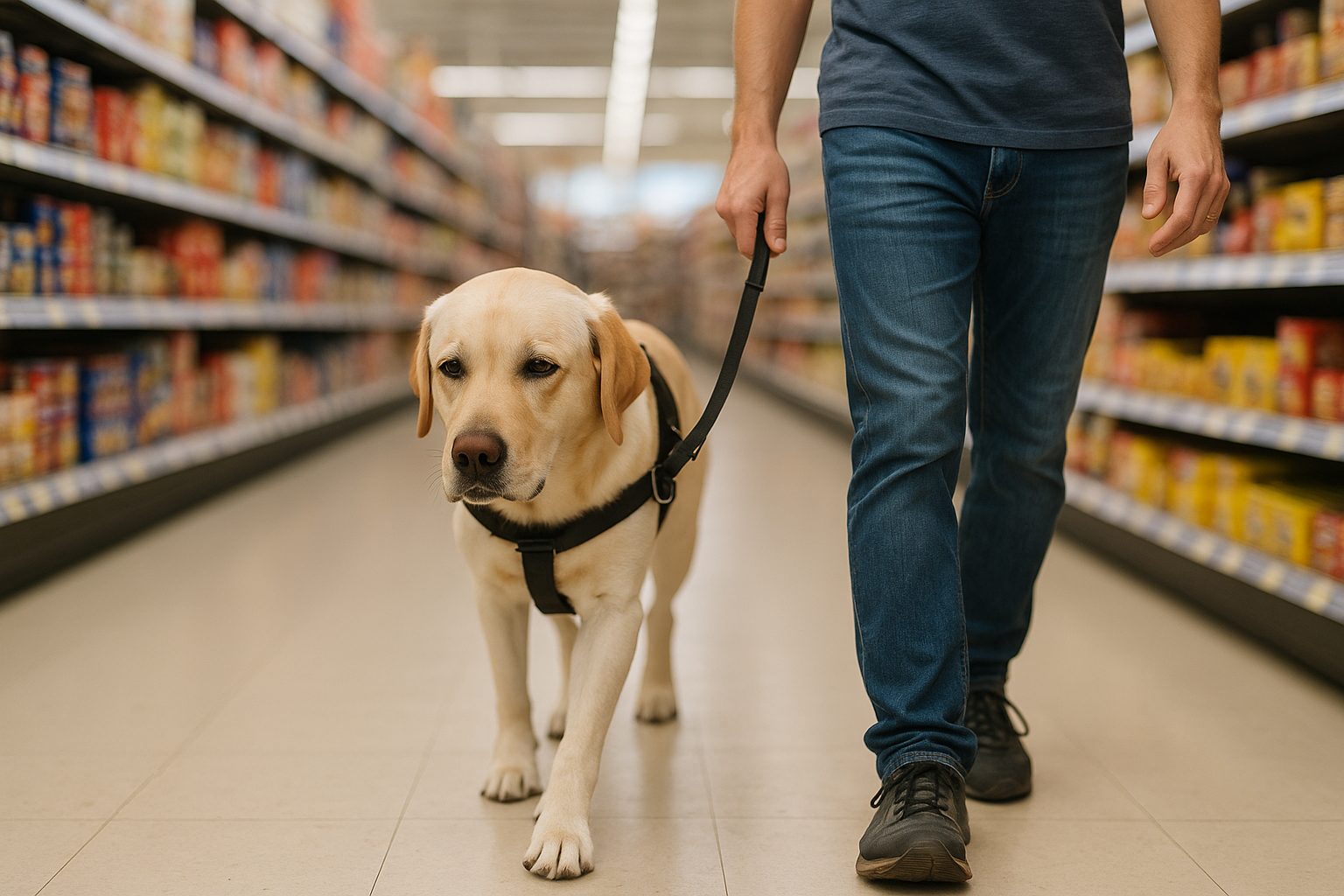
Public access training is what makes service-dog-level behavior reliable in everyday life. It’s not “show obedience.” It’s the skill set that keeps the dog calm, neutral, and controllable in environments full of surprises.
What Public Access Training Includes
- Neutrality around people, dogs, food, and noise
- Settle for long periods without constant cues
- Loose leash walking+automatic check-ins
- Distraction resistance+fast recovery after surprises
- Cue reliability under stress
A Simple Practice Plan (that actually works)
- Pick one skill (settle/leash/neutrality).
- Pick an easy location first (quiet street, or a hallway).
- Train short reps (2–5 minutes), end on success.
- Increase one variable at a time (distance, duration, distraction).
Common Mistakes (and how to fix them)
- Training only at home: Skills won’t generalize without practice in new places.
- Going too close too fast: Increase distance until the dog can think again.
- Repeating cues: Rebuild clarity, reduce difficulty, reward correct responses.
- Skipping the settle skill: “Doing nothing calmly” is a core working skill.
How often to Train
Short, frequent sessions beat long, exhausting ones. A practical schedule is 4–6 short sessions per week plus tiny “life reps” (settles, check-ins, leave-it moments).
What to Track
- Can the dog settle for 2 minutes? 5? 10?
- How close can you get to distractions while staying calm?
- How fast does the dog recover after a surprise?
Travel Example: Hotels
New environments like hotels reveal gaps quickly: hallways, elevators, door noise, and food smells. Proofing in new places matters.
FAQs
- Should I heel all the time? No. The goal is controlled movement and calm choices.
- When do I start tasks? After behavior is reliable in real environments.
Next Step
For the detailed breakdown of the five core skills, see Public Access Training: The five core skills every service dog needs.
Structured Practice Sessions (example week)
- Day 1: Settle practice+short loose leash reps
- Day 2: Neutrality around people at a distance
- Day 3: Distraction resistance (“leave it” pattern)
- Day 4: New environment proofing (different building/street)
- Day 5: Combine 2 skills (settle+distractions)
FAQs
- When do I increase difficulty? When the dog succeeds easily at the current level.
- What if the dog is stressed? Increase distance and shorten sessions.
Practical Checklist
- Define the environments you need to handle.
- Define the behaviors/tasks you need.
- Build foundations first (settle, leash, neutrality).
- Proof skills gradually in new places.
Common Mistakes
- Moving too fast (dog goes over threshold).
- Training only at home (no generalization).
- Repeating cues instead of reducing difficulty.
- Skipping maintenance once things look good.
Skill-by-Skill Mini Drills
Neutrality Drill
Start far from distractions. When your dog notices the trigger and then looks back to you, reward. Over time, you can reduce the distance. The dog learns: “notice → disengage → return to handler.”
Settle drill
Practice short settles in many places: hallway, car, outside a shop. Reward calm body language (soft eyes, head down) — not just the position. Duration is built gradually.
Loose leash drill
Reinforce the position you want. Change direction before pulling happens. You’re teaching a walking habit, not punishing mistakes.
How to know you’re progressing
- The dog recovers faster after surprises
- The dog offers check-ins without prompting
- The dog can settle for longer periods in new places
- You need fewer repetitions of cues
When to Stop and Reduce Difficulty
If your dog can’t take food, is scanning nonstop, or is tense and vocal, you’re too close, or the session is too long. Increase distance, shorten reps, and end on success.
How this Connects to Tasks
Many people want to start with tasks. But tasks only help if the dog can stay regulated in the environments where the task is needed. Public access training is what makes task work usable outside the home.
If you’re still comparing categories, read service dog vs ESA and service animal vs ESA. Then pick the environment that challenges your dog most and build calm reps there.
Final Takeaway
Public access training is not one skill — it is a system of habits: neutrality, settle, leash skills, recovery, and cue reliability.