
General Ownership & Control
Leash & Muzzle Rules
- West Virginia has no statewide leash law, but most cities/counties require dogs to be leashed in public areas.
- Charleston, Huntington, Morgantown, Wheeling, and Parkersburg all mandate dog leashing (typically ≤6 ft).
- Under WV Code §19-20-13, owners are liable for damages caused by dogs “running at large.”
- Muzzles are not required for ordinary dogs.
- Dogs legally classified as “dangerous” under WV Code §19-20-20 must be:
- Muzzled in public
- Leashed with strong restraint
- Confined in a secure enclosure when on private property
Breed-Specific Bans/Restrictions
- West Virginia has no statewide breed bans.
- Some municipalities may impose additional requirements on pit bull–type breeds (insurance/microchip), but most major cities do not ban any breed.
Licensing & Microchipping
- All dogs ≥6 months old must be licensed annually under WV Code §19-20-2.
- Licensing requires proof of current rabies vaccination.
- Microchipping is not mandatory statewide but is widely encouraged and required for shelter adoptions.
Service Dogs & Assistance Animals
Legal Definitions
Under the ADA and West Virginia Human Rights Act (WV Code §5-11-9), a service dog is defined as a dog trained to perform disability-related tasks such as:
- Guiding the blind
- Hearing alerts
- Mobility assistance
- Psychiatric task support (alerts, grounding, interruption)
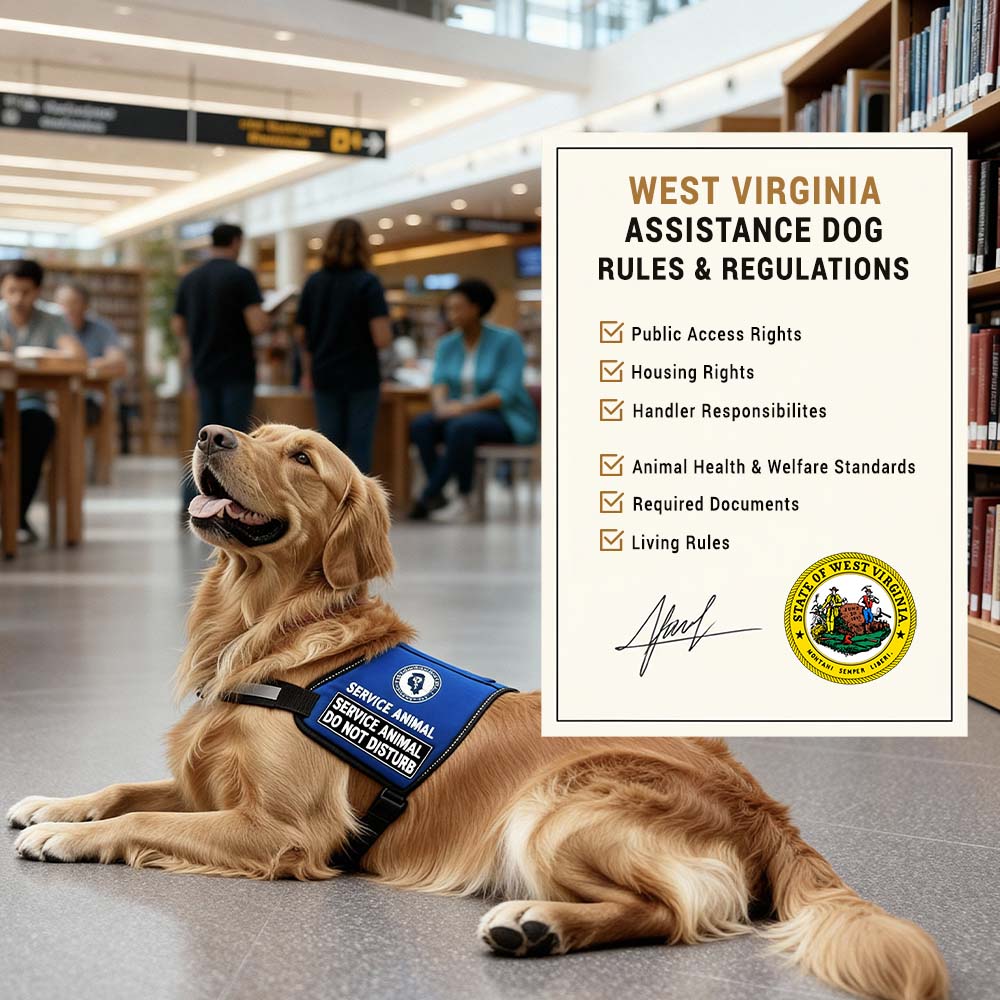
Public Access Rights
- Service dogs are allowed in restaurants, hotels, transit, retail stores, government buildings, workplaces, housing, and all public spaces under ADA and WV Code §5-15-4.
- Denial of access is unlawful discrimination.
Certification/ID Requirements
- West Virginia requires no certification or registration for service dogs.
- Only the two ADA questions may be asked.
- Misrepresentation of a pet as a service animal is illegal under WV Code §5-15-9, with fines up to $1,000.
Emotional Support Animals (ESA) & Psychiatric Service Animals (PSA)
Legal Recognition
Emotional Support Animals and Psychiatric Service Animals are only recognised in West Virginia when registered with an accredited organisation that verifies their purpose and documentation.
Housing Rights
- Registered ESAs/PSAs fall under the Fair Housing Act (FHA) and WV Human Rights Act, requiring landlords to make reasonable accommodations in no-pet buildings when valid documents/registration is provided.
Travel Rights
- Airlines: Only registered and trained psychiatric service dogs qualify under DOT rules.
- ESAs follow airline pet policies.
- Public transit:
- Service dogs always allowed
- ESAs/PSAs accepted case-by-case depending on behavior and operator rules
Veterinary & Animal Welfare Standards
Vaccination Schedules
- Rabies vaccination is mandatory for dogs ≥3 months old under WV Code §19-20A-2.
- Proof must be provided when licensing or upon request by animal control.
- Recommended vaccines: DHPP (distemper, hepatitis, parvo, parainfluenza).
Neutering/Spaying Regulations
- Not required statewide.
- Shelters must sterilize dogs before adoption.
Animal Welfare Acts
Under WV Code §61-8-19, animal cruelty laws require owners to:
- Provide adequate shelter, food, water, and ventilation
- Ensure necessary veterinary care
- Prevent confinement in extreme weather
- Avoid abandonment, neglect, and abuse
Violations may result in misdemeanors or felonies.