
General Ownership & Control
Leash & Muzzle Rules
- Utah has no statewide leash law, but nearly every city and county enforces its own leash ordinances.
- Salt Lake City Code 8.04.100, Provo, Ogden, St. George, and Park City all require dogs to be leashed in public areas unless posted as an off-leash zone.
- Under Utah Code §18-1-3, owners are liable for damages caused by dogs running at large.
- Muzzles are not required for ordinary dogs.
- Dogs legally designated as “dangerous” under Utah Code §18-1-1 and local ordinances must be:
- Muzzled in public
- Restrained with a strong leash
- Confined in a secure enclosure when not supervised
Breed-Specific Bans/Restrictions
- Utah has no statewide breed bans.
- State law prohibits breed-specific legislation, making pit bulls, rottweilers, mastiffs, and other breeds legal in all municipalities.
- HOAs/private housing may impose rules, but government cannot.
Licensing & Microchipping
- Most Utah cities require dogs ≥4 months to be licensed annually.
- Proof of current rabies vaccination is required for licensing.
- Microchipping is mandatory in many major Utah cities (including Salt Lake City, Murray, and West Jordan).
- All shelter-adopted dogs must be microchipped.
Service Dogs & Assistance Animals
Legal Definitions
Under the ADA and Utah Code §62A-5b-102, a service dog is defined as a dog trained to perform specific tasks for an individual with a disability, including:
- Guide dogs
- Hearing dogs
- Mobility assistance dogs
- Psychiatric service dogs (task-trained)
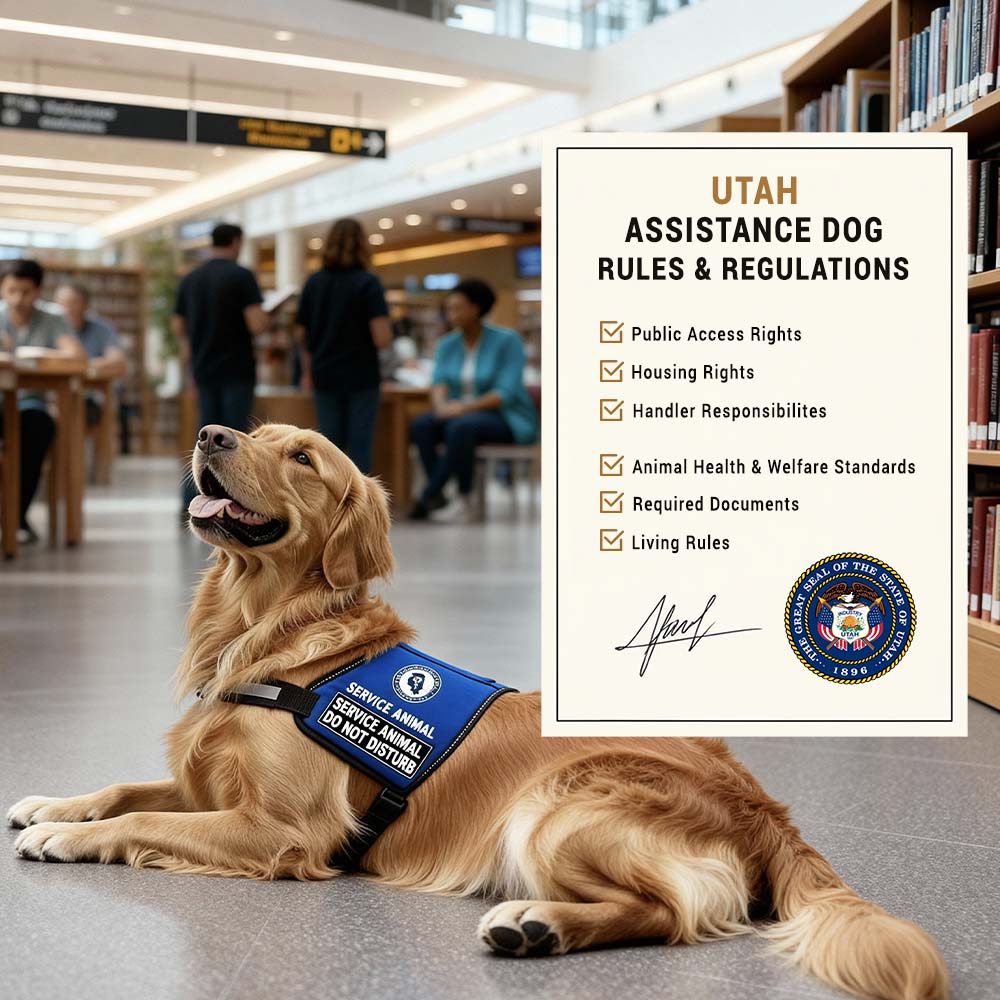
Public Access Rights
- Service dogs may accompany their handlers into restaurants, retail stores, workplaces, transportation, hotels, public buildings, and housing, protected under the ADA and Utah Human Rights Act §62A-5b-104.
- Denial of access is unlawful discrimination.
Certification/ID Requirements
- Utah does not require registration or certification for service dogs.
- Staff may only ask the two ADA questions.
- Misrepresenting a pet as a service animal is a class C misdemeanor under §62A-5b-106, punishable by fines up to $750 and community service.
Emotional Support Animals (ESA) & Psychiatric Service Animals (PSA)
Legal Recognition
Emotional Support Animals and Psychiatric Service Animals are only recognised in Utah when registered with an accredited organisation that verifies their legitimacy.
Housing Rights
- Registered ESAs/PSAs are protected by the Fair Housing Act (FHA) and Utah Antidiscrimination Act, requiring landlords to provide reasonable accommodation in no-pet housing when valid documentation/registration is presented.
Travel Rights
- Airlines: Only trained and registered psychiatric service dogs qualify under DOT rules.
- ESAs are considered pets for air travel—airline policy applies.
- Public Transit: Service dogs always allowed; ESAs/PSAs may be accepted if calm and leashed.
Veterinary & Animal Welfare Standards
Vaccination Schedules
- Rabies vaccination required for all dogs ≥4 months old under Utah Code §26-6-18.
- Proof must be shown upon request by animal control.
- Recommended additional vaccines: DHPP (distemper, adenovirus, parvo, parainfluenza).
Neutering/Spaying Regulations
- Not required statewide.
- Most shelters must sterilize animals before adoption.
Animal Welfare Acts
Under Utah Code §76-9-301–301.7, owners must:
- Provide adequate shelter, water, and food
- Protect dogs from cruelty, neglect, and abandonment
- Not leave dogs in vehicles during unsafe temperatures
Penalties range from misdemeanors to felonies for severe neglect.