
General Ownership & Control
Leash & Muzzle Rules
Ukraine requires dogs to be kept on a leash in public urban areas, including streets, parks, residential zones, markets, and public transportation zones. Major municipalities like Kyiv, Lviv, Odesa, Kharkiv, and Dnipro enforce leash rules actively.
Muzzles are required in certain contexts, especially for:
- Dangerous or aggressive dog breeds
- Large breeds in crowded public spaces
- Dogs on public transportation
- Dogs with a history of aggression or biting incidents
Off-leash activity is permitted only in designated dog parks, fenced exercise grounds, or rural areas where local rules allow it. Even in these zones, owners must maintain full control.
Breed-Specific Bans / Restrictions
Ukraine does not ban any breeds outright, but it maintains a list of dangerous dog breeds that require additional control measures. These breeds commonly include:
- American Pit Bull Terrier
- American Staffordshire Terrier
- Staffordshire Bull Terrier
- Rottweiler
- Mastiff breeds
- Cane Corso
- Dogo Argentino
- Fila Brasileiro
- Tosa Inu
- Caucasian Shepherd
- Central Asian Shepherd
Owners of dogs on the dangerous breed list must follow stricter rules such as:
- Mandatory muzzling in public
- Short, strong leash
- Registration with municipal authorities
- Liability insurance (required in some cities)
Licensing & Microchipping
Microchipping is mandatory for all dogs in Ukraine, and the microchip must be registered with the national database used by veterinary authorities.
Owners must also comply with:
- Mandatory annual rabies vaccination
- Municipal registration or licensing (varies by region)
- Carrying veterinary documentation when in public
Failure to microchip or vaccinate may result in fines.
Service Dogs & Assistance Animals
Legal Definitions
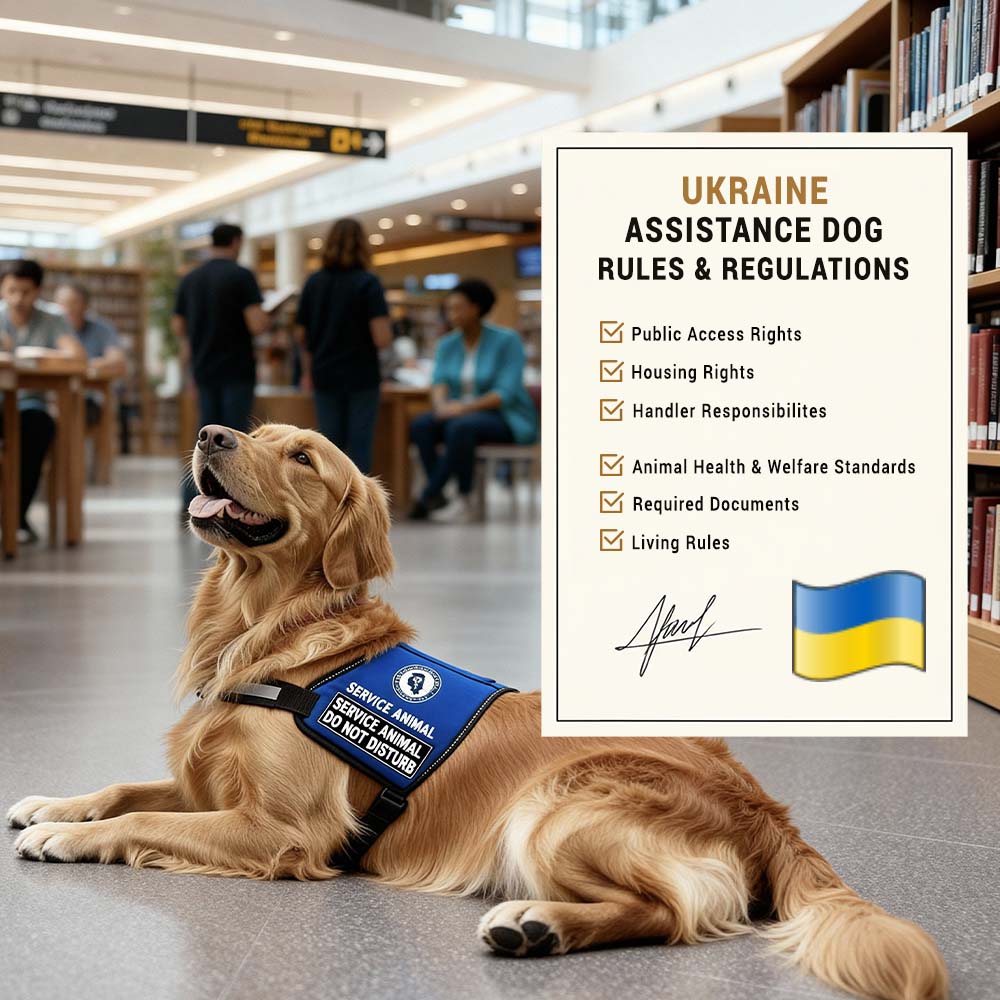
Ukraine recognizes service dogs trained for disability-related tasks, including guide dogs, mobility assistance dogs, hearing dogs, seizure-alert dogs, diabetes-alert dogs, and psychiatric service dogs (PSDs).
Public Access Rights
Service dogs must be allowed in:
- Restaurants and cafes
- Shops and commercial centers
- Hotels and accommodations
- Public transport (buses, metro, trams, trains)
- Hospitals and clinics
- Government buildings
Refusal of a trained service dog is unlawful under disability access regulations.
Certification / ID Requirements
Ukraine encourages handlers to carry official identification. Recommended documentation includes:
- Service dog identification card
- Accredited training or registration certificate
- Visible harness or vest
- Physical ID card (handler + service dog)
- Prescription Letter (ESA, PSA, or service dog letter)
Emotional Support Animals (ESA) & Psychiatric Service Animals (PSA)
Legal Recognition
ESAs and PSAs in Ukraine are only recognized when registered with an accredited organization. Without accreditation, ESAs are considered companion animals and do not receive public-access rights.
Housing Rights
Registered ESAs/PSAs may be permitted in restricted housing depending on landlord policies. Fully trained service dogs must be accepted as disability accommodations.
Travel Rights
- Service dogs may travel in-cabin on flights to and from Ukraine.
- Accredited PSAs may travel as service dogs when task-trained.
- ESAs follow normal pet policies unless recognized by the airline.
- Public transportation accepts service dogs countrywide.
Veterinary & Animal Welfare Standards
Vaccination Schedules
Rabies vaccination is mandatory and strictly enforced. Core vaccines include distemper, parvovirus, adenovirus, and leptospirosis.
Neutering / Spaying Regulations
Neutering is not mandatory, but is strongly recommended to reduce the stray animal population. Many regions offer low-cost sterilization programs.
Animal Welfare Acts
Ukraine enforces animal welfare laws requiring proper food, water, shelter, exercise, veterinary care, and humane treatment. Abuse, abandonment, dog fighting, and mistreatment are punishable by fines or criminal penalties.
Welfare enforcement is overseen by the State Service of Ukraine on Food Safety and Consumer Protection.