
General Ownership & Control
Leash & Muzzle Rules
The United Kingdom requires dogs to be kept under control at all times. While there is no universal national leash law, local councils set specific rules. In most public areas — including parks, town centers, beaches (seasonally), children’s play areas, and nature reserves — dogs must be leashed or kept closely controlled.
Muzzles are required for:
- Dogs identified as aggressive or dangerous
- Dogs under court-issued control orders
- Restricted breeds (see below), when permitted by exemption
Councils may also enforce orders requiring:
- Leashing at all times in designated areas
- No dogs in children’s playgrounds
- Dog exclusion areas on beaches during summer
Breed-Specific Bans / Restrictions
The UK enforces one of the strictest breed-control laws in Europe under the Dangerous Dogs Act. The following breeds are banned unless the owner has a valid exemption certificate:
- Pit Bull Terrier
- Japanese Tosa
- Dogo Argentino
- Fila Brasileiro
- American Bully XL (added in 2024)
Exempted dogs must comply with strict conditions:
- Mandatory muzzle in all public places
- Always kept on a short leash
- Owned by an adult over 16 years old
- Microchipped and neutered
- Covered by third-party liability insurance
Licensing & Microchipping
Microchipping is mandatory for all dogs in the UK. Chips must be registered in an approved database such as Petlog, Animal Tracker, or Identibase.
Additional obligations include:
- A collar and tag with the owner’s name/address whenever the dog is in public
- Vaccination records (rabies is only required for travel)
- Local council dog-control orders depending on region
Failure to microchip or update details may result in fines.
Service Dogs & Assistance Animals
Legal Definitions
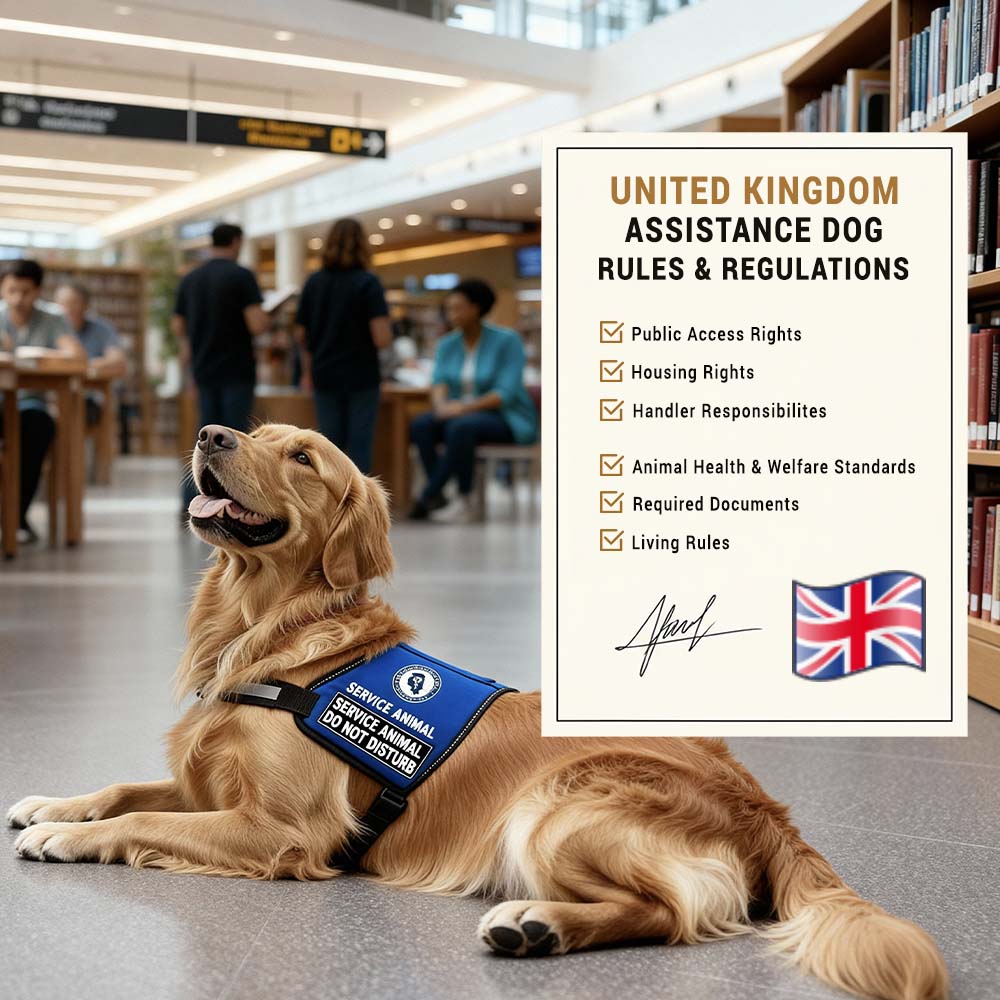
The UK recognizes a broad range of assistance dogs that are fully trained to support individuals with disabilities. These include guide dogs, hearing dogs, mobility assistance dogs, seizure-alert dogs, diabetes-alert dogs, and psychiatric service dogs (PSDs).
Public Access Rights
Assistance dogs must be granted access to:
- Restaurants and cafes
- Shops and supermarkets
- Hotels and accommodations
- Public transportation (buses, trains, ferries, taxis)
- Hospitals and medical facilities
- Government buildings
Refusing entry to a legitimate assistance dog violates the Equality Act 2010.
Certification / ID Requirements
Although there is no mandatory national ID, handlers should carry proof of training. Recommended documentation includes:
- Assistance dog identification card
- Training or registration certificate
- Visible harness or vest
- Physical ID card (handler + service dog)
- Prescription Letter (ESA, PSA, or service dog letter)
Emotional Support Animals (ESA) & Psychiatric Service Animals (PSA)
Legal Recognition
ESAs and PSAs in the UK are only recognized when registered with an accredited organization. Without accreditation, ESAs are considered companion animals and do not have special public-access rights.
Housing Rights
Registered ESAs/PSAs may be accepted in no-pet housing based on landlord discretion. Fully trained assistance dogs must always be accepted under the Equality Act.
Travel Rights
- UK airlines accept certified assistance dogs.
- PSAs may travel as service dogs when accredited and task-trained.
- ESAs follow standard airline pet rules unless recognized by carriers.
- Service dogs are accepted on buses, trains, ferries, and the London Underground.
Veterinary & Animal Welfare Standards
Vaccination Schedules
Core vaccinations for dogs in the UK include distemper, adenovirus, parvovirus, and leptospirosis. Rabies vaccination is required only for international travel but widely recommended.
Neutering / Spaying Regulations
Neutering is not mandatory, but responsible pet ownership campaigns strongly encourage it. Many shelters require neutering before adoption.
Animal Welfare Acts
The UK has some of the strongest animal welfare laws in Europe. Owners must provide adequate food, water, shelter, mental stimulation, exercise, and veterinary care. Abuse, neglect, or abandonment may lead to severe fines or criminal charges.
The Animal Welfare Act 2006 and the Dangerous Dogs Act guide enforcement.