
General Ownership & Control
Leash & Muzzle Rules
- Washington, D.C. has strict leash rules under DC Municipal Regulations Title 24, §900.
- Dogs must be leashed at all times in public unless in a designated dog park.
- Leash length is generally recommended to be 6 feet or less.
- Allowing a dog to run at large is a civil infraction and can result in fines.
- Muzzles are not required for ordinary dogs.
- Dogs declared “dangerous” or “potentially dangerous” under DC Code §8-1901–1906 must:
- Wear a muzzle in public
- Be kept on a secure leash
- Be registered and confined properly at home
Breed-Specific Bans / Restrictions
- Washington, D.C. has no breed-specific legislation.
- Pit bulls, rottweilers, mastiffs, and guardian breeds are fully legal in the city.
- Private housing, landlords, or HOAs may impose their own breed rules.
Licensing & Microchipping
- All dogs must be licensed annually in Washington, D.C. under DC Code §8-1804.
- To obtain a license, you must show:
- Proof of current rabies vaccination
- Proof of spay/neuter for reduced fees
- Microchipping is mandatory for all dogs in D.C. under DC Law 17-281, and the microchip number must be linked to the dog license.
- Dogs must wear their license tag whenever in public.
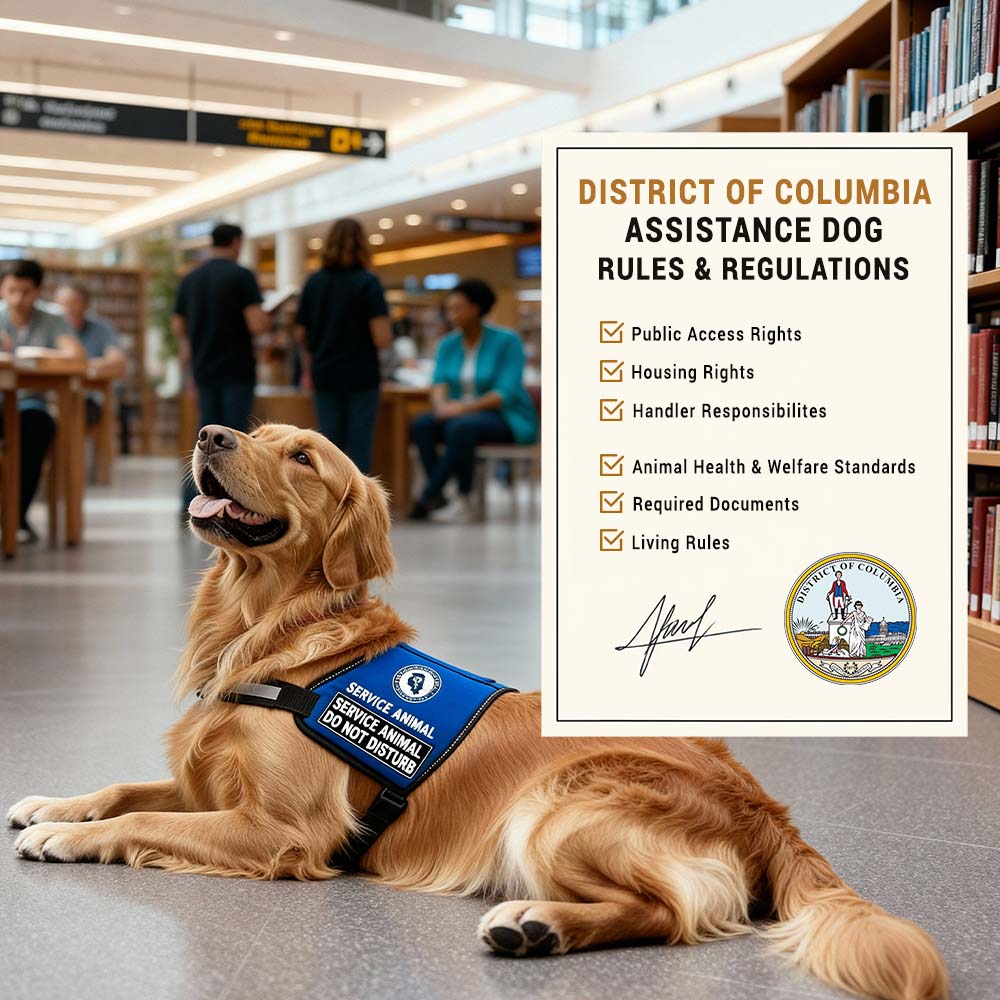
Service Dogs & Assistance Animals
Legal Definitions
- Under the ADA and D.C. Human Rights Act, a service dog is a dog trained to perform tasks for a person with a disability, including:
- Guide dogs
- Hearing dogs
- Mobility support dogs
- Psychiatric service dogs (task-trained)
Public Access Rights
- Service dogs are allowed in:
- Restaurants, stores, and shopping centers
- Government buildings
- Public transportation
- Hotels and workplaces
- Housing (even no-pet housing)
- Denial of access is illegal under DC Code §2-1402.31.
Certification / ID Requirements
- D.C. does not require service dogs to be registered or certified.
- Staff may only ask the two ADA questions.
- Misrepresenting a pet as a service dog can lead to civil penalties in D.C.
Emotional Support Animals (ESA) & Psychiatric Service Animals (PSA)
Legal Recognition
- Emotional Support Animals and Psychiatric Service Animals are only recognized in D.C. when registered with an accredited organization that verifies their legitimacy.
Housing Rights
- Registered ESAs and PSAs are protected under the Fair Housing Act and D.C. Human Rights Act.
- Landlords must provide reasonable accommodation, even in no-pet buildings, when valid registration/documentation is provided.
Travel Rights
- Airlines: Only trained, registered psychiatric service dogs qualify under DOT rules.
- ESAs: Treated as pets for flights.
- Public Transit (Metrobus, Metrorail):
- Service dogs always accepted.
- ESAs/PSAs may be transported in carriers or at operator discretion.
Veterinary & Animal Welfare Standards
Vaccination Schedules
- Rabies vaccination is required for all dogs ≥4 months old under DC Code §8-1805.
- Proof of vaccination is necessary for licensing.
- Recommended vaccines: DHPP (distemper, hepatitis, parvo, parainfluenza).
Neutering / Spaying Requirements
- D.C. promotes spay/neuter strongly and offers public assistance, but it is not legally mandatory for owned pets.
- Shelters must sterilize dogs before adoption.
Animal Welfare Acts
Under D.C. Animal Control Act & Anti-Cruelty Code (DC Code §22-1001–1016), owners must:
- Provide adequate food, water, shelter, and vet care
- Not leave dogs outside in extreme weather
- Never leave dogs in hot or freezing vehicles
- Prevent abuse, cruelty, and neglect
Penalties range from fines to felony charges.