
General Ownership & Control
Leash & Muzzle Rules
- Texas has no statewide leash law, but all major cities/counties enforce local leash requirements.
- Houston, Dallas, San Antonio, Austin, Fort Worth, and El Paso require dogs to be leashed in public areas (usually 6 ft or less).
- Under Texas Health & Safety Code §822.012, owners are liable for dogs allowed to “run at large.”
- Muzzles are not required for typical pets.
- Dogs designated as “dangerous” under Texas Health & Safety Code §822.041–.047 must be:
- Muzzled in public
- Restrained on a strong leash
- Confined safely on private property
- Registered annually
Breed-Specific Bans/Restrictions
- Texas has no statewide breed bans, and state law prohibits municipalities from enacting breed-specific legislation (Texas Health & Safety Code §822.047).
- HOAs and private housing may impose breed restrictions, but cities cannot ban breeds.
Licensing & Microchipping
- Licensing requirements vary by city. Most require licensing for dogs over 4 months old, with proof of current rabies vaccination.
- Microchipping is mandatory in some major cities (including Houston, Dallas, and San Antonio).
- Shelters must microchip dogs before adoption statewide.
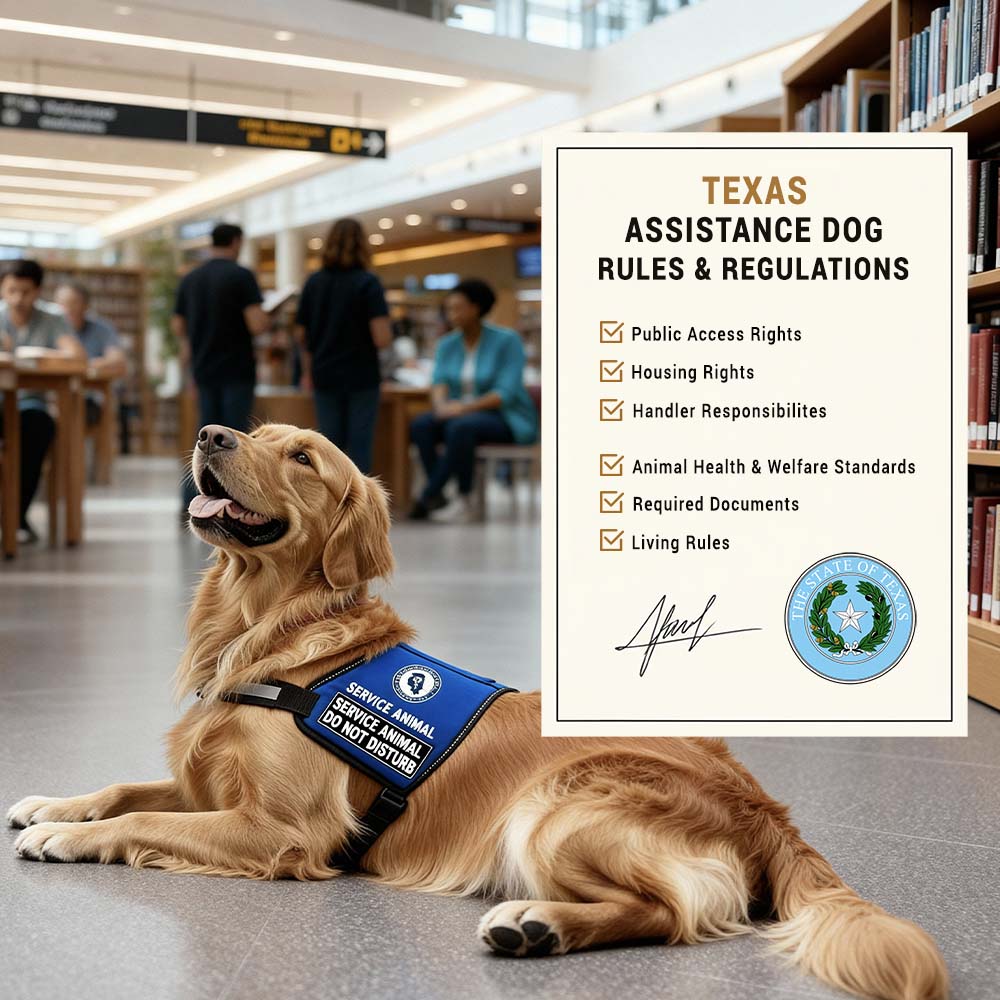
Service Dogs & Assistance Animals
Legal Definitions
Under the ADA and Texas Human Resources Code §121.002, a service dog is defined as a dog trained to perform tasks that mitigate a disability, including:
- Guiding the blind
- Alerting individuals who are deaf
- Mobility support
- Psychiatric service work (such as grounding or interruption tasks)
Public Access Rights
- Service dogs are permitted in restaurants, public transportation, schools, workplaces, retail establishments, hotels, and housing, per the ADA and Texas Human Resources Code §121.003.
- Denial of access is an offense under Texas law.
Certification/ID Requirements
- No certification or state registration is required.
- Only the two ADA-compliant questions may be asked.
- Misrepresenting a pet as a service animal is a misdemeanor under Texas Human Resources Code §121.006, punishable by fines up to $1,000 and community service.
Emotional Support Animals (ESA) & Psychiatric Service Animals (PSA)
Legal Recognition
Emotional Support Animals (ESAs) and Psychiatric Service Animals (PSAs) are only recognised in Texas when registered with an accredited organisation that verifies their purpose and documentation.
Housing Rights
- Registered ESAs/PSAs are protected under the Fair Housing Act (FHA) and Texas Fair Housing Act, requiring landlords to make reasonable accommodations in no-pet housing.
Travel Rights
- Airlines: Only registered and trained psychiatric service dogs qualify under DOT rules.
- ESAs are treated as pets under airline policies.
- Buses/Trains: Service dogs always allowed; ESAs/PSAs may be accepted if calm and leashed.
Veterinary & Animal Welfare Standards
Vaccination Schedules
- Rabies vaccination required for all dogs ≥4 months old under Texas Health & Safety Code §826.021.
- Certificate must be carried or available on request.
- Additional recommended vaccines: DHPP (distemper, adenovirus, parvovirus, parainfluenza).
Neutering/Spaying Regulations
- Not required statewide.
- Major cities require sterilization for shelter adoptions.
Animal Welfare Acts
Texas cruelty laws under Penal Code §42.092 require owners to:
- Provide adequate care
- Prevent neglect, abuse, and abandonment
- Not expose dogs to extreme temperatures
- Not leave dogs in hot or freezing vehicles
Violations can be misdemeanors or felonies.