
General Ownership & Control
Leash & Muzzle Rules
Switzerland has dog-control regulations that vary by canton, but all owners must ensure their dogs remain under control at all times. National rules require responsible supervision, while cantonal laws may require leashes in:
- City centers and public squares
- Parks and playgrounds
- Public transportation areas
- Wildlife protection zones (especially during spring and early summer)
Muzzle rules differ by canton. Muzzles may be required for:
- Dogs with aggression history
- Large or powerful breeds on public transport
- Cantonal breed-restricted areas
- Dogs classified as dangerous after a behavioral incident
Off-leash is allowed in many natural areas, but owners must maintain immediate control, especially during wildlife seasons.
Breed-Specific Bans / Restrictions
Switzerland does not have a nationwide list of banned breeds. However, several cantons enforce restrictions or bans on certain breeds. Examples:
Canton of Zurich: Restricted breeds require special permits.
Canton of Geneva: Pit bulls, rottweilers, and similar breeds may be banned.
Canton of Valais: Some breeds fall under strict handling conditions.
Common restricted breeds depending on canton include:
- American Pit Bull Terrier
- American Staffordshire Terrier
- Staffordshire Bull Terrier
- Rottweiler
- Mastiff breeds
- Cane Corso
- Dogo Argentino
Owners of restricted breeds may be required to:
- Obtain a special ownership permit
- Complete mandatory training courses
- Use muzzles and short leashes in public
- Carry liability insurance
Licensing & Microchipping
Microchipping is mandatory nationwide. The microchip must be registered in the Swiss national database (AMICUS).
Additional requirements include:
- Municipal registration of every dog
- Annual dog ownership tax (varies by canton)
- Mandatory training courses for first-time dog owners in some cantons
- Proof of rabies vaccination
Failure to register or microchip can result in fines.
Service Dogs & Assistance Animals
Legal Definitions
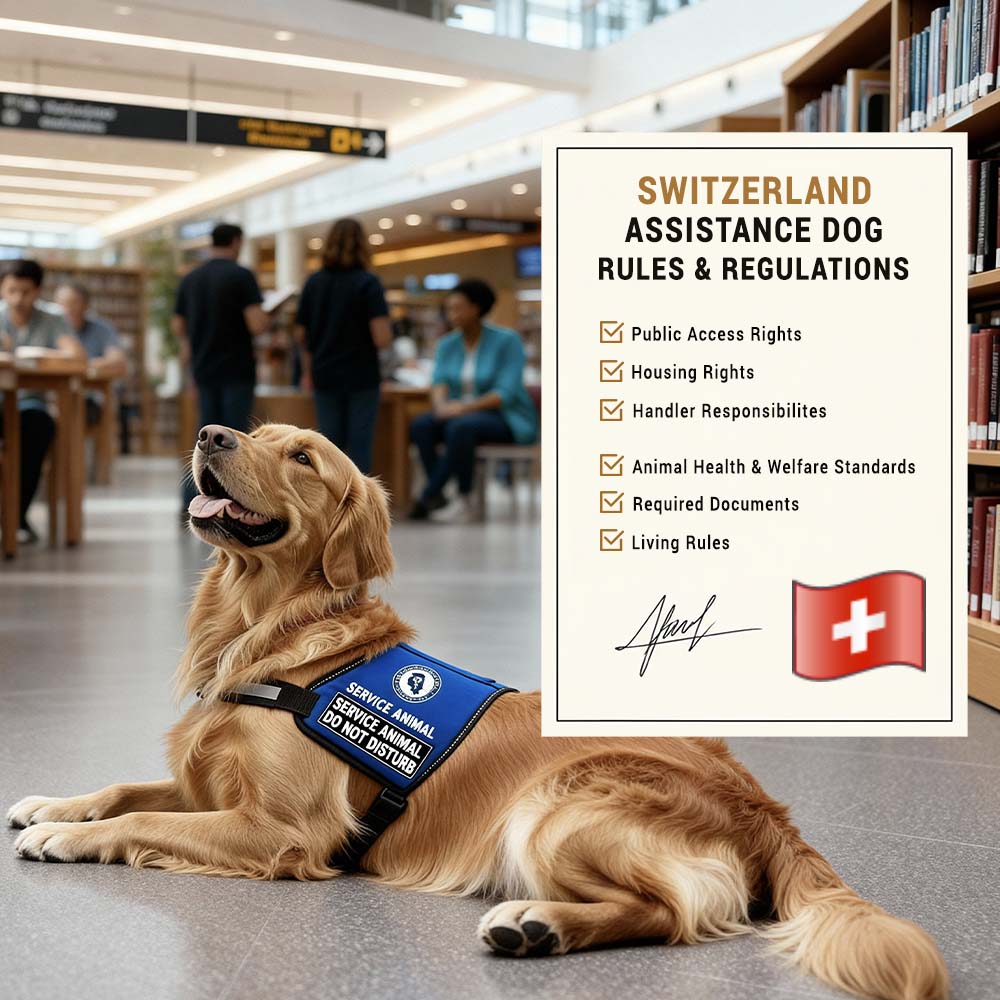
Switzerland recognizes many types of service dogs including guide dogs, mobility assistance dogs, hearing dogs, seizure-alert dogs, diabetes-alert dogs, and psychiatric service dogs (PSDs). These dogs must be task-trained for disabilities.
Public Access Rights
Service dogs must be granted access to all public spaces, including:
- Restaurants and cafes
- Shops and commercial centers
- Hotels and tourist facilities
- Public transportation (trains, trams, buses, ferries)
- Government buildings
- Hospitals and clinics
Businesses may not refuse a trained service dog.
Certification / ID Requirements
Although Switzerland has no unified national service-dog card, handlers should carry identification. Recommended items include:
- Service dog ID or certificate
- Training or registration documentation
- Visible vest or harness
- Physical ID Card (handler + dog)
- Prescription Letter (ESA, PSA, or service dog letter)
Emotional Support Animals (ESA) & Psychiatric Service Animals (PSA)
Legal Recognition
In Switzerland, ESAs and PSAs are only recognized when registered with an accredited organization. Without proper registration, ESAs have no public-access privileges and are treated as companion animals.
Housing Rights
Registered ESAs/PSAs may be accepted in no-pet housing depending on landlord preference. Fully trained service dogs must always be accepted under disability accommodation laws.
Travel Rights
- Airlines serving Switzerland accept trained service dogs in the cabin.
- Accredited psychiatric service dogs may travel as service dogs.
- ESAs follow pet travel rules unless recognized by the airline.
- Public transportation grants full acceptance to service dogs.
Veterinary & Animal Welfare Standards
Vaccination Schedules
Rabies vaccination is mandatory for international travel but recommended for all dogs. Core vaccines include distemper, parvovirus, adenovirus, and leptospirosis.
Neutering / Spaying Regulations
Neutering is not required by law. Switzerland permits responsible breeding but enforces strong animal-welfare protections to prevent irresponsible practices.
Animal Welfare Acts
Switzerland has some of the strictest animal welfare laws globally. Owners must provide:
- Proper housing and shelter
- Regular veterinary care
- Adequate socialization
- Exercise and enrichment
The Federal Food Safety and Veterinary Office (FSVO/OSAV/USAV) oversees enforcement. Mistreatment or neglect can result in severe penalties, including fines or criminal charges.