
General Ownership & Control
Leash & Muzzle Rules
Spain requires dogs to be kept on a leash in most public spaces, including streets, parks, beaches (seasonally), public squares, public transport areas, and commercial districts. Municipalities such as Madrid, Barcelona, Valencia, and Seville enforce leash laws actively.
Muzzles are required for certain dogs and situations:
- Potentially dangerous dogs (PPP/“Perros Potencialmente Peligrosos”)
- Dogs with a history of aggression
- Large or strong breeds on public transportation
- Municipal mandates based on dog behavior
Off-leash is only allowed in designated dog parks or specific time windows (depending on municipality). Dogs must remain under full control.
Breed-Specific Bans / Restrictions
Spain enforces strict regulations for potentially dangerous dog breeds (PPP). These breeds are not banned, but require special permits and controls. The list includes:
- Pit Bull Terrier
- Staffordshire Bull Terrier
- American Staffordshire Terrier
- Rottweiler
- Dogo Argentino
- Fila Brasileiro
- Tosa Inu
- Akita Inu
PPP owners must meet requirements such as:
- Mandatory muzzle in public
- Short, strong leash (no longer than 2 meters)
- Special municipal license (renewed every 5 years)
- Criminal background check
- Liability insurance
- Secure containment on private property
Licensing & Microchipping
Microchipping is mandatory for all dogs in Spain. Chips must be registered in the regional pet identification database (RAIAC, REIAC, or local equivalent).
Dog owners must also comply with:
- Annual rabies vaccination (required in many regions)
- Municipal dog registration
- Carrying vaccination and identification documents
Failure to identify or vaccinate a dog may result in fines.
Service Dogs & Assistance Animals
Legal Definitions
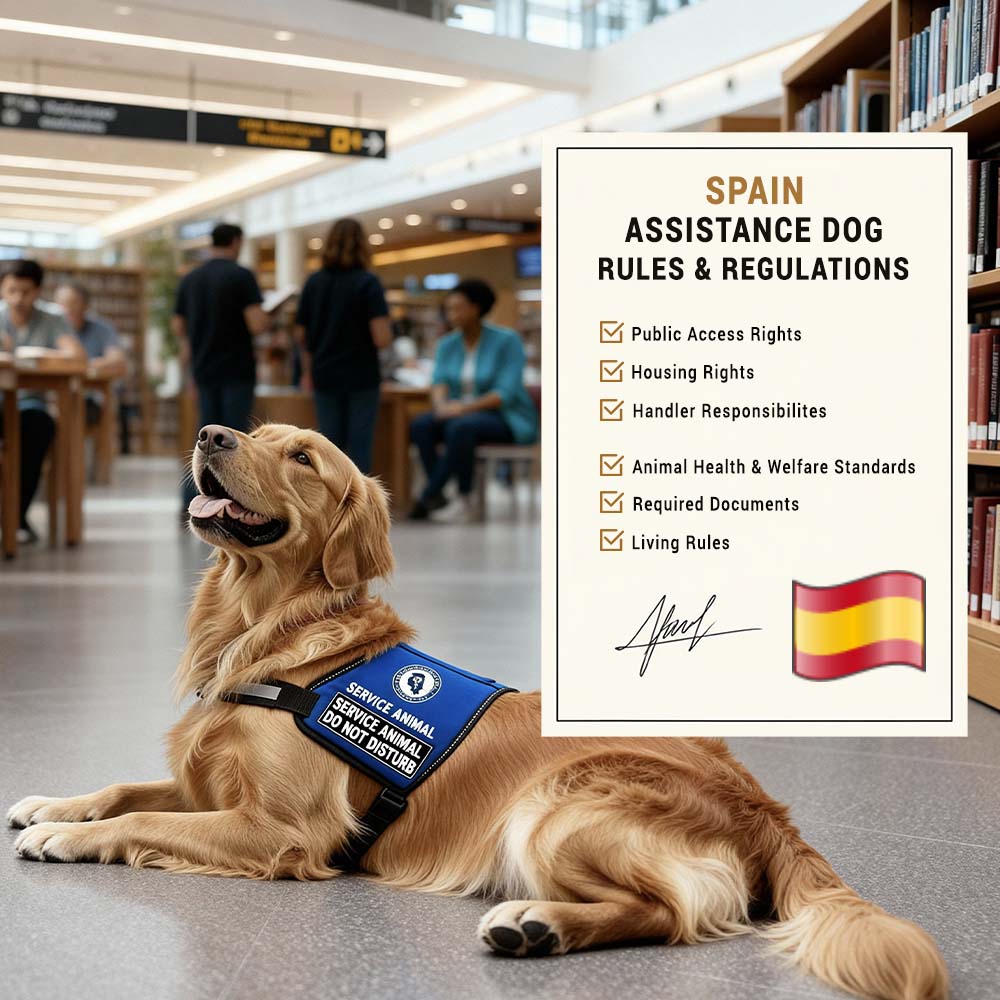
Spain fully recognizes disability-assistance dogs, including guide dogs, mobility assistance dogs, hearing dogs, seizure-alert dogs, diabetes-alert dogs, and psychiatric service dogs (PSDs). These dogs must be task-trained for disability-related assistance.
Public Access Rights
Service dogs must be allowed in:
- Restaurants and cafes
- Supermarkets and retail shops
- Public transportation (metro, trains, buses, ferries)
- Hospitals and medical centers
- Tourist attractions and hotels
- Government buildings
Service dogs cannot be refused entry, even where pets are normally prohibited.
Certification / ID Requirements
Spain requires service dogs to be properly identified. Handlers should carry:
- Official service dog ID (issued regionally)
- Training certificate from an accredited organization
- Visible recognition gear (vest or harness)
- Physical ID Card (handler + service dog)
- Prescription Letter (ESA, PSA, or service dog letter)
Emotional Support Animals (ESA) & Psychiatric Service Animals (PSA)
Legal Recognition
In Spain, ESAs and PSAs are only recognized when registered with an accredited organization. Without recognition, ESAs do not have public-access rights.
Housing Rights
Registered ESAs/PSAs may receive exceptions in pet-restricted housing depending on landlord policies. Fully trained service dogs must always be accepted.
Travel Rights
- Airlines operating in Spain accept certified service dogs.
- PSAs may travel as service dogs when accredited and task-trained.
- ESAs follow standard airline pet rules unless recognized by a carrier.
- Public transport accepts service dogs; ESAs/PSAs depend on operator policies.
Veterinary & Animal Welfare Standards
Vaccination Schedules
Rabies vaccination is mandatory in most regions and strongly recommended nationwide. Core vaccines include distemper, parvovirus, adenovirus, and leptospirosis.
Neutering / Spaying Regulations
Neutering is not legally required but is widely encouraged for population control and responsible ownership. Many municipalities offer subsidized sterilization programs.
Animal Welfare Acts
Spain enforces strong animal welfare protections. Owners must provide food, water, shelter, exercise, and veterinary care. Abuse, mistreatment, abandonment, or neglect is punishable by fines or criminal penalties.
The Ministry of Agriculture, Fisheries, and Food (MAPA) and local police oversee animal welfare enforcement.