
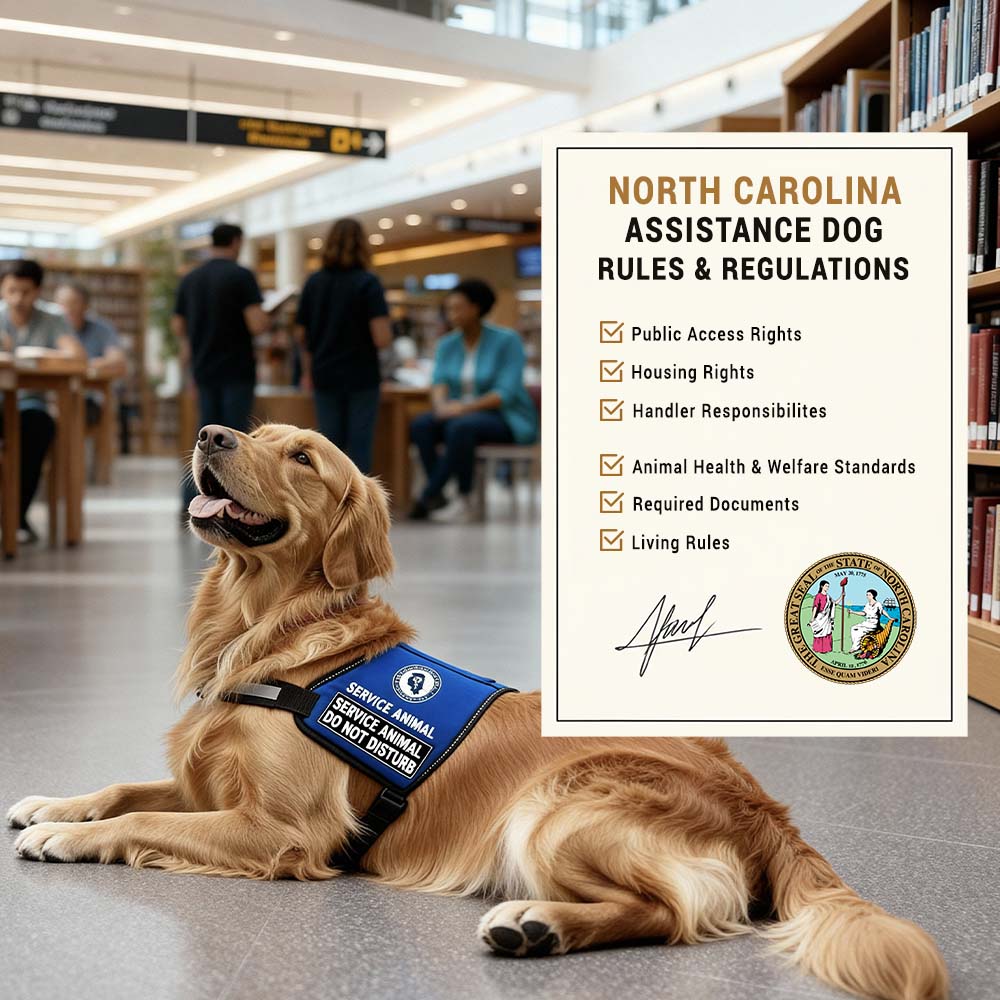
General Ownership & Control
Leash & Muzzle Rules
- North Carolina does not have a single statewide leash law, but most counties and cities require dogs to be leashed when in public.
- Major cities such as Charlotte, Raleigh, Greensboro, Durham, and Asheville enforce leash ordinances (typically 6 feet or less).
- Allowing a dog to run at large may result in fines or impoundment under local animal control laws.
- Muzzles are not required for standard dogs.
- Dogs declared “dangerous” under N.C. Gen. Stat. §67-4.1 must:
- Be securely confined
- Be leashed and muzzled in public
- Be registered with the county
- Carry liability insurance (minimum coverage may be required)
Breed-Specific Bans / Restrictions
- North Carolina has no statewide breed bans.
- Regulation is based on behavior, not breed.
- Some municipalities or private housing providers may have breed policies.
Licensing & Microchipping
- Rabies vaccination is mandatory statewide for all dogs 4 months and older under N.C. Gen. Stat. §130A-185.
- Licensing requirements vary by county; many counties require annual registration.
- Microchipping is not mandatory statewide, but is strongly recommended and often required by shelters before adoption.
Service Dogs & Assistance Animals
Legal Definitions
- Under the Americans with Disabilities Act (ADA) and North Carolina law, a service dog is a dog trained to perform specific tasks for a person with a disability, including:
- Guide work
- Hearing alerts
- Mobility assistance
- Psychiatric service tasks
Public Access Rights
- Service dogs are permitted in:
- Restaurants, stores, and public buildings
- Public transportation
- Hotels and workplaces
- Housing (including no-pet properties)
- Denying access is unlawful discrimination under state and federal law.
Certification / ID Requirements
- North Carolina does not require service dogs to be certified or registered.
- Only the two ADA-permitted questions may be asked.
- Misrepresentation of a service animal may result in penalties under state law.
Emotional Support Animals (ESA) & Psychiatric Service Animals (PSA)
Legal Recognition
- Emotional Support Animals and Psychiatric Service Animals are only recognized in North Carolina when registered with an accredited organization that verifies their legitimacy and purpose.
Housing Rights
- Registered ESAs/PSAs are protected under the Fair Housing Act (FHA).
- Landlords must provide reasonable accommodation when proper documentation is provided.
Travel Rights
- Airlines: Only trained, registered psychiatric service dogs qualify under DOT rules.
- ESAs: Treated as pets for air travel.
- Public transit: Service dogs allowed; ESAs may be accepted at operator discretion.
Veterinary & Animal Welfare Standards
Vaccination Schedules
- Rabies vaccination is required for all dogs 4 months and older.
- Core vaccines (DHPP) strongly recommended by veterinarians.
Neutering / Spaying Regulations
- Not required statewide.
- Required prior to most shelter adoptions.
Animal Welfare Acts
Under N.C. Gen. Stat. §14-360, animal cruelty is prohibited. Owners must:
- Provide adequate food, water, shelter, and veterinary care
- Prevent neglect and abandonment
- Protect dogs from extreme weather
Violations may result in misdemeanor or felony charges.