
General Ownership & Control
Leash & Muzzle Rules
- New York State requires all dogs to be restrained or leashed in public spaces under NY Agriculture & Markets Law §118.
- New York City Administrative Code §161.05 specifically mandates that dogs must be leashed (no longer than 6 feet) whenever in public areas.
- Rural counties often permit voice control in designated open spaces, but leashing is still recommended for safety.
- Muzzles are not required for the general dog population. However, dogs designated as “dangerous” under NY Ag & Mkts §121 must be muzzled and leashed in public, and confined securely on private property.
Breed-Specific Bans/Restrictions
- No statewide breed bans exist in New York.
- However, New York City Housing Authority (NYCHA) prohibits certain breeds in public housing, including:
- Pit Bull-type breeds
- Rottweilers
- Doberman Pinschers
- Private landlords and local jurisdictions may have their own restrictions, so verification is advised before relocation.
Licensing & Microchipping
- All dogs over 4 months old must be licensed with the city, town, or municipality where they reside (NY Ag & Mkts §109).
- Licensing requires proof of rabies vaccination.
- Microchipping is mandatory for all dogs adopted from shelters or rescue organizations (NY Ag & Mkts §380).
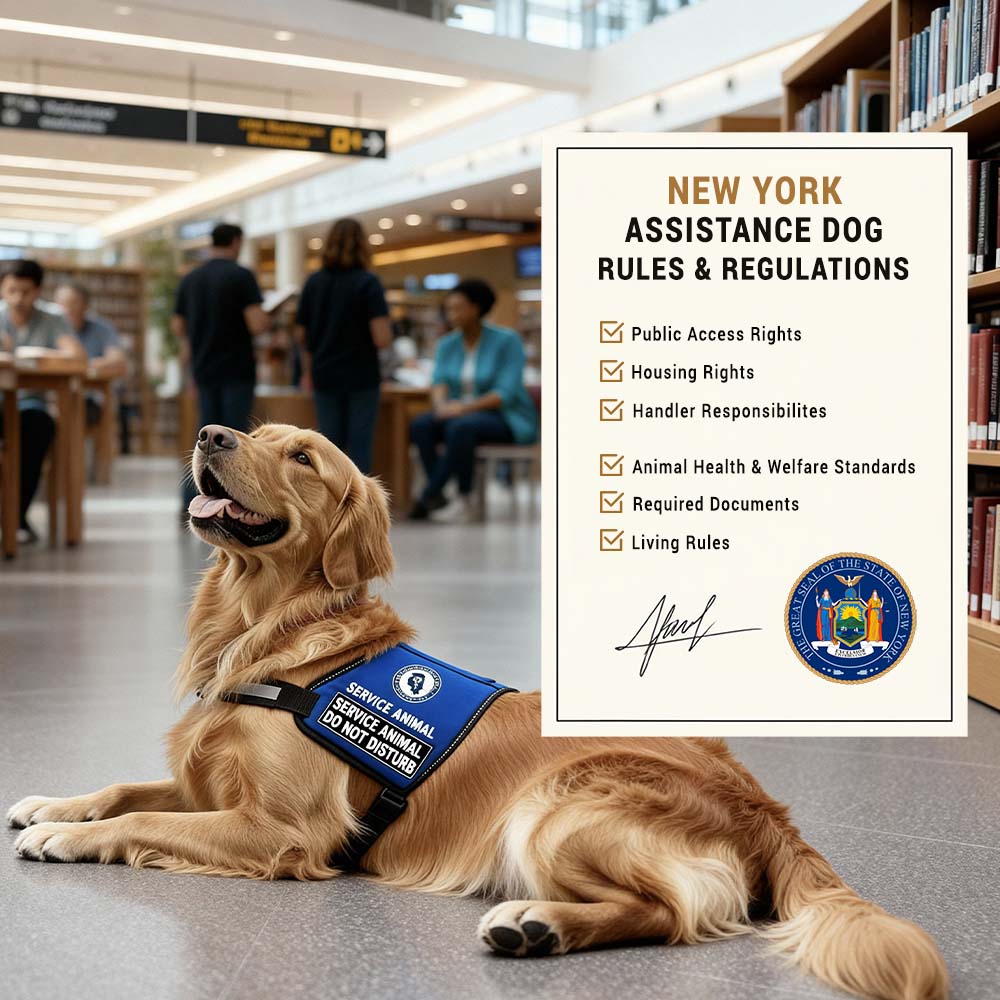
Service Dogs & Assistance Animals
Legal Definitions
Under the Americans with Disabilities Act (ADA) and New York Civil Rights Law §47, a service dog is defined as a dog individually trained to perform tasks for a person with a physical, sensory, psychiatric, or intellectual disability.
Examples include:
- Guide dogs for the visually impaired.
- Hearing dogs for individuals with hearing loss.
- Mobility and psychiatric service dogs trained for alerts, grounding, or task support.
Public Access Rights
- Service dogs are guaranteed full public access under Civil Rights Law §47-b and the ADA.
- They may accompany their handlers into restaurants, hotels, workplaces, public transport, and housing, regardless of pet restrictions.
- Denying access to a service dog is considered discrimination and may lead to civil penalties.
Certification/ID Requirements
- New York does not require service dog certification or registration.
- Businesses may only ask:
- If the dog is required for a disability, and
- What tasks it performs.
- Misrepresentation of a pet as a service animal is a violation under NY Gen. Bus. Law §391-zz, punishable by fines up to $100 and community service.
Emotional Support Animals (ESA) & Psychiatric Service Animals (PSA)
Legal Recognition
Emotional Support Animals (ESAs) and Psychiatric Service Animals (PSAs) are only recognised in New York when registered with an accredited organisation that verifies their legitimacy and role.
Housing Rights
- Registered ESAs and PSAs are protected under the Fair Housing Act (FHA) and the New York State Human Rights Law (Executive Law §296).
- Landlords must provide reasonable accommodation for registered ESAs/PSAs, even in “no-pet” housing, when proper registration or documentation is provided.
Travel Rights
- Airlines: Only psychiatric service dogs (trained and registered) are recognised for in-cabin travel under DOT rules.
- ESAs are treated as pets but may still fly in-cabin depending on airline policy.
- Public Transport (MTA, Amtrak): Service dogs are always permitted; registered ESAs/PSAs may be accepted if calm, leashed, and well-behaved.
Veterinary & Animal Welfare Standards
Vaccination Schedules
- Rabies vaccination is required for all dogs 4 months and older (NY Ag & Mkts §109).
- Proof of vaccination must be shown upon request by authorities.
- Recommended vaccines: distemper, parvovirus, and adenovirus.
Neutering/Spaying Regulations
- Not required statewide, but NYC Health Code §161.15 mandates sterilization for all shelter-adopted dogs before release.
Animal Welfare Acts
Under NY Ag & Mkts §353–357, animal cruelty laws require that owners:
- Provide adequate food, water, shelter, and veterinary care.
- Protect animals from neglect and unsafe conditions.
- Avoid leaving pets in vehicles under extreme weather (“Hot Car Law,” §353-d).
Violations can result in fines, imprisonment, and loss of animal custody.