
General Ownership & Control
Leash & Muzzle Rules
- Nevada has no statewide leash law, but all major cities and counties require dogs to be leashed or under restraint when in public.
- Las Vegas Municipal Code §7.36.030 and Clark County Code §10.36.040 mandate dogs must be leashed (6 feet or shorter) when off private property.
- Reno and Henderson have similar leash regulations.
- Muzzles are not required unless a dog has been declared “dangerous” or “vicious” under the Nevada Dangerous Dog Law (NRS §202.500).
- Dangerous dogs must be muzzled, leashed, and confined securely when outside the owner’s property.
Breed-Specific Bans/Restrictions
- Nevada has no statewide or local breed bans.
- State law (NRS §202.500(6)) prohibits breed-specific legislation, meaning pit bulls, rottweilers, and other breeds cannot be restricted solely based on breed.
Licensing & Microchipping
- All dogs 4 months and older must be licensed annually with proof of current rabies vaccination (NRS §441A.410).
- Licensing is managed by local municipalities such as Clark County Animal Control or Washoe County Regional Animal Services.
- Microchipping is mandatory in most counties (including Clark and Washoe) for identification and registration.
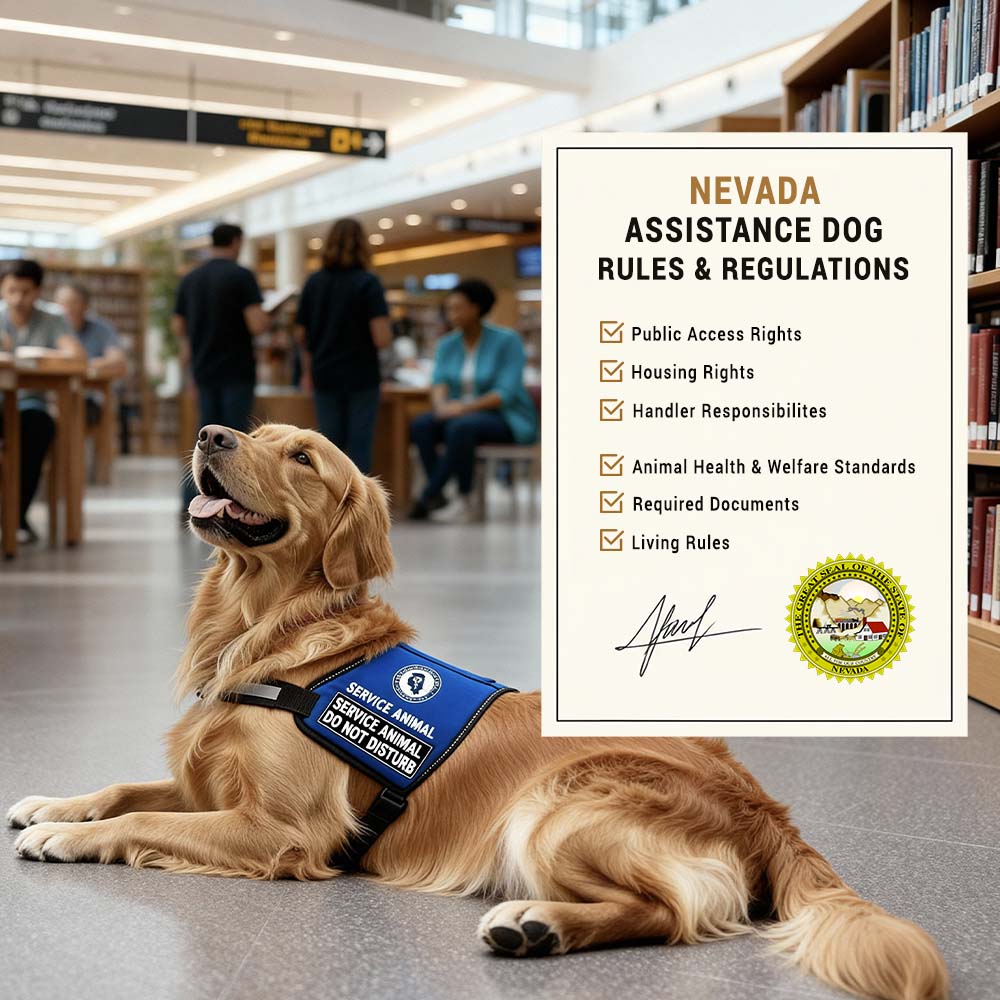
Service Dogs & Assistance Animals
Legal Definitions
Under the Americans with Disabilities Act (ADA) and Nevada Revised Statutes (NRS §426.097–.098), a service dog is defined as a dog individually trained to perform specific tasks for a person with a physical, sensory, psychiatric, or intellectual disability.
Examples include:
- Guide dogs for those with visual impairments.
- Hearing dogs for individuals who are deaf or hard of hearing.
- Mobility and psychiatric service dogs trained for alerts, retrievals, or calming functions.
Public Access Rights
- Service dogs have full access rights to all public places, including restaurants, hotels, housing, transportation, and workplaces, under NRS §426.510 and the ADA.
- Denying access to a service dog constitutes discrimination and may result in fines or civil penalties.
Certification/ID Requirements
- Nevada does not require certification or registration for service dogs.
- Businesses may only ask:
- Whether the dog is required due to a disability.
- What task the dog performs.
- Falsely representing a pet as a service animal is a misdemeanor under NRS §426.805, punishable by fines up to $500.
Emotional Support Animals (ESA) & Psychiatric Service Animals (PSA)
Legal Recognition
Emotional Support Animals (ESAs) and Psychiatric Service Animals (PSAs) are only recognised in Nevada when registered with an accredited organisation that verifies their role and necessity.
Housing Rights
- Registered ESAs and PSAs are protected under the Fair Housing Act (FHA) and Nevada Fair Housing Law (NRS §118.100).
- Landlords must make reasonable accommodations for registered ESAs/PSAs, even in “no-pet” housing, provided valid registration or documentation is presented.
Travel Rights
- Airlines: Only psychiatric service dogs (registered and trained) qualify for in-cabin travel under DOT regulations.
- ESAs are treated as pets for air travel but may still travel in-cabin if permitted by the airline.
- Public transport: Service dogs are always allowed; registered ESAs/PSAs may be accepted if calm, leashed, and under control.
Veterinary & Animal Welfare Standards
Vaccination Schedules
- Rabies vaccination is mandatory for all dogs 4 months or older under NRS §441A.410.
- Vaccination must be performed by a licensed veterinarian, and proof must be available upon request.
- Core vaccines such as distemper, parvovirus, and adenovirus are strongly recommended.
Neutering/Spaying Regulations
- Not required statewide, but Clark County and City of Las Vegas require all dogs over 4 months to be spayed or neutered unless the owner holds an intact animal permit (Clark County Code §10.08.130).
Animal Welfare Acts
Under NRS §574.100–.350, animal cruelty laws require that dog owners:
- Provide adequate food, water, and shelter.
- Protect animals from neglect, cruelty, and extreme weather.
- Avoid leaving dogs unattended in vehicles under dangerous heat.
Violations may result in fines, imprisonment, and seizure of animals.