
General Ownership & Control
Leash & Muzzle Rules
The Netherlands has clear dog-control regulations that vary by municipality. Generally, dogs must be kept on a leash in most public areas, including streets, shopping districts, playground-adjacent zones, and public transportation.
Off-leash is permitted only in designated areas marked as losloopgebied (off-leash zones). These zones are common throughout Dutch cities and forests.
Muzzle rules apply in specific cases:
- Dogs officially classified as dangerous
- Dogs with a history of biting incidents
- Large dogs on certain public transport routes
- When required by municipal ordonnance
Most standard breeds do not require muzzles unless individually designated.
Breed-Specific Bans / Restrictions
The Netherlands does not currently have breed-specific bans. Past restrictions (such as the ban on pit bull-type dogs) have been abolished.
However, dangerous dog rules still apply based on individual behavior. A dog labeled as dangerous may require:
- Mandatory muzzling in public
- Short leash requirements
- Behavioral evaluation
- Special permit or registration
Licensing & Microchipping
Microchipping is mandatory for all dogs in the Netherlands. Puppies must be microchipped by 7 weeks of age and registered in the national system (RVO database).
Municipal dog tax (hondenbelasting) may apply depending on the city. Some cities have abolished the tax, while others still require annual payment.
Owners must also keep vaccination records current, especially rabies for dogs traveling abroad.
Service Dogs & Assistance Animals
Legal Definitions
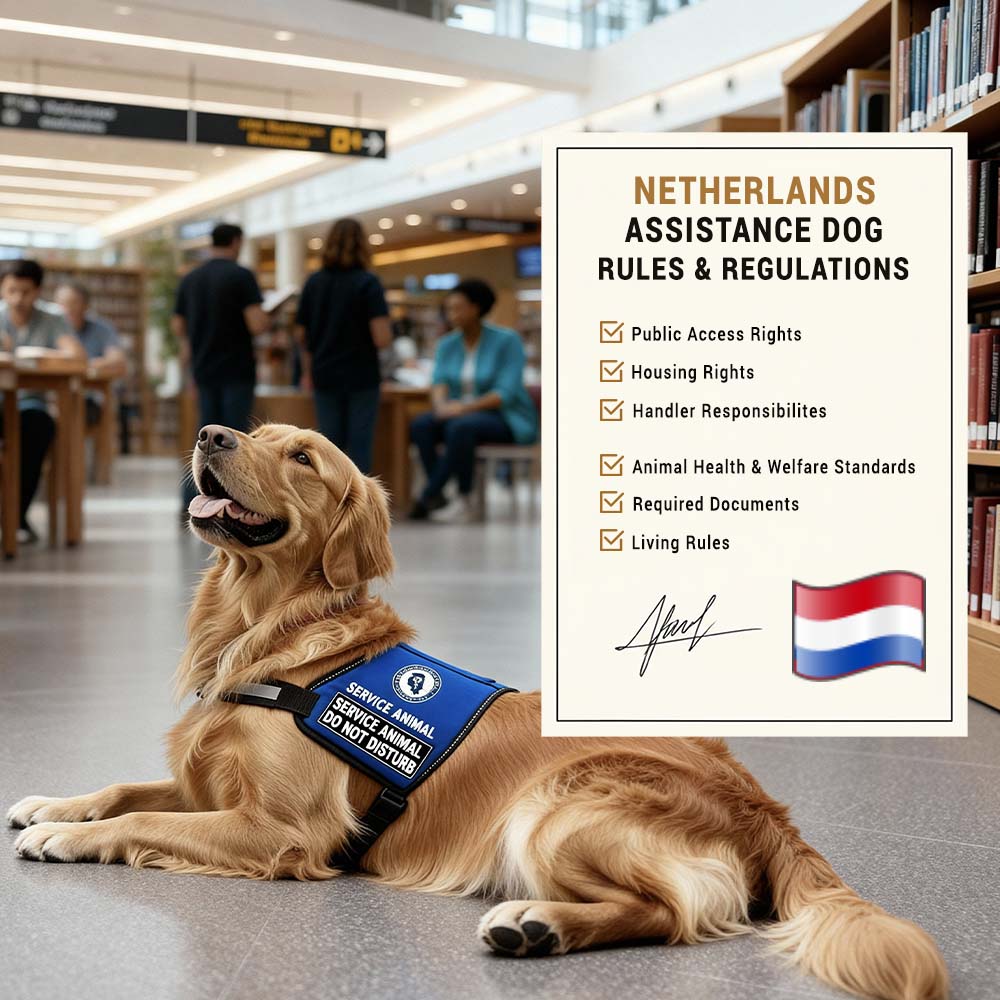
The Netherlands legally recognizes assistance dogs trained to help individuals with disabilities. This includes guide dogs, mobility assistance dogs, hearing dogs, seizure-alert dogs, diabetes-alert dogs, and psychiatric service dogs (PSDs).
Public Access Rights
Assistance dogs have full access rights to:
- Public transportation (trains, buses, trams, ferries)
- Shops, supermarkets, and malls
- Restaurants and cafes
- Hotels and tourist venues
- Government and municipal buildings
- Hospitals and medical facilities
It is illegal to deny entry to a trained assistance dog.
Certification / ID Requirements
Although the Netherlands does not require a specific government-issued ID for assistance dogs, handlers should carry verification to avoid disputes. Recommended items include:
- Physical ID Card (handler + dog)
- Training or registration certificate
- Visible Recognition Gear (vest or harness)
- Prescription Letter (ESA, PSA, or service animal letter)
Emotional Support Animals (ESA) & Psychiatric Service Animals (PSA)
Legal Recognition
In the Netherlands, ESAs and PSAs are only recognized when registered with an accredited organization. Without accreditation, ESAs are considered pets and do not have special public-access rights.
Housing Rights
Registered ESAs/PSAs may receive housing accommodations depending on landlord policy and documentation. Fully trained assistance dogs must always be allowed.
Travel Rights
- European airlines servicing the Netherlands accept certified service dogs.
- PSAs may travel as service dogs if accredited and task-trained.
- ESAs follow normal pet travel rules unless recognized by a specific airline.
- Public transport accepts assistance dogs with no fee; ESAs/PSAs vary by operator.
Veterinary & Animal Welfare Standards
Vaccination Schedules
Core vaccines strongly recommended include distemper, parvovirus, adenovirus, and leptospirosis. Rabies vaccination is mandatory when traveling outside the Netherlands but not required domestically.
Neutering / Spaying Regulations
Neutering is not legally required but is encouraged as part of responsible pet ownership.
Animal Welfare Acts
The Netherlands has robust animal welfare laws requiring proper housing, hygiene, enrichment, medical care, food, water, and humane treatment. Abuse or neglect can result in fines, confiscation, or criminal charges.
The Netherlands Food and Consumer Product Safety Authority (NVWA) oversees enforcement.